
The Bridge to Abundance: How We Navigate the Economics of a Post-Labor World
Human history can be understood as three great eras.
Three Phases of Human History
By understanding where we've come from and where we are, we can frame what we might become next, and how to get there.
Era 1: Survival and Subsistence
For most of human existence, the central challenge was staying alive until tomorrow. We hunted, gathered, farmed, stored food, built shelter, made babies, and defended ourselves against the natural world. Work was not a career. It was survival. If you didn't labor, you didn't eat.
Era 2: Labor and Industry
This is the world most of us were born into. Human labor became the engine of economic life. We built factories, companies, markets, governments, schools, and financial systems around a basic exchange: people work, earn money, and use that money to buy goods and services. Capital needed labor. Labor needed capital. The deal was imperfect, unequal, and often brutal, but it became the organizing principle of modern civilization.
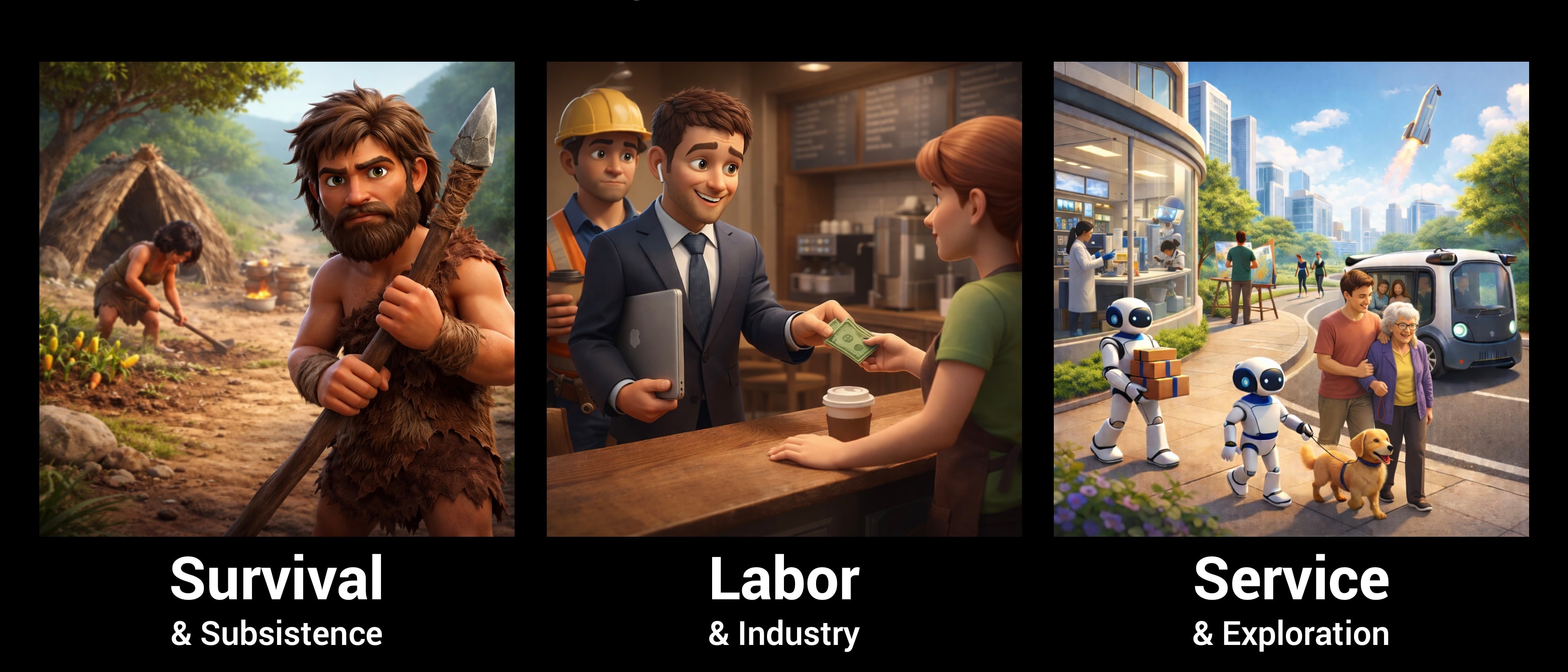
Three Eras of Humanity
Era 3: Abundance
Our third era is now coming into view: an Era of Abundance. In this world, AI and robotics produce most of the goods, services, knowledge, and infrastructure society needs. Work doesn't disappear entirely, but it becomes increasingly optional. People still create, build, lead, serve, teach, explore, and invent—but not because starvation is the alternative. They do it because contribution, curiosity, mastery, community, and self-actualization remain deeply human needs. All under a new economic system.
Abundance is the destination. The hard part is the bridge.
How Do We Get to a World of Abundance?
The defining economic question of the AI age is not whether machines will make us more productive. They will. It is not whether abundance is technically possible. It increasingly looks that way. The real question is whether we can get safely from Phase Two to Phase Three without social collapse, political extremism, or a winner-take-all economy in which a small number of capital owners capture nearly all the gains.
Or, to put it more bluntly: when capital no longer needs labor, how will people share in its wealth? This was a key question Emad Mostaque posed back in January 2025.
Tech Leaders Predict Work-Free Utopia
That question is no longer theoretical. Some continue to argue that AI will be net creator of jobs, and that we will perhaps always remain in Phase Two. While others believe AI will destroy more jobs than it creates. Elon Musk has predicted that AI and robotics could make work optional and lead to what he calls “universal high income,” not merely basic income. “My prediction is that work will be optional,” Musk said, comparing future work to growing vegetables in your backyard because you enjoy it, not because you must. Vinod Khosla has made a similar argument, suggesting that as AI makes labor effectively free, “the abundance of goods and services will be very, very large” and prices could fall dramatically.
We Urgently Need a Plan
That is the optimistic version. But between here and there lies a dangerous transition. The Labor & Industrial economy is built around wages, income taxes, payroll taxes, employer-provided benefits, job-based identity, and the moral assumption that able adults should earn their keep through work. If AI erodes that system faster than we redesign the economic plumbing, we do not get abundance. We get instability and potentially catastrophic collapse.
So what are the options?
There is no single magic answer. The bridge to abundance will almost certainly be built from multiple policy and ownership models layered together. Some are about income. Some are about services. Some are about ownership. Some are about slowing or reducing disruption. Some are about accelerating abundance and sharing the upside.
Leading Options for a Successful Transition
Many ideas have been bandied about for how we make it from here to there. And they play different roles along the way. Here are the major contenders.
Universal Basic Income: Cash as the Shock Absorber
Universal Basic Income, or UBI, is the best-known proposal. The idea is simple: every adult receives a regular cash payment, regardless of employment status, income, or wealth. No bureaucracy deciding whether you deserve it. No benefit cliffs. No requirement to prove desperation.
In a post-labor transition, UBI acts as a shock absorber. If AI displaces workers faster than new roles emerge, cash gives people breathing room. It allows them to pay rent, buy food, retrain, care for family members, start businesses, or simply avoid panic while society adjusts.
Andrew Yang’s “Freedom Dividend” proposed $1,000 per month for every American adult, explicitly positioning UBI as a response to automation. His 2020 Presidential campaign argued that such income would help people “pay their bills, educate themselves, start businesses, be more creative,” and participate in the future economy. OpenAI CEO Sam Altman funded one of the largest UBI experiments in the United States and has long argued that some form of income floor may be needed as AI reshapes labor markets. More recently, however, Altman has suggested cash alone may not be enough and has fallen out of love with UBI. He has also suggested that AI may not destroy jobs at all, though that may have more to do with some idiot lobbing a Molotov cocktail at his front door.
The strength of UBI is freedom. Money is flexible and people know their needs better than government agencies do. The weakness is cost and sufficiency. A modest UBI may not be enough to live on while a generous UBI may be fiscally enormous unless funded by new sources of wealth. It also doesn't answer the deeper question of ownership. If a handful of companies own the AI systems and everyone else receives a stipend, the era of abundance starts to look less like abundance and more like dependency.
“It could be as simple as a large universal basic income for everyone, although I suspect that will only be a small part of a solution.” — Dario Amodei, CEO of Anthropic.
UBI may be necessary. It's also unlikely to be sufficient.
Universal High Income: Musk’s More Ambitious Version of UBI
Elon Musk has pushed the idea beyond Universal Basic Income toward Universal High Income. Let's contrast the two ideas. UBI is usually framed as a safety net while UHI is framed as abundance. It's not about keeping people barely afloat but about an AI-and-robotics economy that produces enough wealth for everyone to enjoy a high standard of living.
Musk has described this as “universal high income, not basic,” in a positive AI future where scarcity largely disappears except where society chooses to preserve it. In a more recent formulation, he reportedly described government-issued checks as the best way to deal with unemployment caused by AI, but with the explicit ambition of high income rather than subsistence support.
The appeal is obvious. If the third era is truly an era of abundance, why design a system around minimum survival? Why not design around dignity, security, and freedom?
The problem is that UHI assumes the abundance engine is already working. It is a third era idea, not necessarily a second era transition mechanism. Before we can distribute universal high income, we need the productive capacity, tax base, ownership structures, and political legitimacy to fund it. Otherwise, UHI becomes a slogan rather than a system.
Still, it's useful because it reframes the ambition. The goal shouldn't be to make poverty slightly less painful. It should be to make material insecurity increasingly obsolete and deliver a high standard of living for everybody.
Negative Income Tax: A More Targeted Income Floor
The Negative Income Tax, sometimes described as a reverse income tax, is an older idea associated with economist Milton Friedman. Rather than giving everyone the same payment, the government supplements income below a certain threshold. As a person earns more, the benefit gradually phases out.
Friedman liked the idea because it gave people cash rather than a patchwork of welfare programs, while preserving incentives to work. MIT Sloan summarizes the argument this way: Friedman wanted poor people to receive cash “rather than an array of welfare benefits,” administered more simply through the tax system.
In the bridge from the second to third era, a negative income tax may be more politically viable than full UBI because it's targeted. It costs less and helps those who need help most. It can smooth the transition for displaced workers without sending checks to billionaires.
The downside is that it reintroduces means-testing. That means paperwork, thresholds, delays, and stigma. It also remains anchored in the idea that employment income is the baseline and public support is the supplement. That may be appropriate during the transition. It may be less appropriate in a true post-labor economy.
Universal Basic Services: Guarantee the Essentials
Universal Basic Services, or UBS, takes a different path. Instead of giving everyone cash, society guarantees access to essential services: healthcare, education, housing support, transportation, childcare, internet access, energy, legal aid, and perhaps AI tools.
The logic is straightforward. In a post-labor transition, the problem is not just income, it's access. If people lose job-based income, they also lose job-based healthcare, mobility, stability, and often social status. UBS attempts to de-risk life by making the essentials less dependent on employment.
The UCL Institute for Global Prosperity helped popularize Universal Basic Services as a way to deliver quality of life, strengthen public services, and improve social cohesion. Advocates define UBS as services that are collectively generated, essential and sufficient, and available to everyone regardless of ability to pay. Critics point to similarities with communism.
The strength of UBS is that it targets real human needs directly. Healthcare isn't useful because it's monetized; it's useful because people need care. Housing isn't optional. Education and connectivity are now participation infrastructure.
The weakness is bureaucracy and choice. Government-provided services can be inefficient, politically fragile, or one-size-fits-all. And memories of the failure of communism echo loudly. Cash gives people agency and services give people security. A serious bridge to the third era probably needs both.
Peter Diamandis has proposed a new XPRIZE focused on developing UBS. While the XPRIZE itself is still under development, the concept is that a large prize will be offered to an organization able to deliver shelter, water, food, healthcare, internet bandwidth, electricity, and AI intelligence to a household of four for $1000 per month.
Universal Basic Compute: Give People Access to the New Means of Production
Universal Basic Compute, or UBC, is a newer idea. Instead of giving people cash, give them access to computing—the raw resource that powers AI. Economists would refer to this as "the means of production."
Sam Altman has floated the idea that everyone could receive “a slice” of future AI compute, which they could use, sell, donate, or pool. This is a subtle but important shift. In the industrial economy, productive power came from factories, machines, land, capital, and labor. In the AI economy, productive power increasingly comes from models, data, chips, energy, and compute.
If computing becomes one of the core engines of wealth creation, then access to compute may matter as much as access to money. A citizen could use their compute allocation to run an AI business, generate media, conduct research, automate personal tasks, contribute to medical discovery, or sell unused capacity on the market. Let's make the idea physical. A person who owns a robot or a even a small fleet of robots that perform valuable economic work can receive income from their labor. Elon Musk has proposed a similar idea for his planned Robotaxi product.
The strength of UBC is that it gives people access to the productive substrate of the AI economy, not just a downstream transfer. The weakness is usability. Most people don't want a monthly allocation of GPU time any more than they want a barrel of crude oil. They want outcomes. For UBC to work, we would need marketplaces, interfaces, agents, and institutions that convert compute into practical value.
Still, the idea points in the right direction. In the third era, it may less about how much cash people receive and more about them having access to the engines that create value, and what exactly they own.
We'll return to this idea later.
Universal Basic Equity: Give Everyone a Stake in the Upside
Universal Basic Equity, also known as Universal Basic Capital, takes the ownership argument one step further. Instead of giving people cash transfers or access to services, society gives every citizen a direct equity stake in the productive assets of the AI economy. That could mean shares in an AI sovereign wealth fund, equity in public-private AI infrastructure, ownership units in compute and robotics platforms, or dividend rights tied to national productivity growth.
The logic is simple: if AI allows companies to generate far more value with far fewer workers, people need a way to participate in that value creation even when their labor is no longer required. The strength of UBE is that it shifts the model from welfare to ownership. Citizens are not passive recipients of support; they become shareholders in the abundance engine.
The weakness is that equity is volatile, politically complex, and uneven unless carefully designed. Markets rise and fall. Governance matters. And if the equity stake is too small, it becomes symbolic rather than transformative. But as a bridge from the second to the third era, UBE may be one of the most important ideas on the table. In a post-labor economy, income keeps people afloat. Equity lets them share in the upside.
And yes, some of these terms are overlapping.
AI Sovereign Wealth Funds: Make Citizens Owners
An AI sovereign wealth fund would give the public an ownership stake in the AI economy. Instead of only taxing income after wealth is created, society would own part of the wealth-generating machinery itself: AI companies, compute infrastructure, data centers, semiconductor capacity, energy systems, robotics platforms, or model-derived revenues.
Norway’s oil fund and Alaska’s Permanent Fund are obvious precedents. Natural resources generate wealth, and citizens share in the proceeds. AI is not oil, but the analogy is useful. AI is being built on public research, public infrastructure, human knowledge, user data, and decades of publicly funded science. If it becomes a foundational wealth engine, there is a strong argument that the public should share in the upside.
Sam Altman proposed an “American Equity Fund” years before the current AI boom, arguing that every adult citizen should receive “an annual share of the US GDP” and that owning a share in America would align citizens around national success. More recently, proposals for AI sovereign wealth funds have become more explicit. Senator Bernie Sanders has proposed an American AI Sovereign Wealth Fund, arguing that “AI is built on humanity’s collective knowledge” and that its wealth should benefit the public, not only a small number of AI owners.
Sanders has now proposed a more aggressive version of this idea: an American A.I. Sovereign Wealth Fund funded by a one-time 50% tax on the largest AI companies (specifically Anthropic, OpenAI and xAI) as they go through IPO, paid not in cash but in stock. The point is not simply to raise revenue; it is to give the public a direct ownership stake in the companies most likely to profit from humanity’s collective knowledge. There are many significant problems with this idea, but it's at least trying to propose something to increase the public's stake in the future. President Trump has suggested he's open to something similar. And OpenAI has talked about offering 5% of its stock to the U.S. government.
The strength of this model is that it moves from redistribution to pre-distribution. Citizens do not merely receive support after markets concentrate wealth. They own part of the productive base. The weakness is execution. When does the fund acquire assets? At what price? Through taxation, equity grants, licensing fees, public investment, or compute royalties? Who governs it? How do we prevent political capture? These are hard questions. But they are the right questions.
Wage Insurance, Retraining, and Mobility Support: Help People Move
During the transition, many people won't need permanent income replacement. They'll need help moving from one role, industry, geography, or skill base to another. Wage insurance can partially replace lost income when displaced workers take lower-paying jobs. Retraining can help workers shift into emerging roles. Mobility support can help people relocate to places with better opportunities.
These tools are practical and politically familiar. They're useful for a world where AI disrupts some sectors faster than others. But they're still second era tools. They assume the answer to displacement is another job. Sometimes it will be, and often it should be. But if AI ultimately reduces the total demand for human labor, retraining alone becomes a treadmill. You can't retrain everyone into the small set of jobs machines haven't yet learned to do.
Retraining is necessary during the bridge. It isn't the bridge.
Adapting For Phase Three: The Age of Abundance
If the second era was about wages, the third era may be about ownership. Here are some key ideas to make things work in a post-labor world of abundance and smooth the transition.
Worker Equity: Give Employees a Real Share of the Upside
A narrower version of the ownership idea is broad-based employee equity. Instead of reserving stock grants for founders and executives, companies could give meaningful ownership stakes to all workers as part of their compensation.
AI will increase the leverage of firms. A smaller number of people may be able to produce much greater output, and if productivity gains flow only to shareholders, inequality widens. If workers hold equity, they participate in the upside of automation.
Employee ownership already exists through stock grants, options, profit-sharing, and employee stock ownership plans (ESOPs). Harvard Business School has highlighted broad-based employee ownership as a way for workers to “share in the wealth created when companies grow profitably.” Ownership Works similarly frames broad-based equity as a way to align workers and employers while honoring “the collective effort behind a company’s success.”
The benefit is cultural as much as financial. Owning equity says you aren't just labor rented by the hour; you're part of the value creation system. The limitation is that company-level ownership is uneven. Workers at successful AI-native companies may do very well while workers at disrupted firms may receive little or nothing. Equity also concentrates risk. If your job and your wealth are tied to the same company, a failure can hurt twice.
Worker equity isnt enough on its own, but it should become a much larger part of the second-to-third era transition.
Robot Taxes and Automation Taxes: Tax the Substitution of Labor
Bill Gates has argued that if robots replace workers, the robots—or more precisely, the companies deploying them—should be taxed. His logic is that human workers pay income and payroll taxes, so when machines replace people, society loses tax revenue just as disruption rises. Gates argued that society should be willing to “raise the tax level and even slow down the speed” of automation to manage displacement.
This approach has intuitive appeal. If a company replaces 10,000 workers with AI systems, its profits may rise while payroll tax receipts fall. An automation tax could capture some of that value and fund retraining, UBI, UBS, or public investment.
The risk is that taxing automation may slow the very productivity growth needed to reach abundance. The International Federation of Robotics has argued against robot taxes, saying “profits, not the means of making them, should be taxed.” Brookings has similarly described robot taxes as attempts to tax firms when they replace human workers, but warned that such policies can be difficult to design without discouraging investment.
A better version may not be a literal robot tax. It could be a broader tax on excess profits, monopoly rents, compute usage, carbon, land value, or capital income. The goal shouldn't be to punish productivity. It should be to ensure that productivity gains help fund the society they transform.
Shorter Work Weeks: Share the Remaining Work
Another path is to reduce working hours as productivity rises. If AI allows society to produce the same output with less human labor, perhaps the answer is to avoid mass unemployment with a four-day week, then a three-day week, then more flexible patterns of contribution. That's not a radical idea. The history of industrialization is partly the history of reduced working hours. Weekends, paid holidays, retirement, and limits on child labor were all social choices. They didn't happen automatically, but were negotiated into the economy.
The strength of shorter work weeks is that they preserve the social role of work while giving people more freedom. Work remains a source of purpose, identity, and connection, but it occupies less of life. The weakness is that the benefits may not distribute evenly. AI might eliminate some jobs entirely while making others more intense. A shorter week helps people whose jobs still exist. It does less for those whose roles disappear.
Still, as a transition mechanism, it deserves serious attention. The third era doesn't require an overnight jump from full-time work to no work. It may arrive first as less work, better work, and more voluntary work.
Data Dividends: Pay People for the Raw Material
AI systems are trained on human output: writing, art, code, speech, images, behavior, preferences, and interaction data. A data dividend would compensate people for the value their data helps create.
This could work through licensing regimes, collective data trusts, payments to creators, national data funds, or royalties when AI systems use protected content. The moral intuition is strong: if AI companies benefit from human knowledge and culture, humans should share in the returns. Anthropic settled a lawsuit on this very issue, though it was for training models on stolen book copies. The use of public works for training data is still considered fair use.
The challenge is measurement. Which data created which value? How do you compensate billions of contributors? What counts as public knowledge versus private property? A data dividend may be easier to implement collectively than individually. Rather than trying to pay everyone fractions of pennies for each contribution, societies could tax or license AI training at scale and route the revenue into public funds.
As with sovereign wealth funds, the deeper idea is ownership. Data dividends recognize that AI wealth does not emerge from nowhere but is built from the accumulated work of humanity.
The Real Choice: Redistribution or Ownership
When you look across these proposals, a pattern emerges. Some options redistribute income: UBI, UHI, negative income tax. Some, like UBS, provide services. Some provide productive resources: compute, energy, data access. Some slow disruption: robot taxes. Some broaden ownership: employee equity and sovereign wealth funds.
The most important distinction isn't left versus right. It's income versus ownership.
Income helps people survive the transition
If we only solve for income, we risk creating a society where a tiny group owns the AI economy and everyone else receives an allowance. That might prevent starvation, but it won't create dignity, agency, or shared prosperity. It could easily become a gilded cage, or worst, devolve into civil unrest and revolution.
Ownership lets people participate in the destination
If we solve for ownership, the future looks different. Citizens own shares of the AI economy. Workers own part of the companies they help build. Communities own energy and compute infrastructure. Public funds invest in the abundance engines. People receive income not only because government redistributes wealth, but because they have a stake in the systems creating it.
That's a much more compelling bridge to an era of abundance.
Conclusion: The Economic Bridge to Abundance
The transition from the first to the second era wasn't smooth. It involved the privatization of common land, mass urbanization, factories, labor movements, public education, financial systems, unions, welfare states, and democratic reforms. The Industrial Era didn't simply arrive. It had to be built, fought over, regulated, and humanized.
The transition from the second to the third era won't be any different.
AI won't automatically produce abundance for all. Technology only creates possibility. It's institutions that will determine distribution. So the economic architecture of the bridge might need to look something like this:
- A cash floor through UBI, UHI, or negative income tax.
- A services floor through healthcare, housing, education, mobility, connectivity, and childcare.
- A productive floor through access to compute, energy, and AI tools.
- An ownership floor through AI sovereign wealth funds, employee equity, and data dividends.
- A transition layer through wage insurance, retraining, shorter work weeks, and mobility support.
- A funding layer through taxes on profits, capital gains, monopoly rents, compute, energy, or automation-driven windfalls.
No single piece is enough. But together, they start to look like a bridge.
The goal isn't to end work; it's to end compulsory economic desperation. Work should become more chosen, more meaningful, more creative, and more human. People will still build companies, make art, care for one another, explore the universe, solve scientific problems, restore ecosystems, raise children, mentor young people, and serve their communities. But they shouldn't have to compete with machines for the right to survive.
That's the promise of the third era.
Abundance Isn't Inevitable
The danger is that we mistake abundance for inevitability. It's not inevitable. It's a design challenge, and we all need to get involved.
The next great human project isn't merely building superintelligent machines. It's building an economy wise enough to share what those machines make possible, because the bridge from Labor & Industry to Abundance won't build itself.
Steve