What AI-First Actually Looks Like
And Why Most Companies Are Getting It Wrong
Most companies think they’re adopting AI. They’re not. They’re adding tools. And there’s a big difference.
AI isn’t just changing how companies work. It’s changing what a company is.
In my last post, I outlined the shift from digital-first to AI-first companies—and why simply layering AI tools onto existing workflows isn’t enough. Becoming AI-first requires something far more fundamental: Redesigning your business with AI as the engine at its core**.**
AI-First Companies in Practice
That raises an obvious question: So what does that actually look like in practice?
Let’s move beyond theory and make this concrete. Here are four examples—spanning media, retail, food, and healthcare—that show how AI-first companies actually operate. And once you see the pattern, it’s hard to unsee it:
Media → unbundling work
Fashion → turning operations into feedback loops
Food → modeling human preference
Healthcare → generating hypotheses at scale
Different industries. Same transformation.AI moves from tool → system → engine.
These steps aren't incremental improvements, they represent a fundamentally different way of running a business.
AI-First News Reporting 📰
Let’s start with media—specifically, the news business.
Chris Guinn, editor of The Cleveland Plain Dealer (Cleveland.com), recently observed that journalism schools are “teaching fear of the future,” warning students that using AI is akin to cheating—that it will rob them of creativity and control.
He’s taking the opposite approach. Guinn is pushing toward a model where reporting and writing are no longer the same job. The real insight here isn’t that AI can write. It’s that writing is no longer the bottleneck.
What Changes?
In a traditional newsroom, reporters do everything:
- develop sources
- doggedly investigate leads
- conduct interviews
- get quotes
- verify facts
- write the story
In an AI-first newsroom, the reporting and writing roles get unbundled. The reporter focuses on:
- facts
- quotes
- story framing
- priorities
- the lede
These inputs are passed to an AI writing system trained on the reporter’s prior work, which produces a first draft in their voice. The reporter reviews, edits, and approves.
The Real Shift Happens Upstream
A second AI system handles lead generation—continuously scanning: news wires (AP, Reuters, Bloomberg, PA Media), social media, local event calendars, financial filings, and even police radio.
It doesn’t just surface signals. It connects reporters to relevant research data, contacts, and context: historical archives, public records, government records, contact information, corporate data, and prior reporting. And prioritizes leads based on editorial direction, audience engagement, and emerging patterns
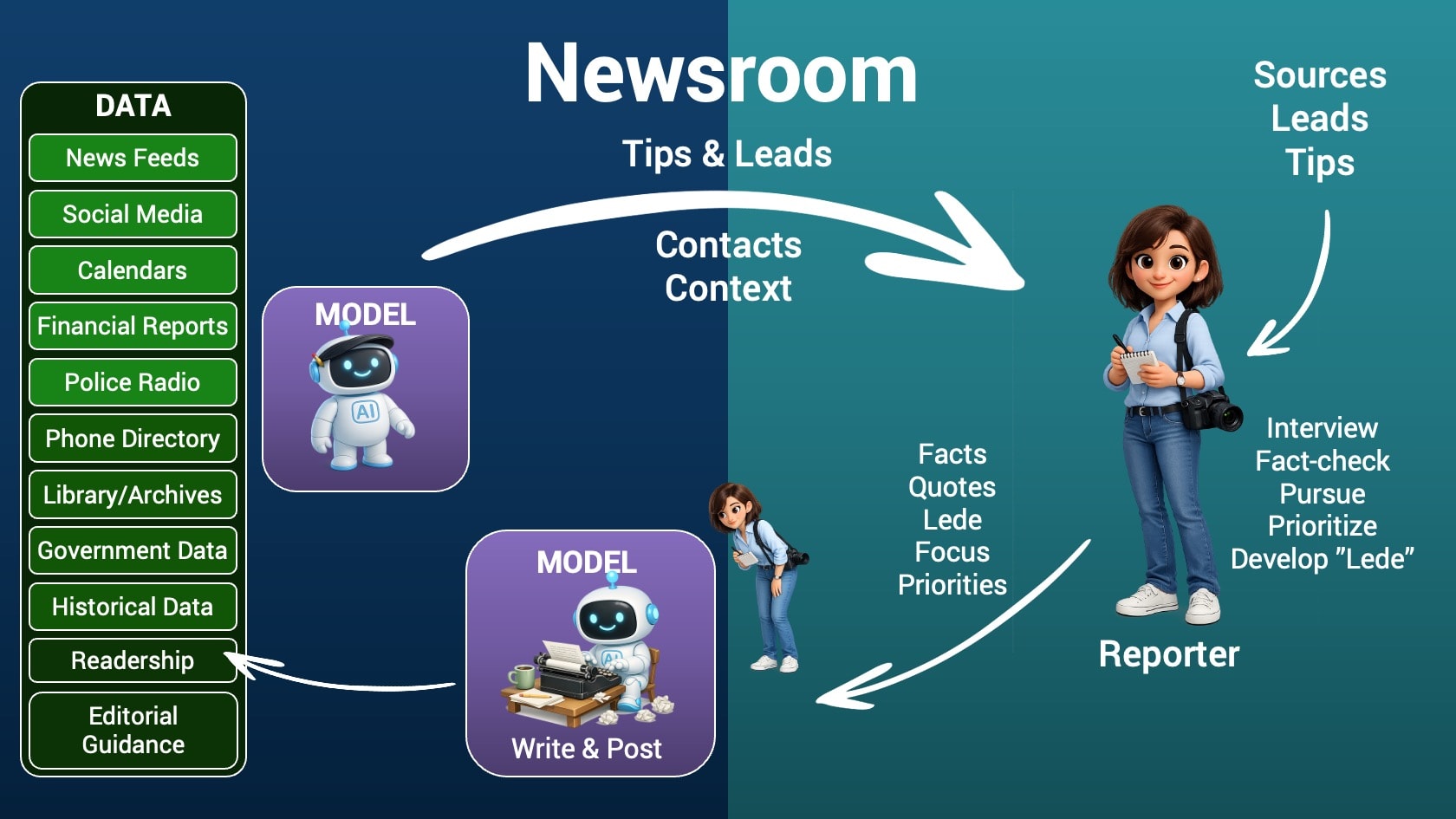
AI-first newsroom
The Result
AI becomes the engine at the center of the newsroom, generating leads, accelerating research, drafting stories, and shaping editorial priorities.
The AI sets reporters up for success.
In this model, people focus on what they do best: building trust, chasing stories, uncovering truth, making judgment calls, and crafting narrative. Reporters maintain the final say, oversee the AI writer, and determine story priorities. Investigative journalists can spend more time on high-importance stories, fulfilling their duty as the fourth estate, because all the “cat rescued from tree” stories are handled by machines.
If it's all done right, readers get faster reporting, better researched stories, deeper investigations, and higher-quality journalism. And the newsroom operates at a speed and scale that was previously impossible.
This is what it looks like when work gets unbundled.
AI-First Fast Fashion 👚
Now let’s shift to retail—specifically, fast fashion. Before we do—I’m not advocating a fast-fashion approach. There are legitimate concerns about the environmental impact, low wages, and obscene waste involved in fast fashion. But it provides an excellent example of the potential of AI-first, so let’s plough on.
Brands like Zara, H&M, and Shein have already compressed product cycles from months to weeks—or even days—while industry laggards might take 6-12 months or longer to get styles into stores. Zara can take a design from sketch to store in about two weeks. But here’s the key insight: They aren’t fast because they try harder. They’re fast because their entire business is built as a real-time feedback loop.
The Current Frontier
China’s Shein, in particular, has pushed this model furthest, using AI-driven demand sensing, algorithm-assisted design, and micro-batch production to hit 3-10 day cycles. It continuously ingests signals from: social media trends, search behavior, on-site activity (clicks, carts, wish lists, and dwell time), and influencer ecosystems.
It identifies micro-trends before they go mainstream.
Shein's product design is heavily AI-augmented, but not yet automated, with AI. Their AI models suggest styles, cuts, and colors. They remix successful patterns (rather than starting from scratch), and generate new SKUs at a massive scale, creating 1000s of designs EVERY DAY.
And instead of committing to large production runs, Shein uses micro-batch manufacturing. They might manufacture 50–100 units per design. Then they do immediate market testing and real-world A/B testing. If a product performs, production scales automatically. If not, it disappears.
This is Shein’s biggest secret weapon. High conversion rates, fast sell-through, or strong engagement trigger auto-replenishment orders and a gradual scale-up of production to match momentum, capturing value while minimizing future markdown risk.
Now Take It One Step Further
A truly AI-first fashion company would push this model to its logical conclusion. A central design AI would:
- ingest global trend signals (social media, TV, influencers, celebrities, competitors, etc)
- monitor real-time demand (web traffic, transactions, sell-through at mark-on, etc)
- access fabric libraries and a style/pattern repository
- understand factory and logistics capacity
It would generate:
- designs (predicting styles, fabrics, and colors)
- pricing strategies (predicting MSRP, margin, and markdown percentage)
- demand forecasts by location
- allocation plans
Manufacturing becomes fully automated. AI-powered robotic machines turn patterns into finished goods. Logistics becomes autonomous as machines take over shipping, warehousing, and delivery. Retail becomes hyper-personalized as AI determines the most productive unit allocation, visual merchandising approach, and persuasion techniques, deploying individualized offers and communications, dynamic pricing, and AI-driven merchandising. In this timeframe, AI predicts mark-on, price elasticity, markdown, and clearance pricing levels to optimize revenue.
And every signal—from sales to returns—feeds back into the system.
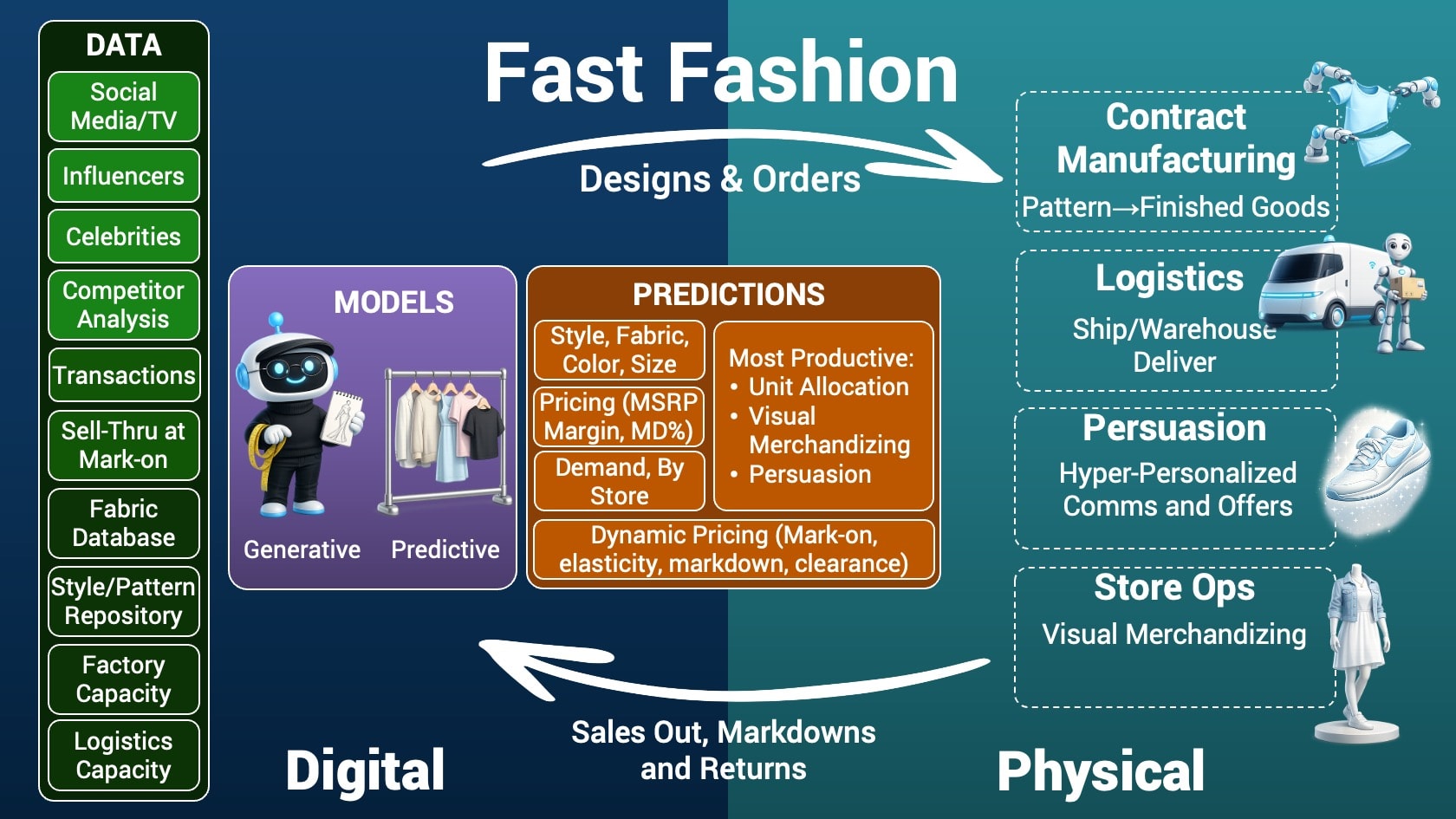
AI-first Fast Fashion
The Result
The company doesn’t just respond to demand.It learns continuously. And over time, learning speed becomes the ultimate competitive advantage. A system like this wouldn’t take weeks to respond to trends. It could take hours or minutes.
This is what it looks like when a business becomes a feedback loop.
AI-First Food & Beverage 🍹
Let’s look at another domain—food and beverage. Because this is where the idea of AI-first takes a significant leap forward.
In most industries, AI is used to optimize decisions. But in food and beverage, the core problem has always been much harder: Taste is subjective.
Or at least, it used to be.
Enter Tastry
Tastry is building something fundamentally different. It's not an AI tool or a recommendation engine. Tastry has built what they describe as an operating system for food and beverage—an AI engine that sits at the core of how products are designed, evaluated, and brought to market.
The Traditional Model
In most food and beverage companies today:
-
product development is driven by expert intuition
-
tasting panels are subjective and inconsistent
-
iteration cycles are slow and expensive
-
success is only known
after
launch
It’s a process built on trial and error. Focus groups and market trials.
The AI-first Model
Tastry replaces this with a predictive, first-principles system grounded in chemistry. At its core is a model of the causal chain:
Chemistry → Perception → Preference → Purchase Behavior
Most AI systems in this space attempt to simulate consumer behavior, but Tastry models the underlying system that produces that behavior.
What This Enables
Once you model the system itself, everything changes. Not incrementally—fundamentally**.**
An AI-first food and beverage company can predict how a product formula will taste before it exists, identify which consumer segments will prefer it—and by how much, simulate thousands of formulation variations in parallel, and optimize across multiple constraints simultaneously. For example, they might want to optimize for preference, repeat purchase probability, cost, regulatory requirements, and to meet untapped market opportunities.
Instead of asking: “Do we think this will work?”, the system asks:“What is the optimal product for this specific audience—and how do we produce it?”
This becomes especially powerful in reformulation—where companies need to change a product without compromising how it’s perceived—for example, to replace artificial dyes, reduce sugar content, optimize cost, or work around ingredient shortages. In other words, the system doesn’t just tell you what to change. It tells you how to change it—without breaking what customers love.
From Intuition to Computation
The outputs aren’t suggestions. They’re decisions:
- optimized formulations (recipes designed for specific consumers)
- preference predictions (who will like it, and how much)
- market fit forecasts (likelihood of success in a specific region or segment)
- reformulation strategies (e.g., reducing sugar without reducing preference)
R&D shifts from an experimental process to a computational one. Tastry customers are seeing:80% reduction in focus group and market testing costs**, 4x faster** product development cycles**,and a400%+ increase** in product success ratesR&D becomes computational instead of experimental.
The Deeper Shift
The breakthrough here isn’t better recommendations. It’s that subjectivity itself becomes computable. For decades, industries like wine, coffee, and food have relied on expert opinion, critic scores, and coarse segmentation. Tastry uses AI to replace that with chemistry, data, and prediction.
It moves the industry from: “Let’s make something and see if people like it” to**“Let’s design something people will like—before we make it.”**
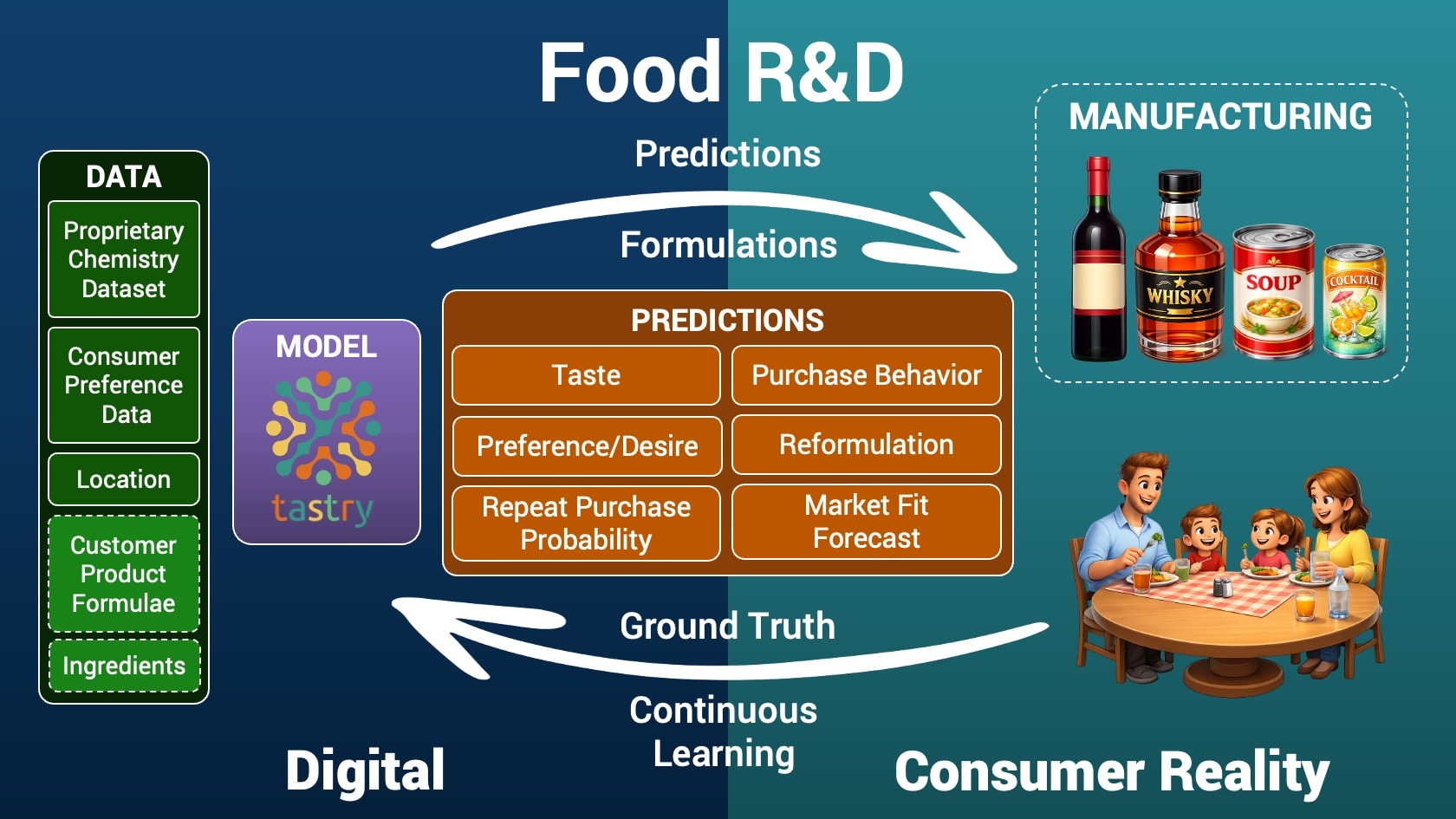
AI-First Food R&D, powered by Tastry
The Result
In an AI-first food and beverage company:
-
products are designed
with
the market, not for it
-
launches are de-risked before they happen
-
iteration cycles compress dramatically
-
personalization becomes precise
-
and every outcome feeds back into the system
The company becomes a continuous taste-learning engine and R&D changes forever.
Why It atters
This example reveals something profound. AI-first isn’t just about automating workflows. It’s about understanding and predicting human preference at a fundamental level. Not what people say they like or what experts believe is good. But what people will actually choose—predictably, consistently, and at scale.
As Tastry CEO Katerina Axelsson explains, “While many AI approaches in this space try to simulate consumer behavior, Tastry models the underlying system that generates that behavior.”
This is what it looks like when companies use AI to model human preference.
AI-First Clinical Trials
Finally, let’s look at healthcare—specifically, clinical trials. Earlier this year, I worked with a clinical trials company to explore what an AI-first model might look like. The contrast with traditional organizations is stark.
In traditional companies, people are the engine. Which also makes them the bottleneck in a world of limited headcount and a fixed number of hours in the day. In AI-first companies, AI becomes the engine—and people guide it.
People Shift Roles
In an AI-first model, people:
- guide and steer the system
- provide oversight (human-in-the-loop)
- handle issues, exceptions, escalations, and edge cases
- manage ethics and governance
- continuously refine the system
- develop the vision to continuously expand impact
The work changes. But the importance of humans doesn’t.
The System Spans Digital and Physical Worlds
In most scenarios, when building a vision for an AI-first approach, it’s helpful to consider operations spanning both the digital and physical domains. Drug discovery is mostly digital, while validation of biological reality occurs firmly in the physical world, inside wet labs.
Drug discovery increasingly begins in silico—inside AI models trained on vast datasets: scientific literature, clinical data, chemical and protein structures, assay results (previous wet lab results), and a range of omics data: genomics, proteomics, transcriptomics, metabolomics, epigenomics, and microbiomics.
These models generate hypotheses about a disease path and how to interrupt it, identify targets, design molecules or compounds, and predict efficacy, toxicity, and interactions. Specifically, the AI predicts a drug’s manufacturing yield, stability, potency, toxicity, absorption, solubility, and its binding affinity to the target, among other things.
AI-powered companies, including BenevolentAI, Atomwise, and Alphabet’s Isometric Labs, already operate in the drug discovery space. Other companies—including IBM, Insilico Medicine, Synthia, and Iktos—build AIs that provide guidance on drug synthesis.
Then Reality Takes Over
Now, all those hypotheses move into the physical world. In an AI-first clinical trials organization:
- compounds and molecules are synthesized by machines
- wet labs are automated
- experiments are run by robots and AI agents
- systems are connected to lab data infrastructure
Machines oversee the process of screening, analysis, and validation of drugs for efficacy. Results are fed back into the models. Ground truth is updated. And the system learns. Continuously.
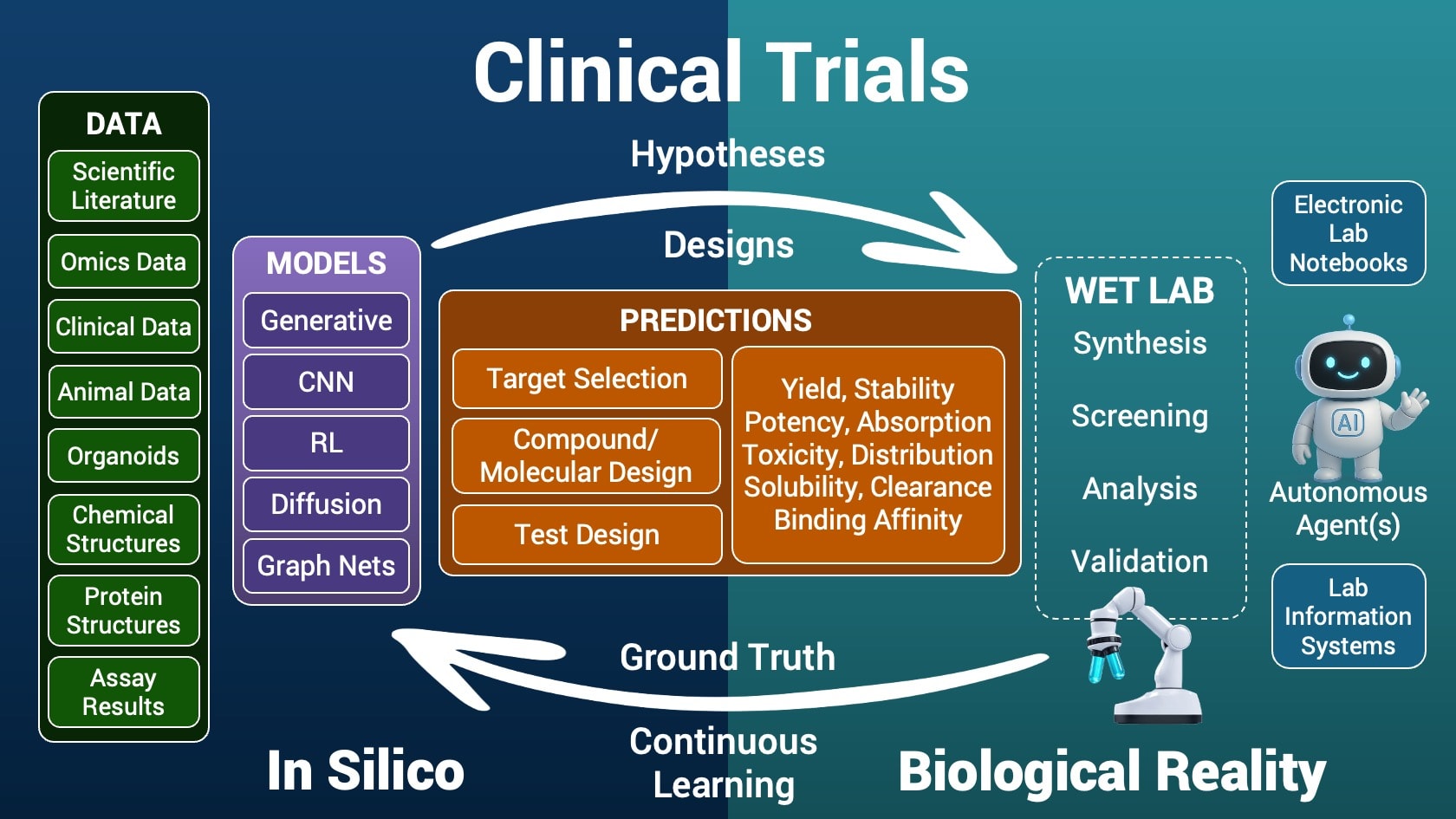
AI-First Drug Discovery and Clinical Trials
The Result
The bottleneck shifts from experimentation…to imaginationand the pace of discovery accelerates dramatically. Perhaps by orders of magnitude.
This is what it looks like when hypotheses are generated at scale.
What These Examples Reveal
Across industries as different as journalism, fashion, healthcare, and even taste itself, we don’t just see different applications of AI. We see a common set of underlying shifts that define what it means to become AI-first.
Some of these shifts are visible within individual industries. Others only become clear when you step back and look across them. AI is not being used to improve existing processes. It is becomingthe core operating system of the business.
1. Work Gets Unbundled
Tasks that were once inseparable—like reporting and writing, or design and demand planning—are broken apart. AI takes on what is scalable and repeatable, and people focus on judgment and direction.
2. Organizations Become Learning Systems
Pipelines turn into loops. Former Google CEO Eric Schmidt recently shared a key insight: “In a business, try to figure out all the different learning loops and then try to accelerate the learning. Fastest learner wins.”
AI-first companies operate as continuous loops: Sense → Decide → Act → Learn
This loop runs constantly—and at a speed no traditional organization can match.
3. Speed is a Byproduct
These companies aren’t fast because they try harder. They’re fast because they learn faster. And learning velocity compounds.
4. The Role of Humans Evolves
The question is no longer: “How do we make people more productive?” It becomes:“How do we design systems where AI does the work—and people amplify its impact?”
5. AI's Role Shifts Dramatically
AI moves from optimizing decisions to predicting outcomes todesigning the system itself. Whether that's stories, products, molecules, or experiences. All before they exist.
The Implication for Leaders
Most organizations today are still treating AI as an add-on. A tool, a feature, a pilot. But as these examples show, the real opportunity—and the real risk—lies elsewhere. Not in tools, but in transformation. AI-first companies don’t just do things better.They operate differently. And over time, that difference compounds: faster learning, better decisions, and continuous adaptation. Until eventually, they are no longer competing on the same playing field.
The shift to AI-first is not about adopting new tools.It’s about rebuilding your business around a new engine.
Steve