The Self-Improving Enterprise
Using AI to build intellgence flywheels and sustained competitive advantage
For the last few years, most companies have been asking the same basic questions about AI:
“How can we use AI to make our people more productive?”
“How can we use AI to reduce costs?”
I hear those two questions from my clients all the time. And they’re sensible questions, but they reflect very traditional thinking. No doubt about it, AI can help people write, code, summarize, research, and create faster. It can automate some tasks. And there’s lots of value here. But I think it’s the wrong question. The more important and forward-looking question I guide them to ask is this:
“What happens when intelligence itself becomes abundant?”
This question forces them to think beyond chatbots, copilots, productivity hacks and short-term cost-cutting, and lift their aspirations for what the company can achieve. It’s an unlock that dares them to dream a bit, and move toward a very different type of organization: one that’s not merely AI-enabled, but AI-first.
Here’s how I explain the opportunity to them.
Build Intelligence Flywheels
In an AI-first organization, AI is not a tool bolted onto old workflows. It becomes the operating system of the business (more on that later). It senses, learns, recommends, acts, measures, adapts, and improves. The enterprise becomes a living, learning system.
I call this the Self-improving Enterprise. At its heart are continuous learning loops powered by what I’ve started to refer to as the Intelligence Flywheel. Forward-looking leaders should be thinking about how to build intelligence flywheels across their organization.
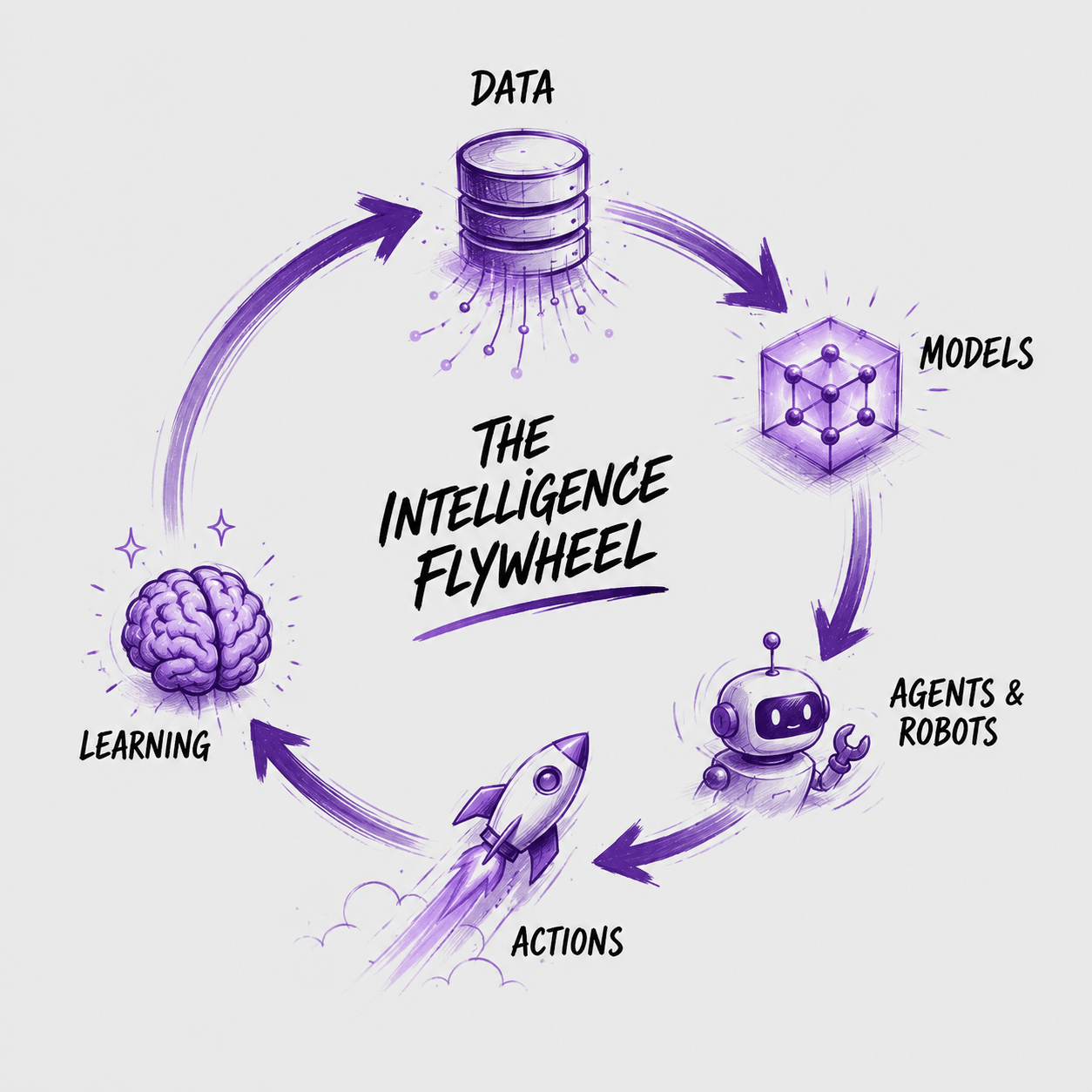
The Intelligence Flywheel
Here’s how you do it. Every interaction becomes a signal. Every signal improves the model. Every improved model improves the abilities of agents and robots. Every improved agent/robot takes better actions. Every action produces new data. And so the flywheel turns, as your organization learns faster and faster, and competitive advantage compounds.
I explored this idea in a previous post on AI-first organizations. You can see rapid learning loops—the intelligence flywheel—at companies like SHEIN, Tastry, and in pharmaceutical development. Let’s look at some more examples.
Intelligence Flywheels in Action
BMW is using virtual factories and digital twins built inside Nvidia Omniverse to optimize layouts, robotics, and logistics before production begins. The factory isn’t just a physical place. It’s also a simulated, measured, continuously improving system.
Google DeepMind’s GNoME system identified millions of candidate crystal structures, with hundreds of thousands predicted to be stable. That doesn’t mean every material will be useful, or even synthesizable (is that a word? Well, it is now). But it shows how AI can radically expand the search space for science, simulating potential and guiding researchers to focus their efforts.
In education, AI tutors, assessment systems, and personalized learning platforms can generate real-time insight into where students struggle and what interventions help. The institution can move from static curriculum cycles to adaptive learning systems. Rapid feedback loops can only improve education by hyper personalizing it.
Cybersecurity teams in financial services use AI agents to monitor fraud, detect suspicious activity, triage customer issues, support underwriting, and help compliance teams manage complexity. Their value goes beyond automation. The true value is faster sensing, faster response, and faster learning.
A Self-improving Enterprise won’t simply try to use AI to do the same work with fewer people. It will use AI to learn faster than its competitors. Learning velocity is set to become the ultimate competitive advantage in a fast-moving world, powered by AI. So, winners will place this intelligence flywheel at the heart of everything they do, and it’ll change how they compete.
Intelligence Becomes Infrastructure
Intelligence used to live in people’s heads. Now it’s also inside infrastructure. If this idea seems weird, let’s put it in historical context.
This Isn't New
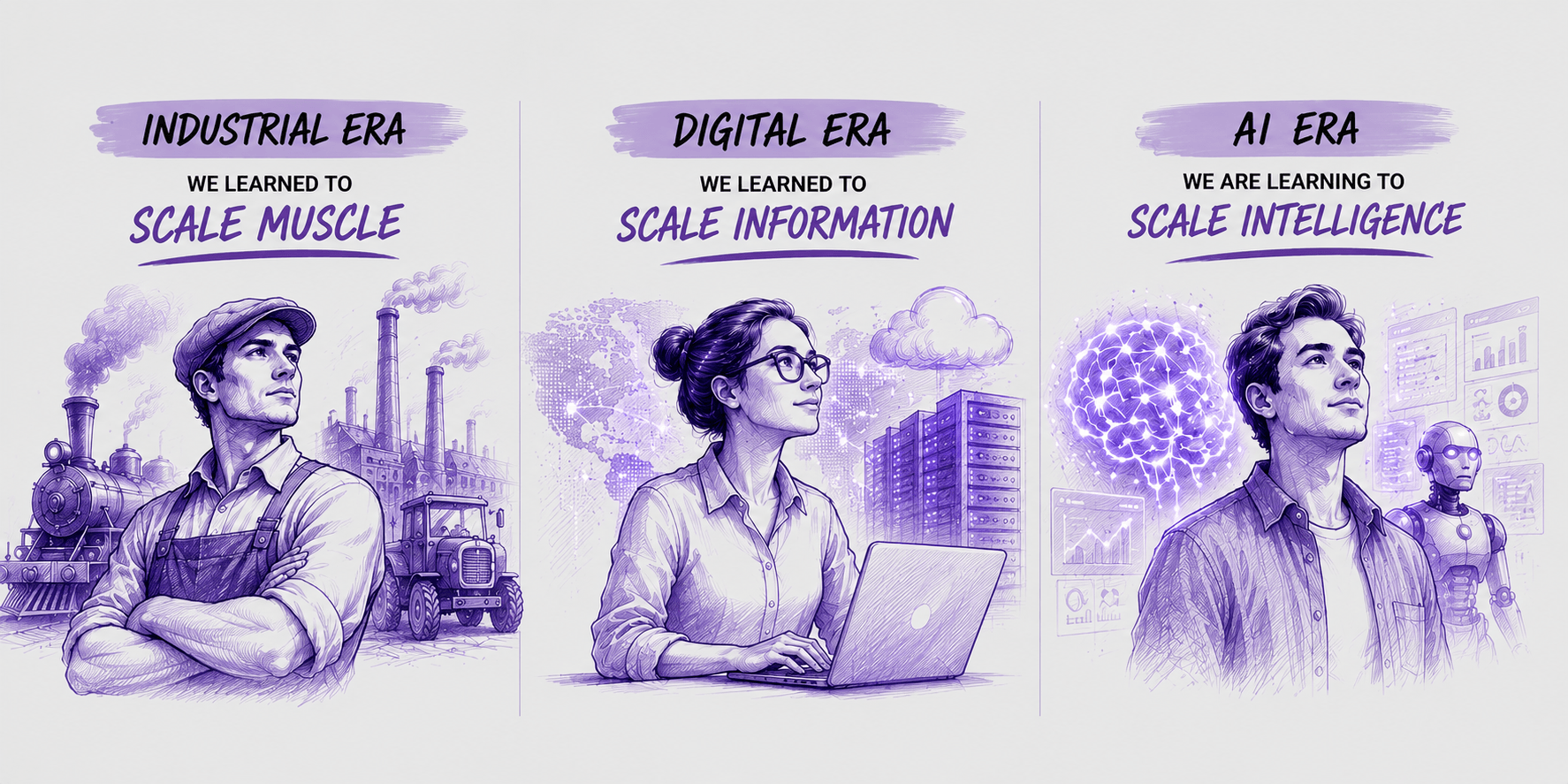
In the Industrial Era, we learned how to scale human muscle. We built steam engines, factories, tractors, trucks, and industrial machines to expand our productive capacity, our stamina, and our strength.
In the Digital Era, we learned how to scale information. Computers, networks, databases, software, and the internet made knowledge easier to store, search, share, and apply.
Now, in the AI Era, we are learning how to scale intelligence. Machine learning, foundation models, agents, world models, and robots expand our ability to think, reason, create, discover, and solve problems, enabling us to accelerate innovation, unlock new scientific breakthroughs, and tackle challenges that were once beyond our reach.
Historically, if a company needed more analysis done, it hired analysts. If it needed more software, it hired developers. If it needed more customer support, it hired service reps. The only way to scale intelligence was to scale headcount.
Intelligence On Demand
Now, AI turns intelligence into something closer to infrastructure that’s scalable, increasingly cheap, and available on demand. The latest models are incredible. Every company is about to gain access to a vast new supply of synthetic intelligence. It’s still not perfect, or risk-free, but it’s useful, ever-improving intelligence.
And when intelligence becomes a commodity, competitive advantage shifts from access to intelligence to the judgment to direct it wisely—and pursue the right goals.
This might sound like a worrying development for human intelligence in the workplace. It will certainly change things, but in a world of abundant, cheap intelligence, human judgment becomes the real source of power.
From AI Tools to Digital Employees
As I’ve outlined previously, there are three phases to AI transformation.
Three Phases of AI Transformation
Most organizations are still in the first phase—enabling people with AI tools—copilots, chatbots, writing assistants, coding tools, meeting summarizers, generative design, content creation, and research assistants. This is useful, but it doesn’t fundamentally change the organization.
The second phase, reengineering, is where companies redesign workflows around human-AI-robot collaboration. Instead of asking, “How can AI help this person do their job?” they ask, “How should this work be redesigned now that AI is available?”
The third phase is reimagining, where a company starts to rebuild itself around abundant intelligence. AI is no longer a sidecar; it’s a core capability. AI is embedded in customer service, operations, marketing, product development, finance, HR, legal, supply chain, engineering, and R&D.
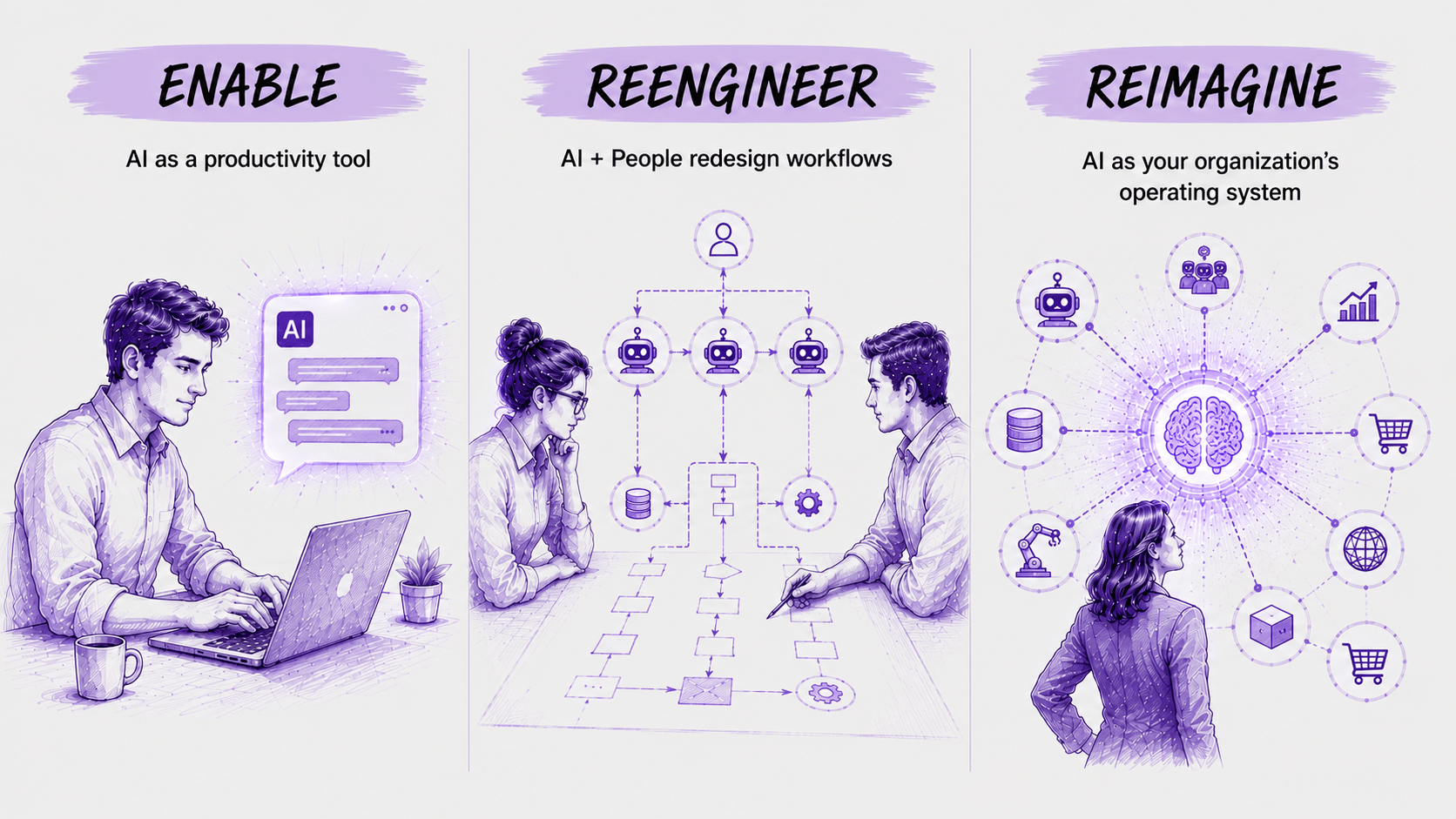
The Three Phases of AI Transformation
Digital Employees
We are already seeing the rise of digital employees. These agentic AI systems can pursue goals, use tools, access data, follow policies, collaborate with other agents, escalate to humans, and complete work. Forget chatbots, this is the real deal.
The major enterprise software companies are all chasing this vision as fast as they can. ServiceNow is building agentic workflows and AI agent orchestration into enterprise operations. Salesforce talks explicitly about “digital labor” through its Agentforce offering. Microsoft Copilot Studio now allows companies to build and manage their own agents connected to business data. These are all early signals of what’s coming in 2027 and beyond.
The near-future enterprise won’t just employ people. It will orchestrate a blended workforce of people, agents, robots, simulations, and automated workflows.
To manage digital employees, leaders will need to answer questions like:
Who gives agents their goals? Who defines their permissions? Who monitors their decisions? Who audits their actions? Who decides when they should escalate to a human? Who owns the outcome when they get something wrong?
These aren’t questions for the IT department. They are leadership questions.
Synthetic Customers and Simulated Markets
We won’t just live in a world of digital employees, we will also work with synthetic customers and simulated marketplaces. The self-improving enterprise will not only use AI to perform work. It will use AI to understand the world before acting in it.
For decades, companies have relied on surveys, focus groups, historical sales data, A/B tests, and market research to understand what customers want. These methods won’t disappear. Real customers still matter and human behavior is messy, emotional, cultural, contextual, and often irrational. But AI gives companies a new tool: the ability to simulate customer reactions before launching products, campaigns, pricing changes, policies, or experiences. AI is used to create digital twins of customers or markets using historical data.
Early Work in Synthetic Modeling
Research into synthetic customers at Bain & Company suggests that AI-generated personas built from real-world data can deliver comparable insights in half the time and at one third the cost of traditional consumer research.
Tastry models chemistry and consumer tastes to accurately predict preference and desire for beverage recipes that have yet to be physically created.
Back in 2023, Cornell University researchers first introduced the idea of “generative agents” that simulate believable human behavior in a virtual environment, and Harvard Business Review has explored how generative AI can be used for early-stage market research by simulating customer responses to product concepts.
These efforts are a complement for real market testing, not a replacement; a new stage in the innovation process that maintains experimentation but moves much of it upstream so significant learning occurs before launch.
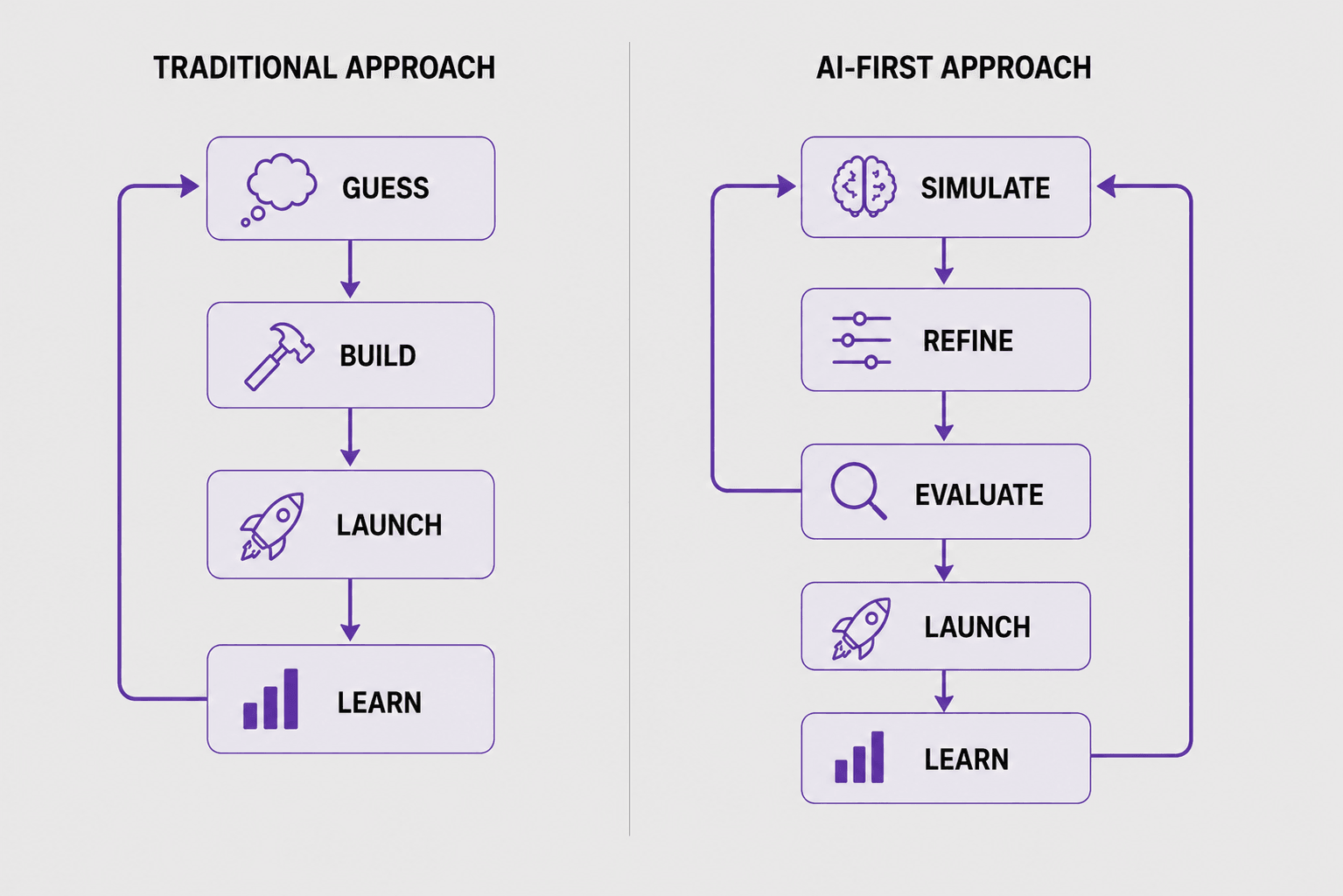
AI Enables Digital Experimentation at Scale
AI doesn't eliminate experimentation. It moves much of the experimentation upstream where it happens in the digital domain. Which is a much cheaper approach than building costly physical prototypes or running hundreds of focus groups.
A consumer products company can test hundreds of package designs against synthetic customer segments before commissioning any expensive real-world research. A retailer can simulate how different customer groups might respond to pricing changes. A bank could test how customers might react to a new loan product. A media company could evaluate audience reactions to storylines, trailers, formats, or subscription bundles before investing heavily in production.
Winners won’t blindly trust synthetic customers. That would be dangerous. Synthetic customers can be biased, incomplete, or misleading. Companies should use simulation intelligently: to expand the range of hypotheses, identify risks earlier, and accelerate learning before real-world testing starts. AI doesn’t eliminate uncertainty, but it’ll help savvy companies explore uncertainty faster.
Human Jobs Shift Toward Purpose
When people hear about agents, automation, synthetic customers, and digital employees, they naturally worry that humans are being pushed out of the system. That concern is warranted, and we shouldn’t minimize it, but the more useful way to think about this is that human roles move up. As AI does more of the work, people decide what work is worth doing.
Human Roles Are Elevated
Humans become responsible for purpose, values, judgment, and accountability. Their role is to answer questions like: Why do we exist? What future are we trying to create? What principles guide us? What tradeoffs are we willing, or unwilling, to make? Given all available information, what should we do? And who owns the outcome?
In this world, human judgement is king.
AI Works and People Decide
AI can recommend, optimize, simulate, create, and even act. But people still have to decide what matters. For example, should we optimize for profit, sustainability, resilience, fairness, customer trust, speed, quality, or long-term brand value? Should we launch a product that customers may want but society may not need? Should we automate a workflow if the result damages employee trust? Should we use synthetic customers to accelerate product development if the simulation underrepresents vulnerable groups? More on this topic here.
To assure necessary levels of human control over AI operations, governance and trust cannot be an afterthought. They must run vertically through the entire AI operating system: infrastructure, data, models, agents, workflows, customer experiences, and leadership decisions.
The companies that win will not be the ones that move fastest at any cost (move fast and break things, anyone?) They will be the ones that move fastest with trust.
The AI Operating System
If you put all of this together, a new enterprise architecture begins to emerge.
At the bottom is infrastructure: compute, storage, networks, devices, sensors, and robotics. Above that sits the data foundation: enterprise data, customer data, operational data, documents, images, audio, video, and real-time signals. Next is the intelligence layer: large language models, domain models, world models, knowledge graphs, prediction engines, optimization systems, and simulations.
Above intelligence comes the digital workforce: agents, copilots, robots, workflows, synthetic customers, and simulated markets. Those layers, together, represent the new AI operating systems of an enterprise.
If the AI operating system is the engine room, the people in an organization are sat on the bridge providing direction. They determine the company’s purpose and values, and bring judgment, and accountability. They are there to steer the engine in the right direction, to deliver on key business outcomes (the ultimate destination of the ship): growth, innovation, productivity, customer experience, profitability, sustainability, and resilience. The AI operating system is wrapped with governance, security, audit, and trust. And running through all of it is the intelligence flywheel.
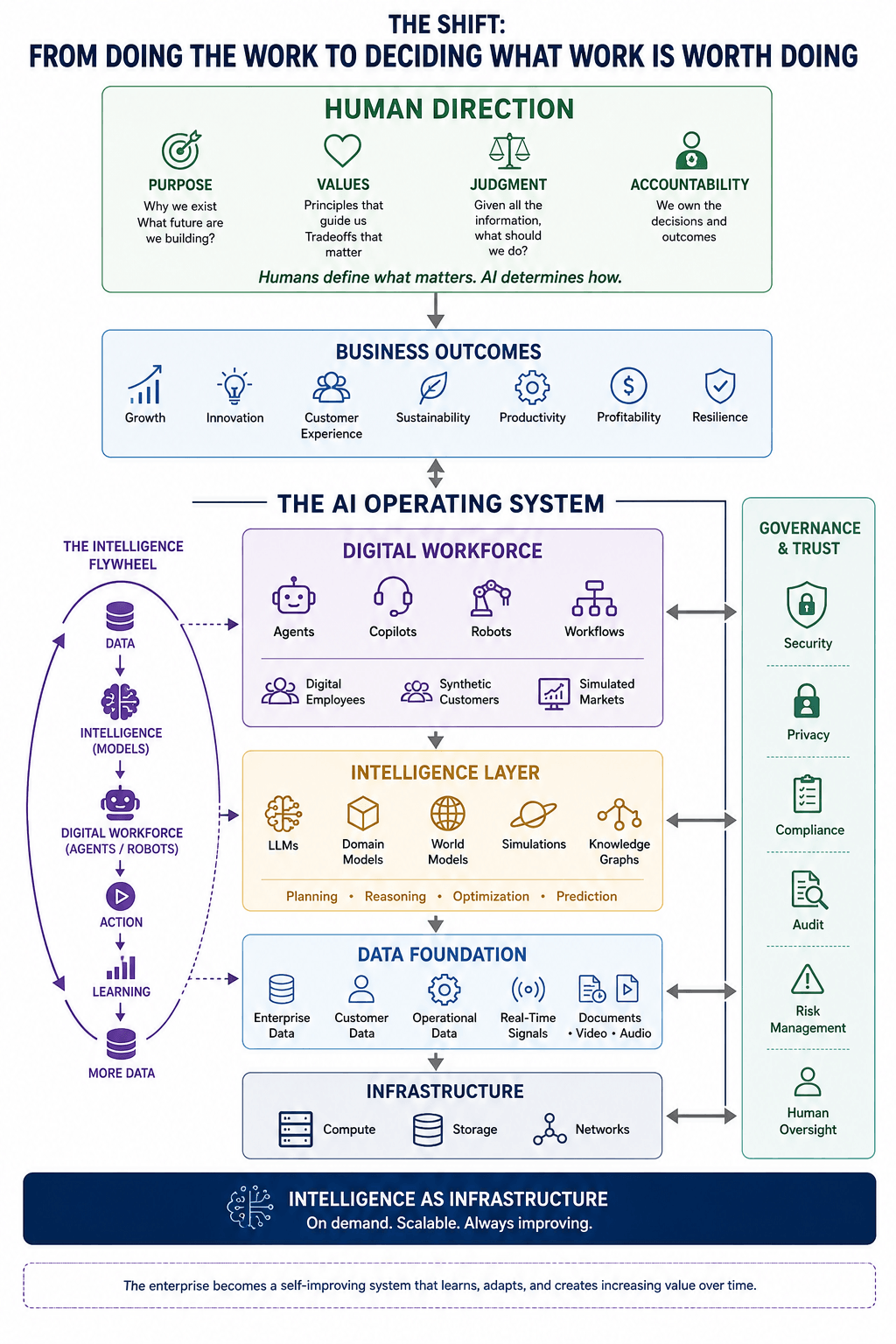
ChatGPT's best effort at sketching out a block diagram of the Self-improving Enterprise. Not too bad.
This is the AI operating system of the self-improving enterprise.
Most companies aren’t anywhere near ready for this. They’re still debating which chatbot to use and running pilots that are disconnected from strategy and likely trying to bolt AI onto an old workflow.
Leaders should stop treating AI as a productivity layer and instead think of it as a shift in the operating model.
From Doing the Work to Deciding What Work Is Worth Doing
The most important shift ahead isn’t technological. It’s philosophical.
For most of modern business history, organizations were built around scarce labor and scarce expertise. Companies created value by assembling people, processes, capital, and assets into productive systems.
As intelligence itself becomes abundant, it doesn’t mean human intelligence no longer matters. It means the human role changes. We move from doing the work to deciding what work is worth doing.
When everyone has access to powerful AI, advantage will not come from having tools. Everyone will have tools. Advantage will come from asking better questions, setting better goals, building stronger learning loops, earning deeper trust, and making wiser choices about where to aim this extraordinary new capability.
Judgment, taste, ethics, leadership, brand, and trust will matter far more.
AI will help us build faster, but people must decide what is worth building and what we’re optimizing for. Simulation AIs will help us explore possible futures, but we must decide which future we want.
The future enterprise will be self-improving, learn rapidly, and be more automated, intelligent, and adaptive than anything we have known before. And if we build it right, it will also be more human. Because the real promise of AI is not simply that machines will do more of the work. The real promise is that humans may finally get to spend more of our time deciding what matters most.