
Booking an AI keynote speaker isn't like booking a speaker on leadership or sales, and you have to navigate a sea of nouveau AI speakers (read repackaged charlatans) who will likely disappoint.
The subject moves faster than almost any other topic on the circuit, the pool of people claiming expertise has exploded, and the gap between genuine practitioners and polished storytellers is wide. Get it right and you set the tone for your entire conference. Get it wrong and you'll pay a premium fee for content your audience could have read in a newsletter.
This guide lays out the practical steps for vetting, shortlisting and booking the right person, along with the questions that separate substance from hype.
Why Booking an AI Speaker Differs From Other Topics
Most keynote topics are reasonably stable. A speaker on negotiation, connection, or team culture can deliver largely the same talk year after year. AI content from even six months ago can read as outdated to a 2026 audience, because the capabilities, risks and business opportunities have moved on. When vetting potential speakers, look at their social media or blog for recent frontier thinking or fresh applications of AI so you know they're not just well-informed, but have fresh perspectives and valuable insights to share.
The AI speaker category also has unusually wide pricing variance. AI has one of the widest fee spreads of any keynote topic, with a $15,000 difference between percentile bands, which tells you that generic "AI will change everything" content is treated as a commodity while industry-specific, leadership focus, or operational expertise commands a real premium. Planners who don't understand this distinction often overpay for a name without understanding what that name will actually deliver.
Finally, demand has become seasonal and competitive. Top-tier AI speakers typically book four to nine months in advance, with peak demand in spring and again from September through November, so starting the search early is recommended if you want your first-choice speaker. If you've left it late, it's always worth a try, though. Lately, booking cycles have contracted, and even some of the best speakers might have availability. And if you've left it really late, skip the agency and go to the speaker direct for a quick-turn response.
Define Your Goal Before You Search
The single biggest mistake in booking an AI speaker is starting with a name instead of an outcome. Before any shortlisting begins, define the specific, measurable behavior you want attendees to adopt within 30 days of the event. Event planners who skip this step tend to end up with a 'novelty' booking: an entertaining talk that generates applause but no lasting business impact.
Ask the planning committee a blunt question: what should people do differently on the Monday after this keynote? The answer you get will shape everything downstream. For example:
- If the goal is inspiration and buy-in from a skeptical audience, you need someone who can make the stakes vivid without descending into fear or hype.
- If the goal is strategic clarity for a leadership audience, you need someone with leadership experience who can map a credible roadmap for the next two to three years and offer frameworks to move the team forward.
- If the goal is practical adoption, you need someone who can speak to specific tools, workflows and failure modes relevant to your industry.
These goals point toward different archetypes of speaker, which is the next decision to make.
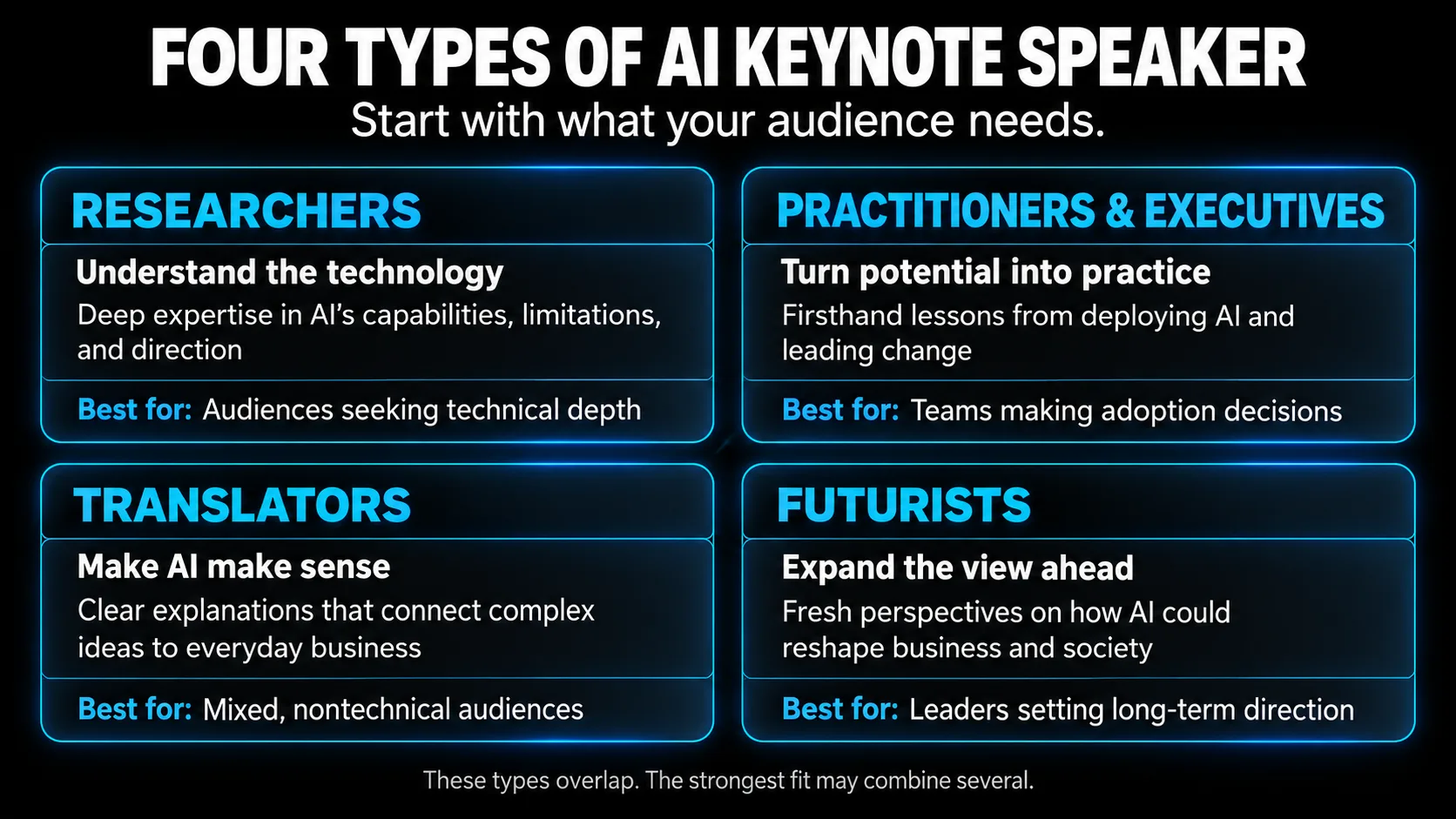
Researcher vs Tech Executive vs Futurist
AI keynote speakers generally fall into four overlapping archetypes, and matching the archetype to your audience matters more than matching a famous name to your budget.
Researchers
Researchers bring intellectual rigor and deep technical grounding. They are strong for audiences that want credibility on where the technology itself is headed, but can run too academic for a commercially focused crowd.
Practitioners and Executives
This group brings operational implementation experience: what it actually takes to deploy AI inside a large organization, including the failures. They are well suited to audiences making near-term adoption decisions.
Translators
Translators make the subject accessible to a broad business audience without technical background, which works well for association conferences with mixed seniority and function.
Futurists
Futurists offer long-range vision and help leadership teams think several years out, which suits strategy off-sites and annual meetings where the goal is to set direction rather than fix a process.
For association annual conferences, the right choice usually depends on the makeup of the room. A single-industry trade association with operational attendees benefits from a practitioner or translator; a broader professional association often gets more value from a futurist who can frame the big picture without alienating non-technical members.
Business leaders consistently rate industry specialization as essential, with more than half saying a generalist's sweeping "AI will change everything" talk fails to engage senior executives who need sector-specific context on risk and regulation.
Buyer Beware: Questions To Ask Before You Book
Once you have a shortlist, a structured vetting process protects you from an expensive mismatch. The standard booking process now runs in six steps: evaluate credentials, request availability, hold a discovery call, agree on scope and fee, sign a contract with a deposit, and complete pre-event tailoring.
The discovery call is where the real vetting happens. A 30- to 45-minute discovery call should reveal whether a speaker has a proprietary framework or is simply summarizing recent headlines. Ask for a point of view that is theirs, not a recap of what's in the news.
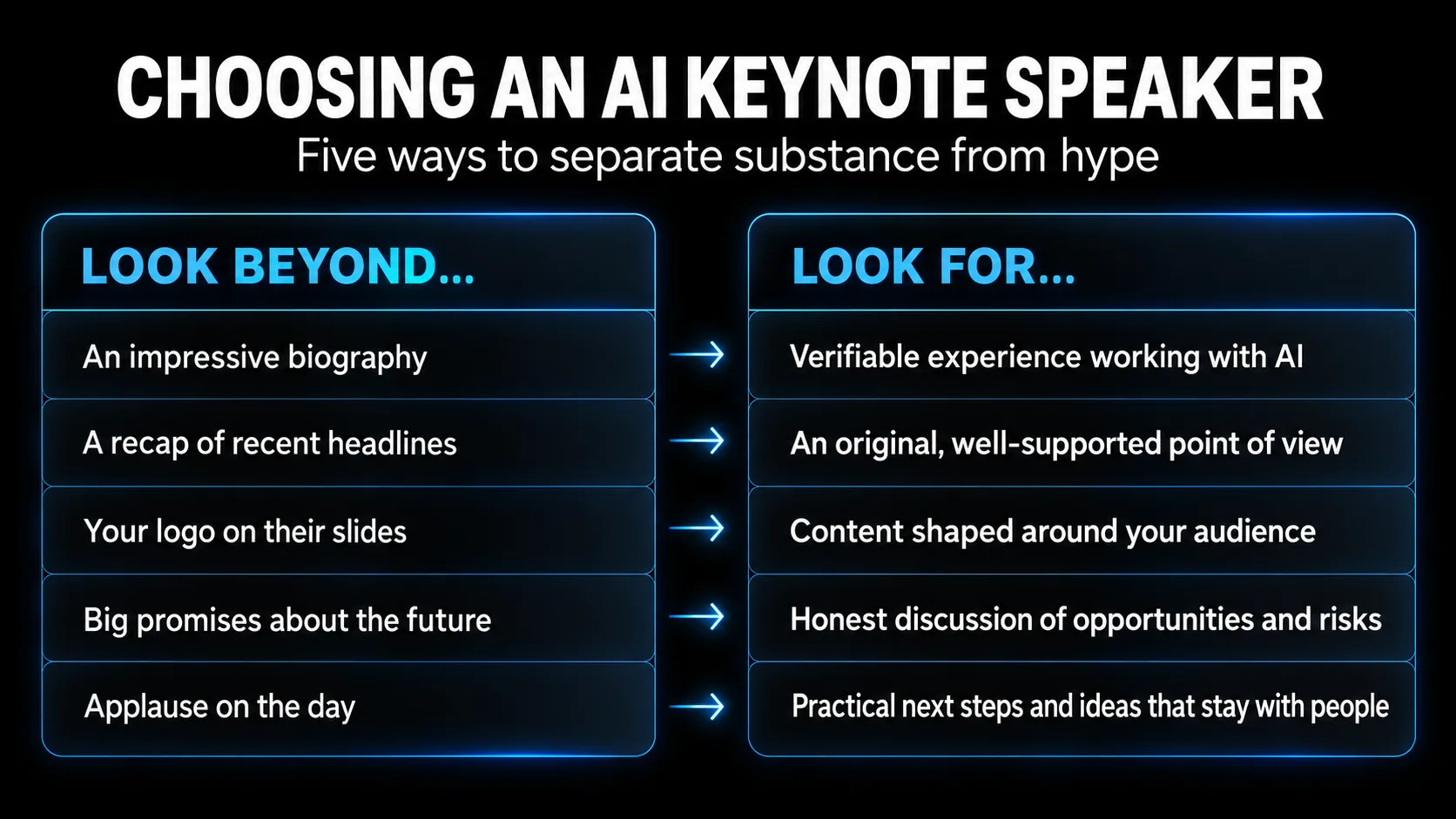
Be very careful when choosing your speaker. There are a lot of rebranded AI speakers out there who two years ago were focused on business consulting or even motivational speaking. Their opportunistic pivot towards AI is not what you want on your stage. You need to discern true experts with deep experience, a well-informed and valuable perspective, sharp communication skills, and an understanding of your audience and their needs from a repackaged consultant who only recently found AI religion. So, other questions worth asking directly:
- Can you point to dated, third-party evidence of hands-on work — a patent, a product launch, published research or thought-leadership pieces — rather than a bio that describes expertise in the abstract?
- Will you speak to the hard topics, including AI governance, bias and workforce displacement, not just productivity gains?
- What does your fee include, and does it change for a virtual format? Virtual keynotes typically run 50 to 75 percent of the in-person rate, though top-tier speakers with high-end studios sometimes hold firm on full fees.
- Can we speak with two or three planners from past events, or can you share testimonials from former clients?
Red Flags That Signal Hype Over Substance
The AI speaking market has grown faster than its quality control. Watch for these signals during vetting:
Stale Material
A most-recent talk or public commentary from 2024 or earlier suggests the content has not kept pace with the field. There may be some exceptions here. Some speakers whose business is focused on C-suite leadership teams won't have video from engagements where a camera in the room wouldn't be appropriate.
Personalization Theater
Adding your company logo to an otherwise generic deck is not customization. Authentic tailoring involves pre-event stakeholder interviews and specific, some level of content customization, and named case studies relevant to your industry, not a cosmetic swap.
Avoidance of Hard Topics
A speaker who only talks about upside and never addresses governance, bias, or job displacement is giving you a sales pitch, not an informed or balanced briefing.
Vague Answers on the Discovery Call
If a speaker cannot articulate a distinct point of view without reaching for a recent headline, that is a preview of what your audience will get on stage.
Pedigree
If your speaker has only been "in AI" since the release of ChatGPT in November 2022, you should seriously question their credibility. Look for speakers with practical experience in the field dating back into the 2010s or prior. Prioritize those with long-term associations in the high-tech industry, AI research labs, and with business transformation experience.
Fee bands are also a useful sanity check. Emerging voices typically run $5,000 to $10,000, established professionals $10,000 to $25,000, and marquee pioneers or former technology executives $25,000 to $65,000 or more. A price far outside these bands, in either direction, warrants a second look at what you are actually buying. Know what level of speaker your budget will stretch to and don't expect to attract a champagne speaker with a beer budget. Avoid the charlatans, and you'll find that the AI speaking world is very much a get-what-you-pay-for sector.
Next Steps For Event Planners
Start the search early if you can. Event planning horizons have shortened in 2026 as economic uncertainty has led CFOs to hold event teams back until the last minute. Given booking windows of three to nine months for top-tier speakers, waiting until one-two months before your event limits you to whoever happens to be available.
Before contacting anyone, write down the specific behavior change you expect from attendees within 30 days, and share that goal with every candidate or speaker bureau you approach. Use it to decide which archetype — researcher, practitioner, translator, or futurist — fits your audience.
During vetting, insist on dated evidence of hands-on work, run a real discovery call, and contact two or three past event planners as references. Treat stale content, generic slides with your logo pasted on, and avoidance of hard topics like governance and job displacement as disqualifying signals, not minor quibbles. Check their pedigree, and find out how long they've really 'been in AI' and where they cut their AI teeth.
The right AI keynote speaker will leave your audience with clear, credible next steps and fresh perspectives that shape their decisions and conversations for months to come. That outcome is worth the extra diligence it takes to find the right fit.
Good luck!