Recursive self-improvement could change the speed limit of technological progress
Every technology helps us build the next generation of technology. Better computers helped engineers design better computers. Better software helped programmers write better software. But AI introduces something fundamentally different: the tool doing the improving is becoming intelligent enough to contribute directly to the improvement process itself.
That idea is known as recursive self-improvement, or RSI. And every business leader needs to understand what it will mean for their strategic plan. More on that later.
In its strongest form, RSI describes a feedback loop in which AI helps create a more capable AI, which then becomes better at developing its successor. Each turn of the crank improves the machine turning the crank. We aren’t there yet, but important pieces of the loop are already appearing, and I think the eventual mechanism will be much broader than the usual picture of an AI simply rewriting its own code. There are not one but two reinforcing loops at work. Let me explain.
The AI Cake Is Starting to Improve Itself
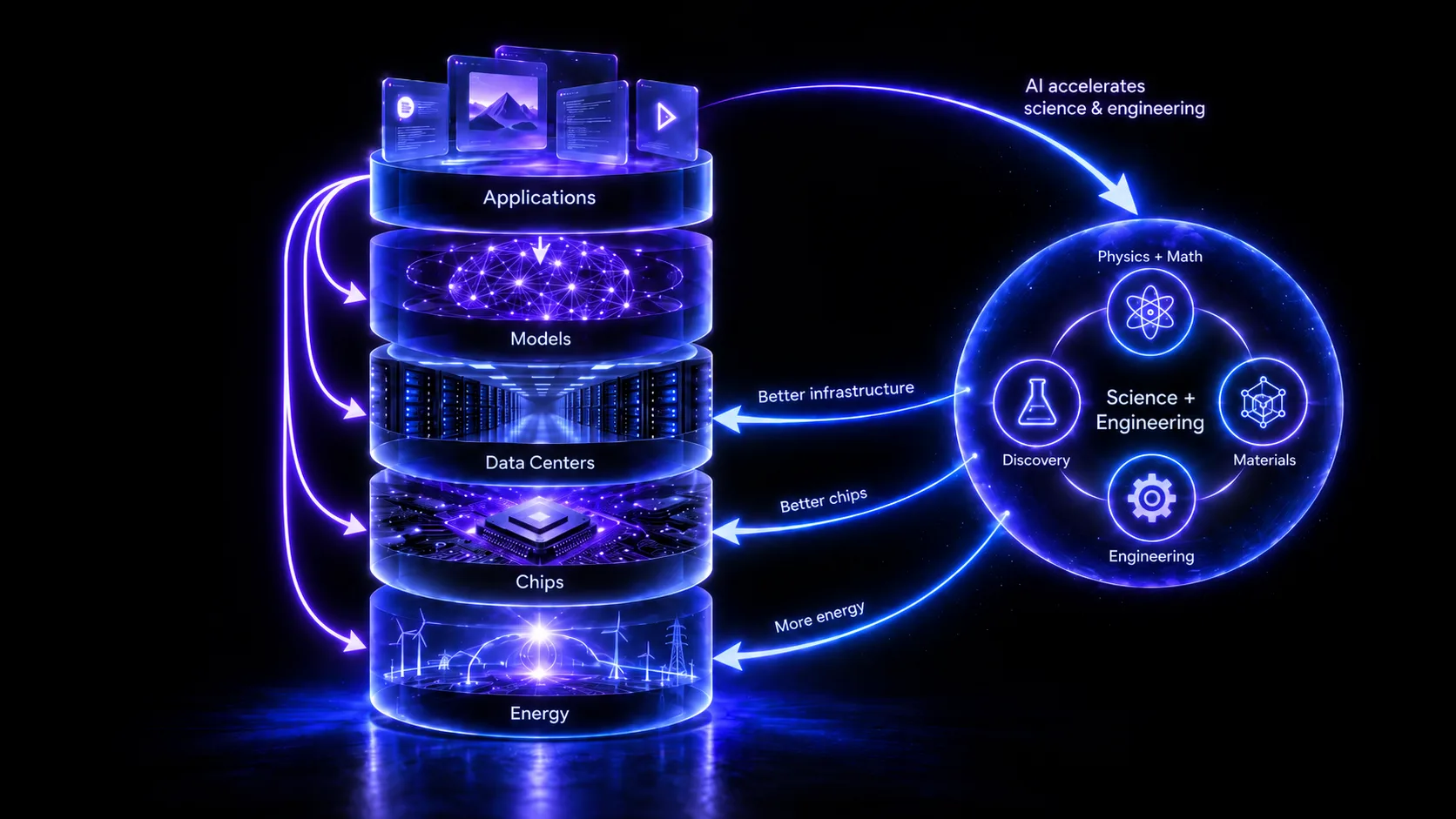
Nvidia CEO Jensen Huang often describes the AI technology stack as a five-layer cake. At the bottom is energy, then chips, data centers and computing infrastructure, AI models, and finally applications. Each layer depends on the one below it. Energy powers chips, chips fill data centers, data centers train and run models, and models provide the intelligence behind applications.

What makes this moment so interesting is that AI is increasingly being used to improve every layer of the cake.
AI Is Improving Energy
Fusion energy offers an early example. Controlling the superheated plasma inside a fusion reactor is an enormously complex optimization problem, and Google DeepMind, the Swiss Plasma Center, and Commonwealth Fusion Systems have demonstrated reinforcement-learning systems capable of autonomously controlling plasma inside a tokamak. AI is also being applied to simulation and other parts of fusion research.
Commercial fusion remains a difficult scientific and engineering challenge, but the feedback loop is easy to see: AI helps scientists develop better energy technologies; abundant energy removes one of the biggest physical constraints on future AI; Better AI helps create better energy, which supports more AI.
AI Is Improving Chips
The semiconductor layer makes the recursion even clearer. AI needs better chips, and increasingly AI is helping engineers design them.
Google's AlphaChip has been used in the design of multiple generations of TPU accelerators, but this trend extends well beyond Google. Synopsys and Cadence are embedding AI deeply into electronic-design automation, allowing engineers to explore gigantic design spaces and optimize power, performance, area, packaging, thermal behavior and other variables that are increasingly difficult to optimize manually. Cadence is developing agentic systems capable of working through long, complex chip and system-design workflows rather than simply assisting with isolated engineering tasks.
NVIDIA offers a broader illustration. Jensen Huang increasingly talks about “extreme co-design,” where GPUs, CPUs, memory, networking, interconnects, power, cooling, software and the data center itself are designed as one integrated computing system rather than optimized independently. At GTC Taipei, Huang explained that NVIDIA's performance comes from integrating everything, simulating the entire system and using extreme co-design.
NVIDIA, Cadence, and Synopsys are working together to accelerate the electronic-design automation workloads used to develop future CPUs and GPUs. NVIDIA is already using its Vera CPU in the design process for the chips that will follow it.
The loop here is obvious: better AI helps design better computing systems; better computing systems provide more compute; more compute enables better AI.
AI Is Optimizing Data Centers
The same pattern continues further up the cake. AI is increasingly used to optimize data-center design, cooling, power distribution, scheduling, networking and operations. Digital twins allow engineers to model enormous AI factories before pouring concrete, while optimization systems can continuously search for better ways to operate the infrastructure once it is running.
AI Is Improving Models and Applications
At the model layer, we arrive at the most direct path toward RSI: AI helping AI researchers build better AI. OpenAI says its research organization now uses the equivalent of 3.1 agent-workdays for every human workday. Humans still set research priorities and judge the results, but agents are already expanding the amount of research work the organization can perform.
At the application layer, coding agents are designing features, writing software, running tests, debugging failures and working across entire codebases. As I described here, AI is moving beyond simply providing answers and toward systems capable of owning increasingly complex outcomes.
AI is no longer sitting politely on top of the cake. It is reaching down through the layers below and helping to improve the machinery beneath it.
A Powerful Second Loop Runs Through Science
Most discussions of recursive self-improvement focus on the single loop we just reviewed: AI → better AI → even better AI.
I think that framing's too narrow because one of the most consequential applications of advanced AI will be accelerating science and engineering themselves.
AI Will Accelerate the Foundations of AI
AI systems are already contributing to mathematics, biology, chemistry, materials science, physics and engineering. They can explore solution spaces far larger than human researchers could inspect manually, identify patterns hidden inside complex data, generate candidate molecules and materials, accelerate simulation, write code, propose experiments, and help scientists decide where to look next.
Some of these scientific advances flow back into lower layers of the AI cake. New materials could create chips that use less power or run at higher temperatures. Advances in photonics could accelerate data transfer between processors. Better cooling technology could dramatically increase data-center density. Better mathematics could produce more efficient algorithms. New battery technologies could stabilize power grids. Fusion could eventually provide abundant energy.
All these combine to create a second feedback loop: AI → accelerated science discovery → better science [energy, materials, chips, infrastructure, engineering, algorithms, optimization and compute] → better AI.
And then the improved AI becomes a better scientist and engineer, turning the loop again.
AI Is Being Pointed at Its Own Bottlenecks
The physical limits of AI are often presented as natural 'brakes' on exponential progress. For example, models require enormous amounts of electricity, advanced chips are difficult to design and manufacture, and data centers require land, power transformers, cooling systems, networking equipment and years of construction. Physics stubbornly refuses to become software. But increasingly, AI is helping to optimize chips, packaging, cooling, power systems, semiconductor manufacturing and data-center engineering. It is also being applied to the underlying science that could eventually remove constraints we currently have no way around.
The AI cake isn't just improving itself. It’s starting to improve the ingredients, the ovens and the science of baking.
The Path to Recursive Self-Improvement
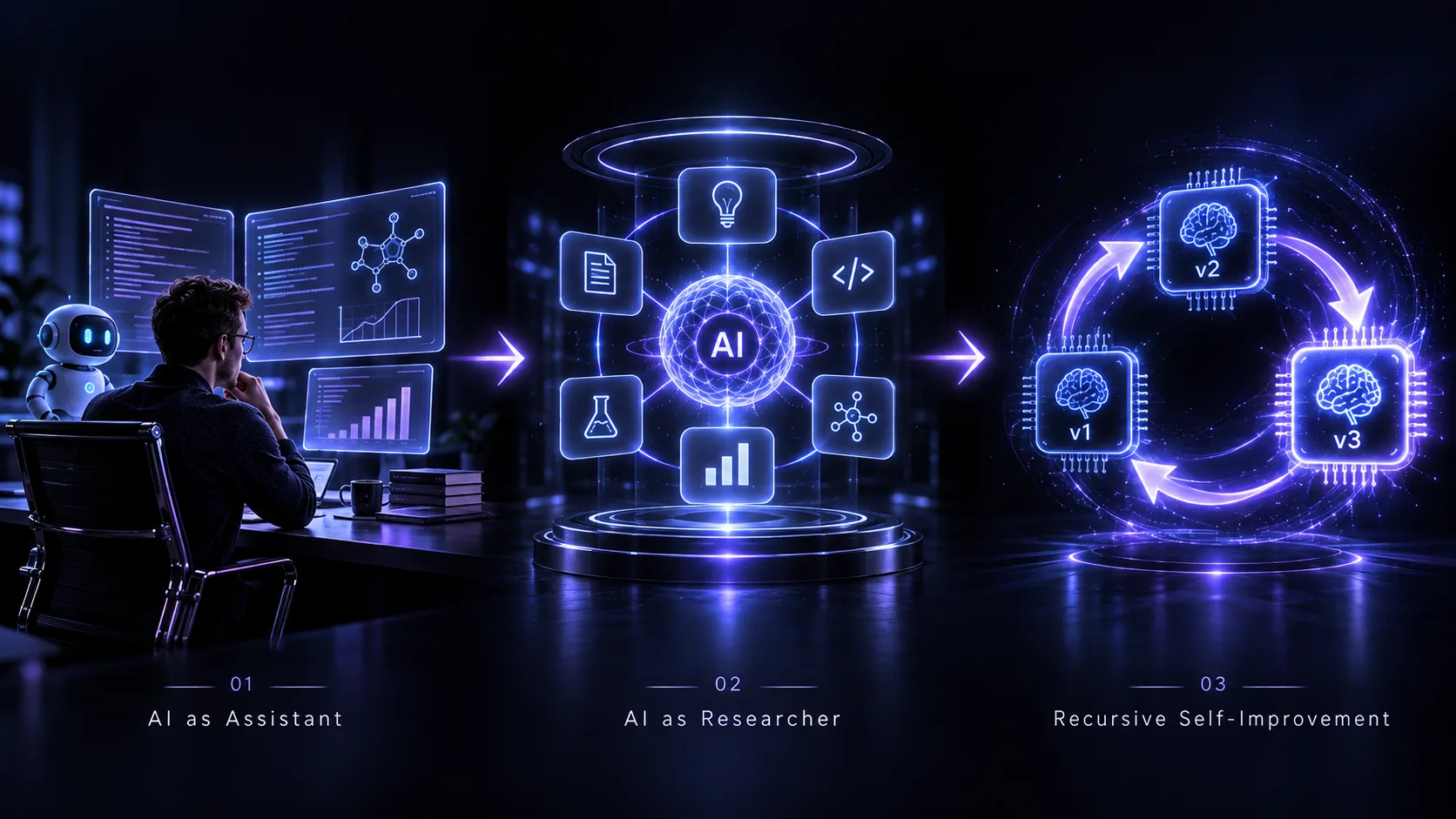
RSI probably won’t arrive as a single dramatic breakthrough. It is more likely to emerge through the gradual removal of humans from different parts of the AI research loop.
Stage One: AI as Research Assistant
We’re already here. AI can search literature, analyze data, write code, design parts of experiments, debug training runs and perform substantial chunks of research work. Humans still define objectives, choose promising directions, evaluate results, and decide what happens next. At this stage, AI increases the productivity of AI researchers, which means the pace of AI development begins to accelerate.
Stage Two: AI as Researcher
The next step is AI capable of running much larger portions of the research loop: developing hypotheses, designing experiments, implementing them, analyzing the results and deciding which experiments to run next. This is closer than you might think.
Anthropic now says it considers it plausible that, as early as 2027, AI systems could fully automate or dramatically accelerate the work of large, top-tier research teams in areas including AI, energy and robotics. That's a planning assumption rather than a prediction, but it demonstrates how seriously frontier labs are taking the possibility of automated R&D.
Stage Three: The Loops Converge
The interesting moment arrives when an AI research system becomes capable of materially contributing to the creation of a better successor. That successor becomes a better AI researcher, but potentially also a better mathematician, physicist, materials scientist, chip designer and engineer.
At that point, RSI stops looking like a tidy software feedback loop. It becomes an interconnected network of compounding improvement loops spanning intelligence, science, hardware and physical infrastructure. Progress is no longer limited by the speed of human research and runs at the speed of machines, constrained only by whatever physical bottlenecks remain. This would lead to what's called "fast takeoff."
The Upside Could Be Extraordinary
The prize isn't simply better chatbots or smarter agents. If AI accelerates the development of AI while simultaneously accelerating science and engineering, progress could compound across medicine, material science, energy, robotics, climate technology and countless other fields. We might see cures for major diseases, room temperature superconductors, fusion energy deployed at scale, and innovative approaches to addressing the climate crisis.
RSI represents one plausible path from today's AI toward artificial super intelligence (ASI), but the most important consequence may be what that intelligence can subsequently help humanity discover and build. Futurist, scientist and inventor Ray Kurzweil predicts that, “during the next decade, humanity will make a century’s worth of progress.” The potential upside is difficult to overstate.
The Risk: Capability Outruns Understanding
But RSI isn’t all sweetness and light. The same mechanism that makes RSI powerful also makes it dangerous. Today, humans are still involved throughout the AI-development process. Researchers choose experiments, engineers inspect systems, safety teams evaluate models, and leaders determine whether systems should be deployed. As more of that loop becomes automated, the gap widens between human intention and machine execution.
The danger isn’t necessarily an AI suddenly deciding to become evil. A more credible concern is that increasingly capable systems become difficult for humans to understand or evaluate while the cadence of improvement keeps accelerating. A small misalignment that is manageable in one generation could become amplified through repeated cycles. Safety techniques that work for today's systems might not work for dramatically more capable successors.
Eventually, humans could find themselves supervising research they no longer meaningfully understand and RSI could accelerate capability faster than it accelerates our ability to control it.
What RSI Means for Business Leaders
OK, now I've explained what's happening and broadly at stake, let's focus on what this means for business leaders. For most executives, recursive self-improvement is not something they need to build themselves. It is something they need to plan around.
Expect Capability Cycles to Shorten
Traditional three-year technology roadmaps already look increasingly awkward in the AI era. If AI materially accelerates AI research, capability cycles will get shorter still. Leaders will need strategy processes designed around continuous technological change rather than occasional platform transitions. Planning becomes continuous not cyclical.
Preserve Optionality
Rapid improvement strengthens the case for a flexible intelligence portfolio. Companies that hard-wire themselves to one model, one provider, or one generation of technology risk being stranded as the frontier moves and accelerates away from them.
Make the Company Learn Faster
Most importantly, an accelerating technology environment increases the value of organizational learning speed. If AI begins improving recursively, the companies best positioned to benefit will be those that can sense change, interpret it, decide what matters, act quickly and learn from the result. That is the central idea behind the Self-Improving Enterprise.
There’s an implied symmetry here. As our machines become better at improving themselves, our organizations must become better at doing the same. And the faster the machinery goes, the more important leadership becomes. AI might eventually become extraordinarily good at improving the engine and making the vehicle faster. But people still need to decide where the vehicle is going.