
A leadership playbook for building the AI-first enterprise
Most leadership teams now accept that AI will transform their business. The challenge is knowing what to build, in what order, and where to focus as the technology moves at extraordinary speed. The danger is that companies respond to each new capability individually, buying copilots, experimenting with agents, launching automation projects, and deploying new models without a clear picture of how those pieces fit together. They end up with plenty of AI activity, but no coherent path toward becoming a fundamentally better company.
I think there is a more useful way to frame the journey. AI transformation happens in three overlapping phases: AI as Tool, AI as Worker, and AI as Operating System.
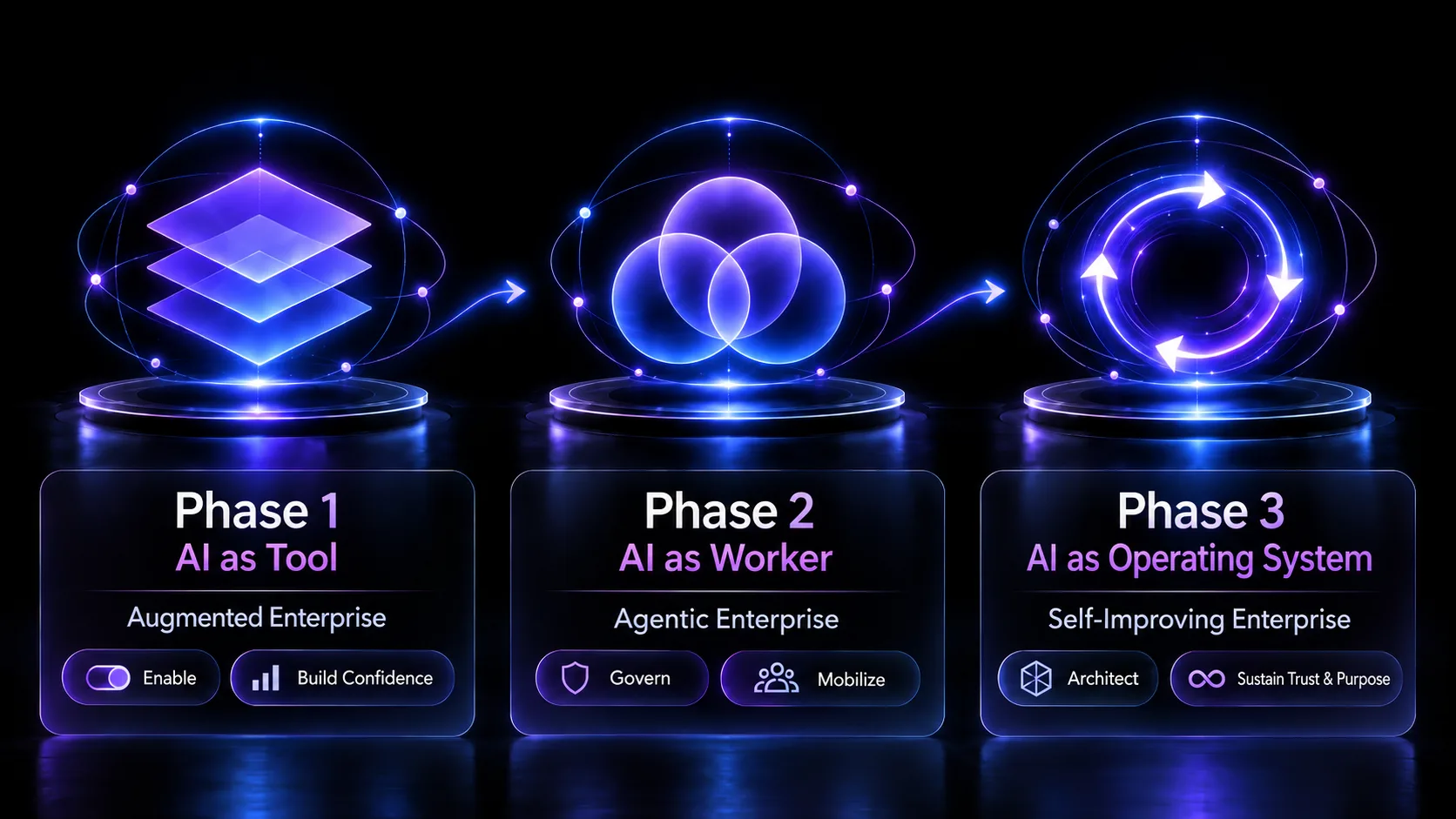
Each phase represents a different role for AI inside the enterprise, a different operating model, a different relationship between people and machines, and a different job for leadership. Phase 1 creates the Augmented Enterprise. Phase 2 creates the Agentic Enterprise. Phase 3 creates the Self-Improving Enterprise.
This is a build sequence as much as it is a maturity model. Companies must develop capabilities in each phase that become the foundation for the next. Leaders who understand the sequence can stop treating AI as a collection of technology projects and start building the organizational capabilities they’ll need over the next several years.
Phase 0: Understand What AI Changes
Humans were the intelligence layer
Before AI, people were effectively the intelligence layer of the company. Software stored information, moved it around, performed calculations and executed processes, but humans supplied most of the judgment. People interpreted what was happening, decided what mattered, resolved ambiguity, made tradeoffs, coordinated work and determined what should happen next. Companies were therefore designed around the limits of human intelligence: expertise was scarce, decisions moved through hierarchies, work passed between specialists, information was summarized into reports, and most management processes operated periodically because continuously sensing and responding to everything happening across the business would have required an impossible number of people.
AI changes the foundational constraint
AI changes this foundational constraint. Intelligence is becoming abundant, inexpensive, scalable and increasingly capable of acting on its own. That means the opportunity isn't simply to make existing processes faster. Over time, it becomes possible to design the company differently because intelligence itself is no longer as scarce as it once was.
That is the starting point leaders need to understand. The transformation ahead isn't primarily about adding AI to the company they already have. It's about progressively redesigning the company around what becomes possible when intelligence is everywhere.
Phase 1: AI as a Tool
Build the Augmented Enterprise
The first job is to put powerful intelligence into people's hands.
In Phase 1, AI remains a tool. People initiate the work, direct the AI, evaluate its output and remain accountable for the result. Copilots help employees write, research, analyze, design, code, plan and make decisions. AI becomes a new layer of capability available to almost every role, allowing individuals to work faster, explore more options and tackle problems that previously required more time or specialist expertise.
Move beyond deployment
The objective shouldn't simply be to deploy a chatbot or buy thousands of Copilot licenses. Leaders should deliberately build an Augmented Enterprise, where employees know how to use AI effectively and where the organization systematically identifies which forms of intelligence can improve each role. This requires much more than technology deployment. Companies need access to capable models, secure connections to internal knowledge, AI literacy, experimentation programs, clear usage policies, and mechanisms for sharing successful practices across teams.
The leadership role: Enable
The leadership role in this phase is to Enable. Leaders need to remove the barriers that prevent people from experimenting while establishing enough governance to make experimentation safe. They should encourage teams to redesign how they personally work, not simply use AI to perform the same tasks a little faster. The goal is to increase the intelligence available to every employee and build an organization that becomes progressively better at discovering where AI creates value. In this phase, AI should amplify what a person can do, not just help them do the old stuff a little faster.
The human agenda: Build confidence
The human agenda is equally important. Leaders need to build confidence. Employees who see AI as something being done to them will use it differently from employees who see it as a way to expand what they can accomplish. Training must therefore go beyond teaching how to prompt. People need repeated opportunities to experiment, understand the technology's strengths and limitations, develop judgment about when to trust it, and see how their own role can become more valuable as routine cognitive work becomes easier.
Phase 1 is successful when AI stops being a novelty and becomes an everyday part of how people think and work.
But augmentation isn't the destination. It's preparation for what comes next.
Phase 2: AI as Worker
Build the Agentic Enterprise
Phase 2 begins when AI moves from helping people perform work to performing work itself.
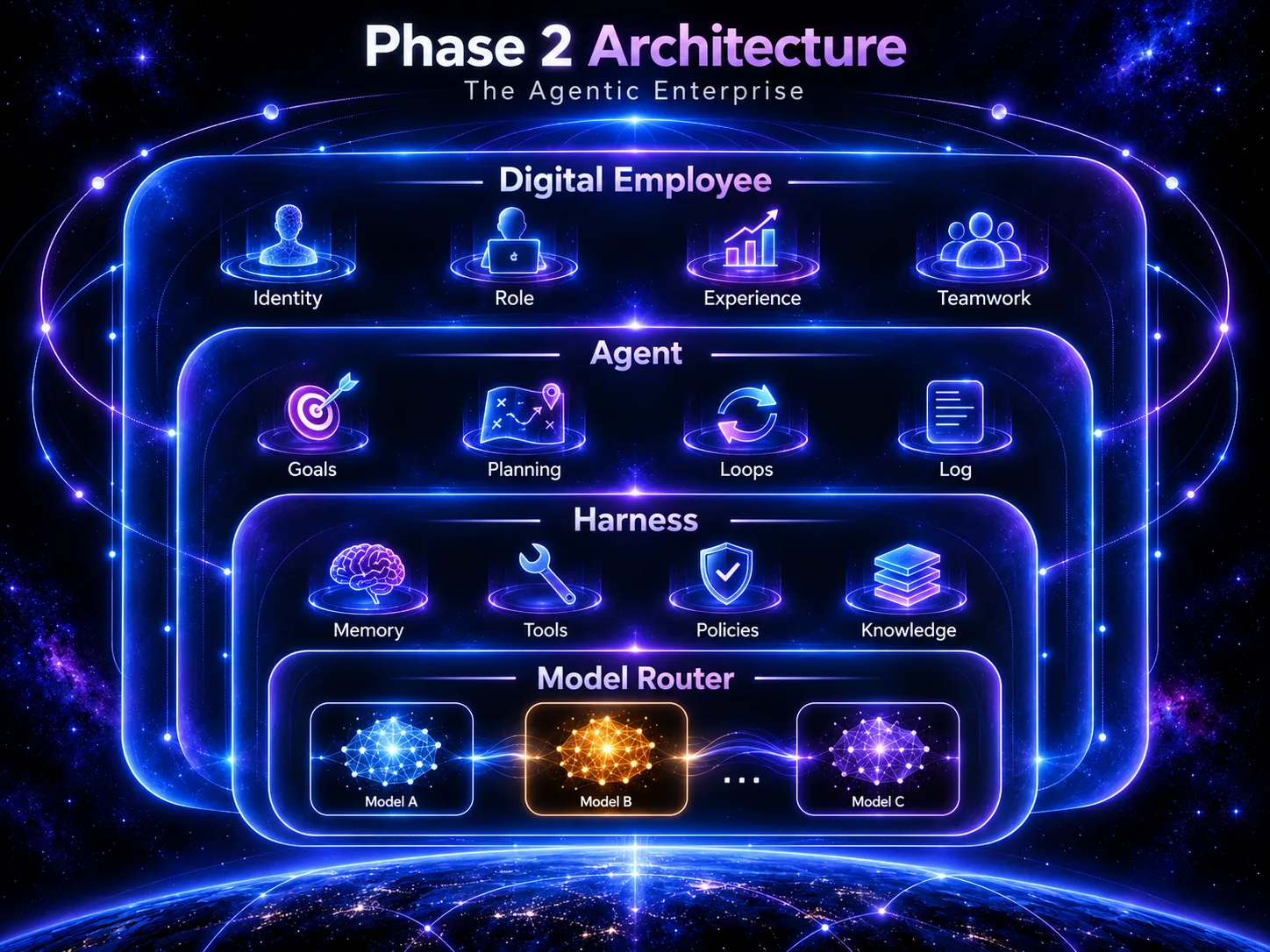
Agents can be given goals, use tools, access information, make plans, execute tasks, evaluate results and continue working with progressively less human intervention. As these systems gain persistent identities, memory, defined roles, access rights and responsibility for outcomes, they begin to resemble what I call digital employees.
Shift the unit of transformation from tasks to work
In Phase 1, leaders use AI to improve individual tasks. In Phase 2, they redesign the work itself.
Simply dropping agents into existing workflows will capture some efficiency, but the real opportunity comes from rethinking workflows that were designed around human limitations. Companies contain enormous amounts of organizational friction created because people have limited time, attention and availability. Work sits in queues. Information moves between departments. Managers coordinate handoffs. Reports summarize activity. Decisions wait for meetings. Entire processes exist because the intelligence required to move work forward has historically been scarce.
Redesign around abundant intelligence
Agents allow leaders to begin removing those constraints.
The leadership opportunity isn't to automate the old company more efficiently, but to redesign work around a world in which intelligence and execution can operate continuously. Processes can be shortened. Handoffs can disappear. Decisions can move closer to the point of action. Work that once required multiple teams can increasingly be coordinated by intelligent systems, with people stepping in where judgment, relationships, creativity, or exception handling create the most value.
The leadership role: Govern
The leadership role in Phase 2 is to Govern. Every digital worker needs a clearly defined role, objective, level of authority, access to appropriate tools and information, measures of success and rules governing when to escalate to a person. Leaders need to think deliberately about the division of labor between humans and machines, deciding where human judgment adds value and remains essential, where machines can operate independently, and how the two should collaborate.
Build an authority and escalation architecture
This is also where companies should begin developing an authority and escalation architecture for AI. An agent allowed to research a market requires very different controls from an agent allowed to negotiate with suppliers, commit company funds, contact customers, or change a production schedule. Leaders need explicit rules governing which decisions machines can make, which require approval, and which should always remain human.
The human agenda: Mobilize people
The human challenge shifts from building confidence to mobilizing people. Phase 2 changes roles more fundamentally than Phase 1 because work itself is moving. Leaders need to involve employees in redesigning work rather than simply announcing automations from above. You want employees to be supporters, not saboteurs of transformation efforts, so include people in the design process. You'll be glad you did. Your people also know how work really gets done, and that's not usually the way its documented in policy and procedure manuals. Cut your people out, and you'll design agentic solutions for a world that doesn't actually exist.
The best human-machine operating models won't be created by asking where AI can replace people. They will emerge by identifying what machines can do exceptionally well, what humans should continue to own, and how combining the two can produce an outcome neither could achieve alone.
The companies that master this phase will start to look noticeably different. They will have blended workforces of people, agents, digital employees and, in physical environments, increasingly capable robots. Human-machine collaboration will become part of organizational design, not simply a feature inside software.
And that creates the foundation for the most important phase of all.
Phase 3: AI as Operating System
Build the Self-Improving Enterprise
Phase 3 begins when intelligence stops being confined to individual tools and digital workers and becomes part of the operating fabric of the company itself.
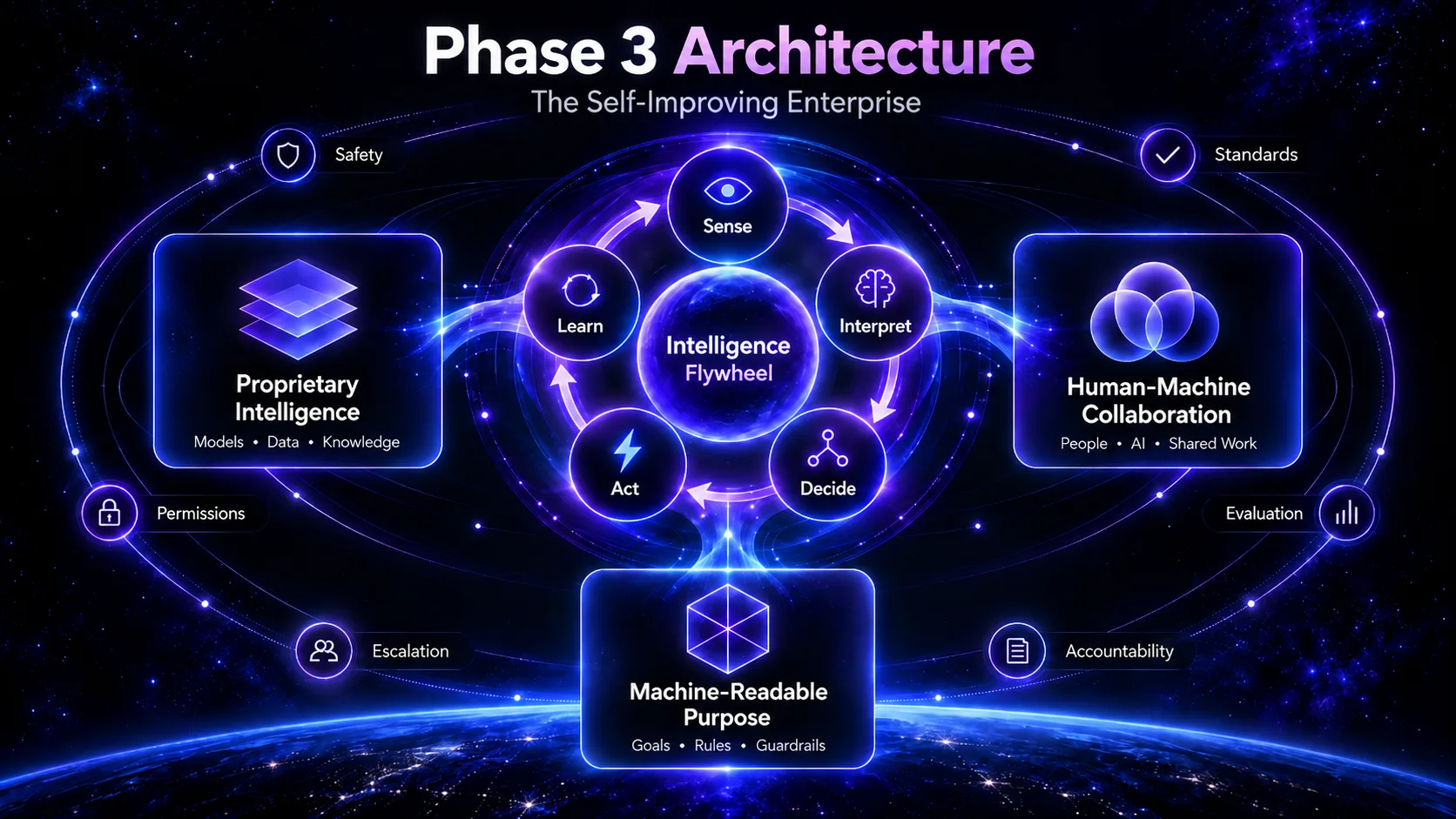
The objective is to create an organization that can continuously sense, interpret, decide, act, and learn. Customer behavior, operational performance, market signals, competitor activity, product usage, financial information, and knowledge from across the enterprise feed into intelligence systems that identify what is happening, determine what it means, initiate appropriate action, and learn from the result.
Build intelligence flywheels
The process I just described is what I can an Intelligence Flywheel, likely one of the defining architectures of the AI-first enterprise.
Traditional companies often learn slowly because organizational learning is manual. People gather data, create reports, hold meetings, make decisions, execute changes, and wait to see what happens. A well-designed intelligence flywheel compresses that loop. The outcome of every customer interaction, operational event, experiment, and decision becomes new information that can improve what the company does next. The faster and more accurately that loop turns, the faster the organization improves.
Leaders should begin identifying the flywheels that matter most to their business. A retailer might build one around understanding demand signals, testing products, learning from customer response, and adjusting inventory. A manufacturer might connect equipment performance, quality data, process conditions, and engineering knowledge so the system continuously learns how to improve yield. A financial institution might create a loop that becomes progressively better at understanding customer needs, risk, and the next best action.
Competitive advantage increasingly comes not simply from possessing AI, but from building systems that learn from proprietary experience faster than your competitors can.
Build proprietary intelligence
Proprietary learning becomes a critical asset. Over time, companies shouldn't rely exclusively on the same general-purpose models available to everyone else. Their advantage will increasingly come from the proprietary intelligence built on top of them: models, agents and systems informed by the company's unique data, knowledge, decisions, customer interactions, processes, and accumulated judgment. General models provide intelligence. The company adds context, experience, and expertise that competitors can't easily reproduce. This is a major selling point of open weight models—you can post-train them with your proprietary data to build your own proprietary intelligence that runs on-prem inside the firewall, yielding compounding competitive advantage.
Design human-machine collaboration deliberately
Human-machine collaboration also reaches a more sophisticated level in Phase 3. People won't simply supervise machines or intervene when something goes wrong. The strongest organizations will deliberately design environments where human judgment and machine intelligence improve one another. AI can surface patterns, simulate options, remember enormous amounts of context, and operate at machine speed. Humans can contribute purpose, values, creativity, empathy, social understanding and judgment in situations where objectives are ambiguous. Your competitive capability comes from building a system that combines those strengths effectively.
Make culture machine readable
As more decisions move into intelligent systems, leadership itself has to move upstream.
The leadership role in Phase 3 is that of Architect. Leaders increasingly define the goals, principles, authority structures, and rapid learning systems within which intelligent machines operate. They can't review every decision an AI system makes, particularly when those decisions begin happening continuously and at machine speed. Instead, they need to encode enough of the organization's intent that AI can act appropriately without constant supervision.
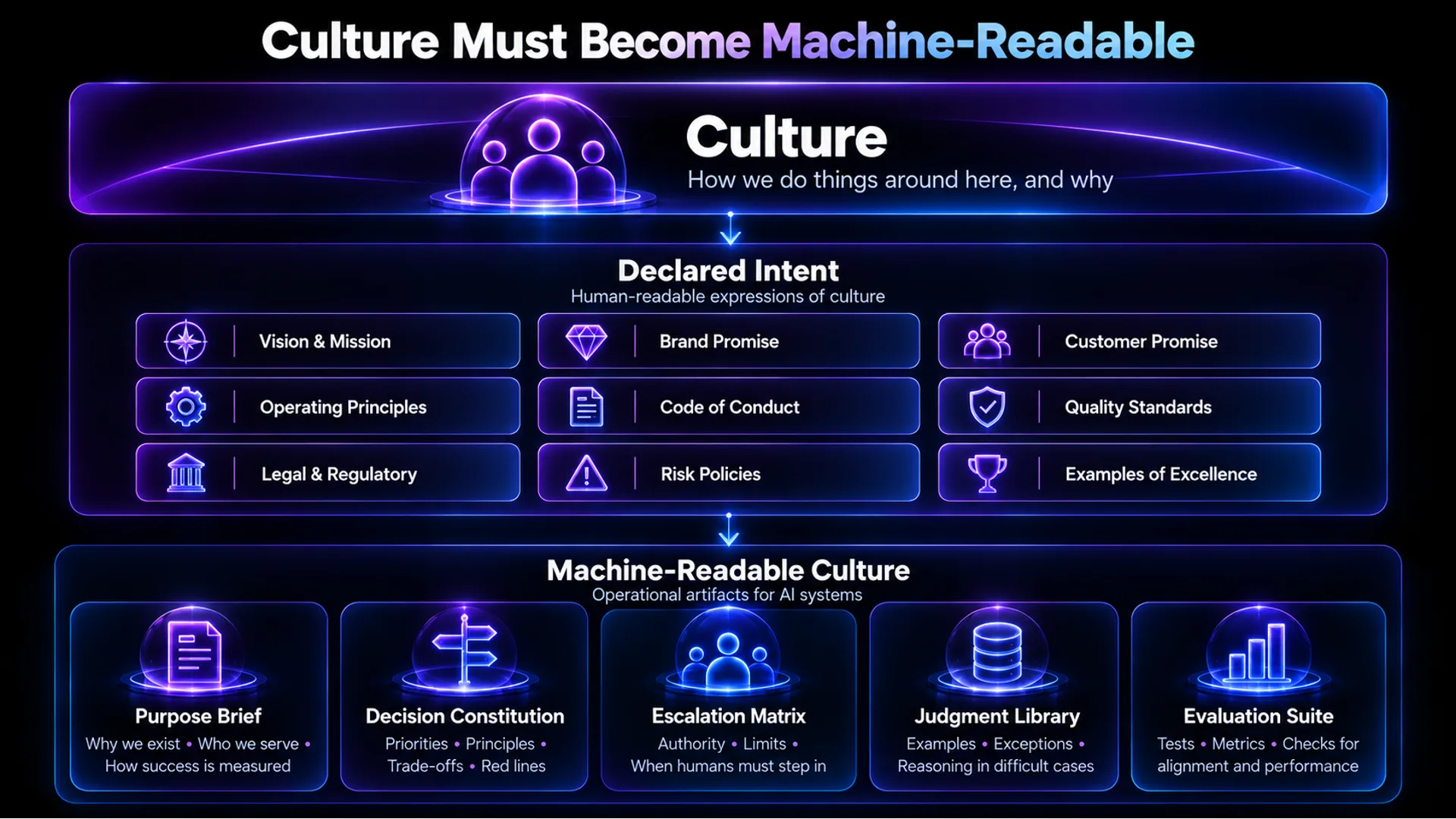
This is where machine-readable culture becomes essential. We bombard human employees with vision and mission statements, code of conduct training, safety standards, the brand promise they are expected to help keep, and if they still come into an office space, posters on the walls that explain how they are expected to behave and the values the company holds dear. This is reinforced through every interaction with managers and leaders in ways big and small.
For machines, it's different.
Turn leadership judgment into infrastructure
Companies will need to translate ideas that currently live implicitly inside experienced leaders into forms intelligent systems can use. A Purpose Brief defines what the organization is ultimately trying to achieve. A Decision Constitution establishes the principles that should govern tradeoffs. An Authority and Escalation Matrix determines where machines have permission to act and where humans remain responsible. A Judgment Library captures examples of how experienced leaders reason through difficult situations. An Evaluation Suite then continuously tests whether AI systems are producing outcomes consistent with the company's goals, standards and values.
This may sound abstract today, but it will become increasingly practical as companies delegate more decisions to machines. The more autonomy AI receives, the more precisely leaders need to communicate what good judgment looks like and the behavioral expectations of employees, no matter whether they are human or digital.
The human agenda: Sustain trust and purpose
The human agenda in Phase 3 is to sustain trust and purpose. As machines perform more work and make more decisions, people need greater clarity about the mission they are serving, the role they play and the principles governing the systems around them. Strong culture is even more important in an AI-first company and becomes part of the architecture.
Build the Phases in Order, But Don't Wait to Think Ahead
The phases will overlap
These phases will overlap. Most companies will use Phase 1 tools, Phase 2 digital workers, and Phase 3 intelligence loops simultaneously in different parts of the business. Don't make the mistake of assuming that because the technology allows a company to jump ahead, the organization is ready to do so. In the real world, each team will move at their own pace.
Each phase builds the foundation for the next
Phase 1 builds AI literacy, experimentation muscle, and access to intelligence. Phase 2 builds the organizational capabilities required to delegate work, including roles, authority, escalation, and human-machine collaboration. Phase 3 connects those capabilities into learning systems and surrounds them with the purpose, proprietary intelligence, and governance required for increasing autonomy.
The three phases give leaders a useful way to sequence the work ahead: 1. Enable the Augmented Enterprise, 2. Govern the Agentic Enterprise, 3. Architect the Self-Improving Enterprise.
An equally important human journey runs alongside the organizational one: 1. Build Confidence. 2. Mobilize People. 3. Sustain Trust and Purpose.
These six leadership responsibilities provide a much more durable roadmap than chasing whichever hot new AI capability happens to be attracting attention this month.
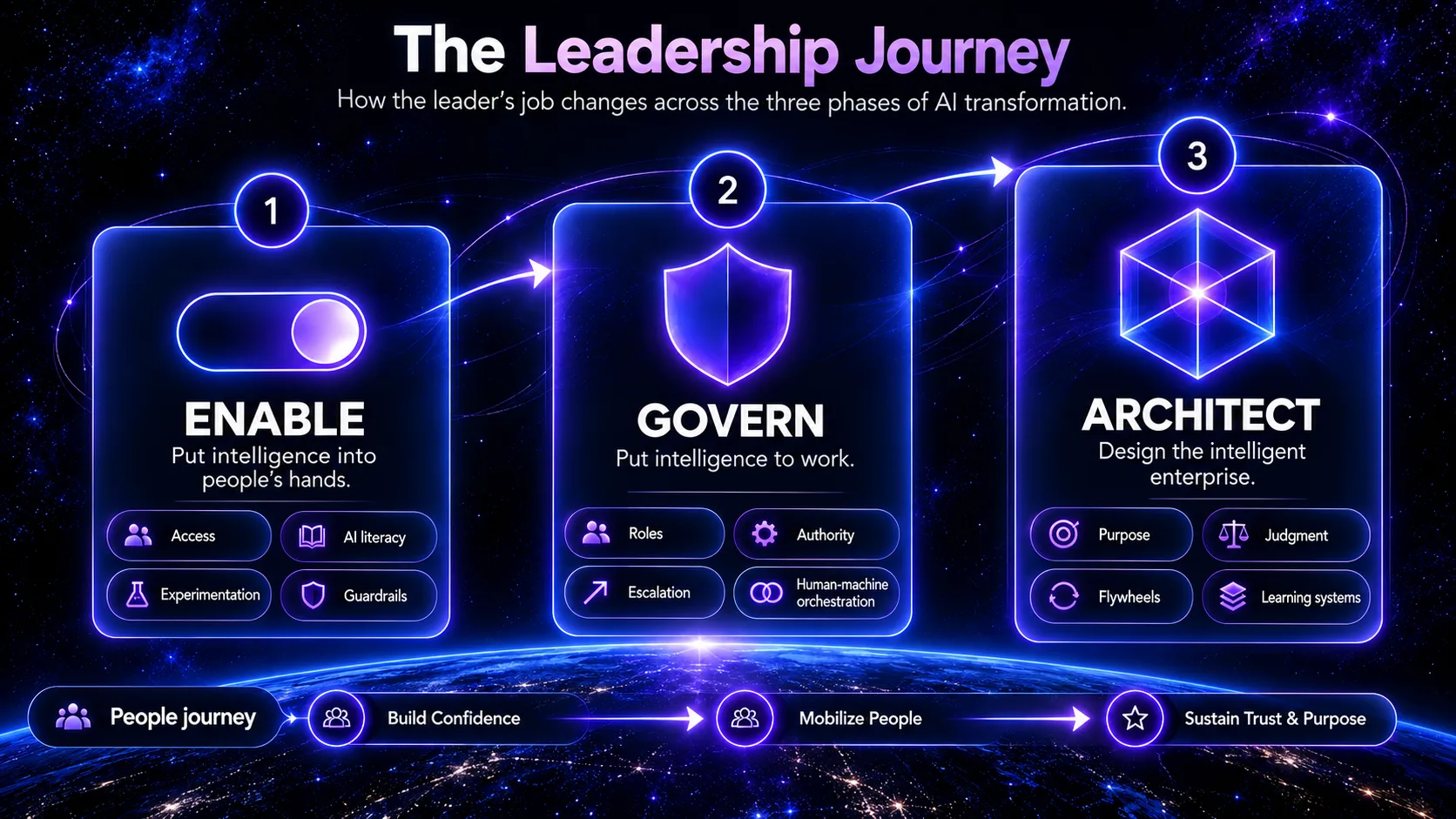
The Leadership Job Is Getting Bigger, Not Smaller
Leadership moves upstream
AI will take on more tasks, more decisions, and eventually more responsibility for operating parts of the company. That doesn't diminish leadership. It makes leadership more consequential because leaders increasingly shape the systems that shape everything else.
In Phase 1, leaders determine whether people are empowered to use intelligence.
In Phase 2, they decide how work, authority, and responsibility should be divided between people and machines.
In Phase 3, they architect culture, purpose, judgment, intelligence, and rapid learning loops that determine how the organization behaves and how quickly it improves.
The real transformation is the company itself
That's the larger arc behind AI transformation. We aren't simply adding better technology to today's company. We're progressively rebuilding the company around a new abundance of intelligence.
The organizations that recognize this early can start building the capabilities they'll need before everyone else realizes they matter. And that's where the next generation of competitive advantage will come from.
Steve