
Seven emerging workloads could fuel unprecedented demand for AI compute. Here's why business leaders need to prepare now.
Years ago, I was the proud owner of an Intel386 PC tower with 32MB of memory, and I thought I was the bees’ knees. It was a beast of a machine, and I remember thinking I had all the compute power I’d need for years to come.
Of course, I was right, but only for the things I could imagine doing at the time.
I wasn’t imagining the things I’d want to do with computers in the future: streaming movies, playing Fortnight, navigating a city with live traffic, editing 4K video, or wearing a portable computer to monitor my health. Incidentally, did you know that the first Apple Watch has more compute power than a room-sized, liquid-cooled Cray 2 Supercomputer from the late 1980s? Well, it does. About twice as much.
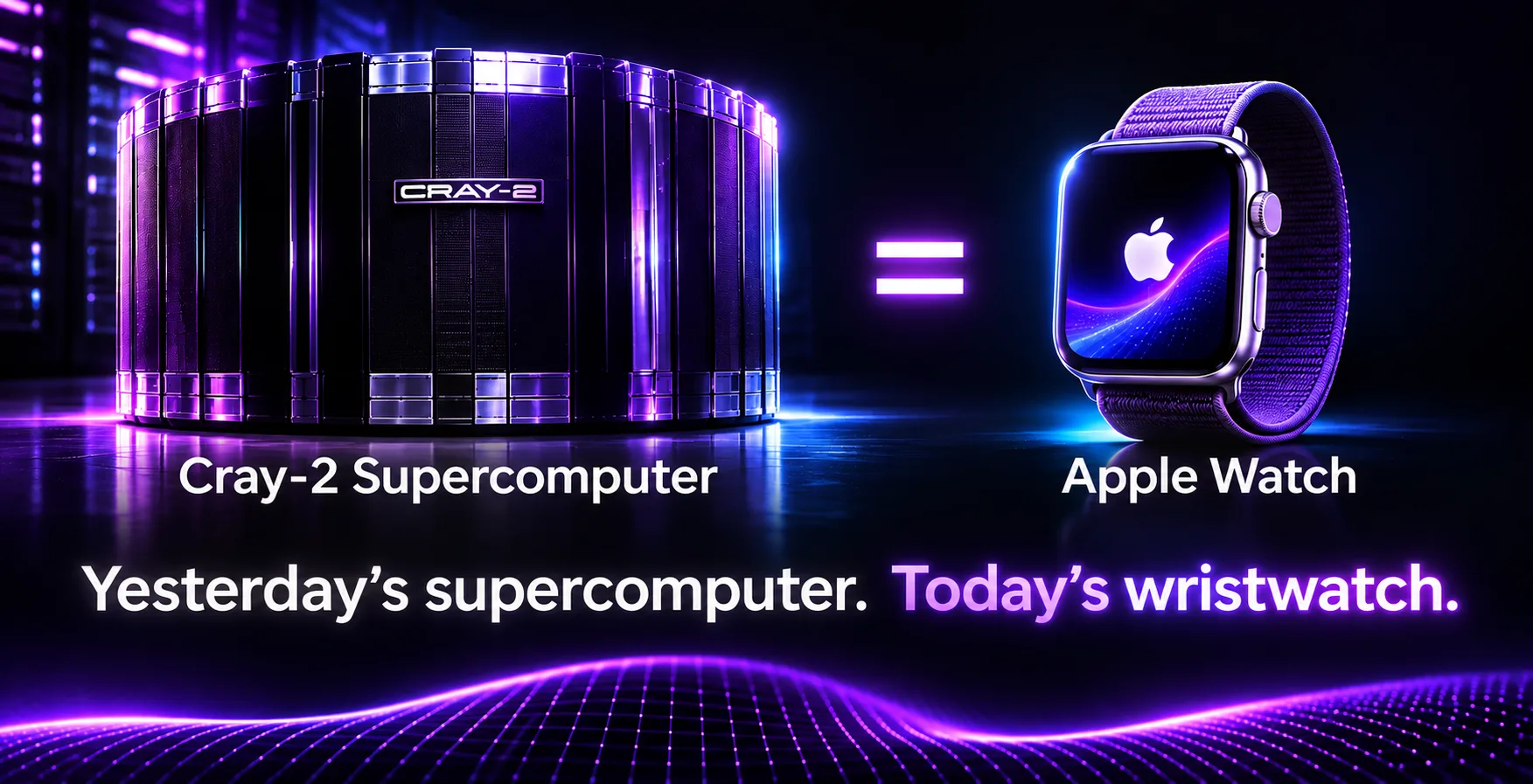
Moore’s Law applies to intelligence, too
Why am I dwelling on the glory days of Moore’s Law? As Moore’s Law made computing cheaper and more capable, we found new uses for it, and those uses became things we couldn’t imagine living without.
We never reached a comfortable level of computing and declared ourselves done because our ambitions grew with the capabilities computers gained.
This same experience is about to repeat with intelligence. We aren’t ever going to have enough of it. It’s why I’m highly confident that the tech industry will strike deals with Democratic governors, Native American nations, and municipalities to build AI data centers that significantly benefit the communities that host them.
I’m also highly skeptical of arguments that falling token prices mean we’re building far too much AI infrastructure. That perspective underestimates just how much work we’ll give to AI as 1) it becomes capable enough to do it and 2) as prices fall exponentially.
For business leaders, there’s a very practical consequence: the intelligence your business strategy depends on may become affordable long before the computing capacity needed to deliver it becomes available. Organizations must plan for that gap. Leader must ensure they have enough computing oomph (either on-prem at the edge or in the cloud) to follow the Three Phases of AI Transformation at a pace that leaves their competition behind. Failure to build enough local compute capability or to attain sufficient capacity commitments from hyperscalers could leave you high and dry. The rest of this post explains why, and to give you a sneak peek: you won’t only be competing with other enterprises for capacity.
Falling prices aren’t the same as failing economics
First of all, let’s dispel this silly notion that falling token prices fundamentally make the AI industry unsustainable. The price of a token is what the customer pays. The cost is what the provider spends producing it. Both can fall. Better hardware, algorithms, and serving software constantly reduce production costs; pruning, distillation, and quantization make models more economical to run. NVIDIA reports up to ten times lower token costs with Vera Rubin than Blackwell for inference. If production costs fall faster than prices, producer margins can improve even as customers pay less. Profitability still depends on volume, utilization, and recovering investment, but a falling selling price alone tells us remarkably little. The computing industry has spent decades selling more capability for less money.
Abundance changes what’s worth attempting
A service that costs $100 per customer might be reserved for VIPs. But at ten cents, everybody gets it. At one cent, perhaps that service now runs continuously.
That’s the mechanism behind Jevons paradox: efficiency stimulates enough additional consumption to outweigh the savings per use. In the case of AI, cheaper intelligence not only makes more work affordable, expanding consumption, but better intelligence makes entirely new work possible, expanding it further.
With cheap, capable AI, a company might go from testing ten product concepts to exploring ten thousand or a service business might give every customer the attention once reserved for its largest account.
Put simply: Like on my 386 PC, today's workload is a poor measure of tomorrow's appetite.
From one answer to an army of agents
The amount of computing consumed by AI is about to skyrocket. Early chatbots generated an answer to a query and stopped. Newer reasoning models spend additional tokens thinking through a problem. Agents repeatedly call models, reason, use tools, inspect results, and try again. A swarm of agents coordinates the efforts of many agents working toward a larger outcome. Each step up this ladder uses more tokens and more compute capacity:
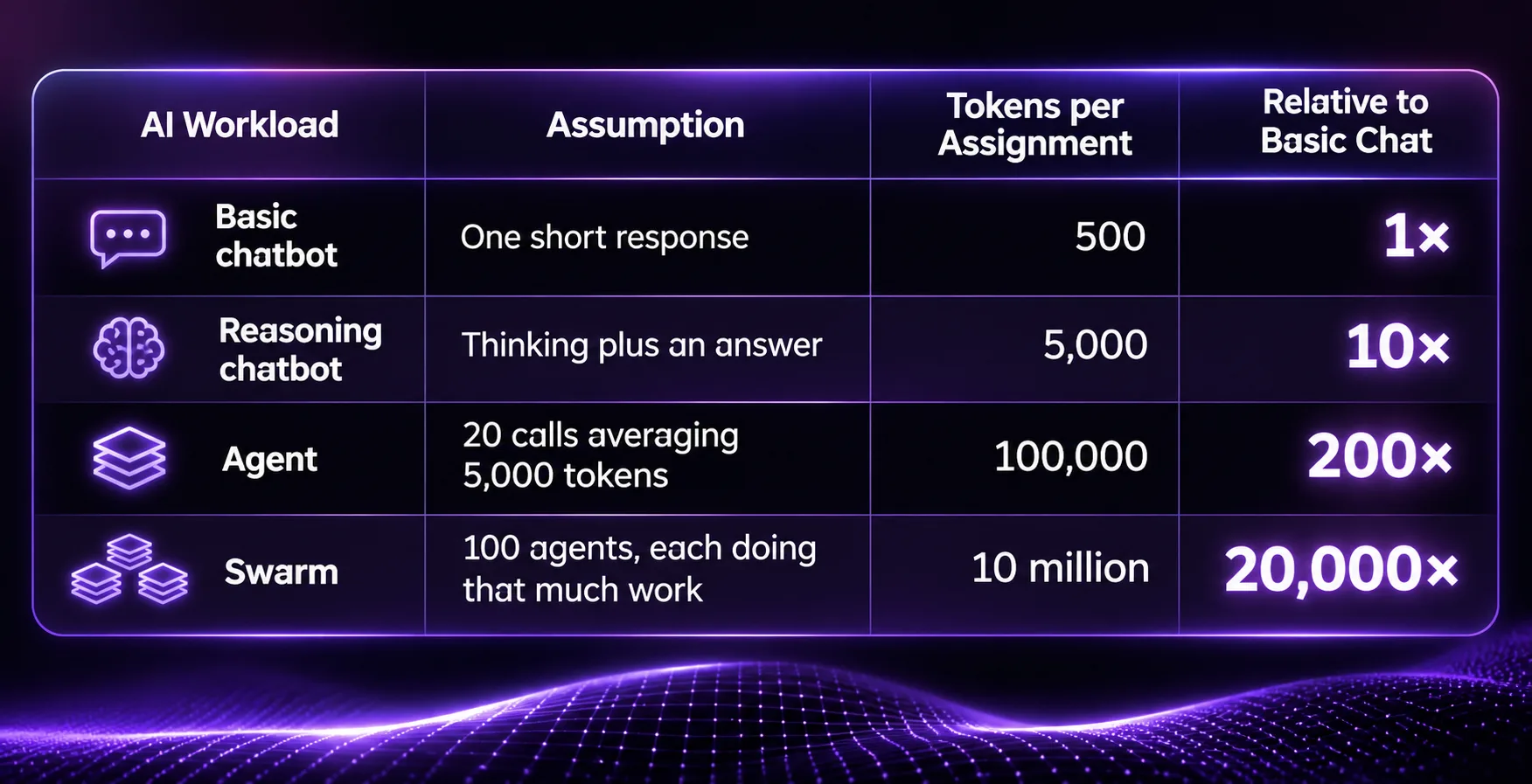
The arithmetic is fairly straightforward: 10 × 20 × 100 = 20,000 times more tokens consumed by an agent swarm than a basic chatbot. Of course, these aren’t universal averages, but they’re plausible token budgets for these progressively larger assignments.
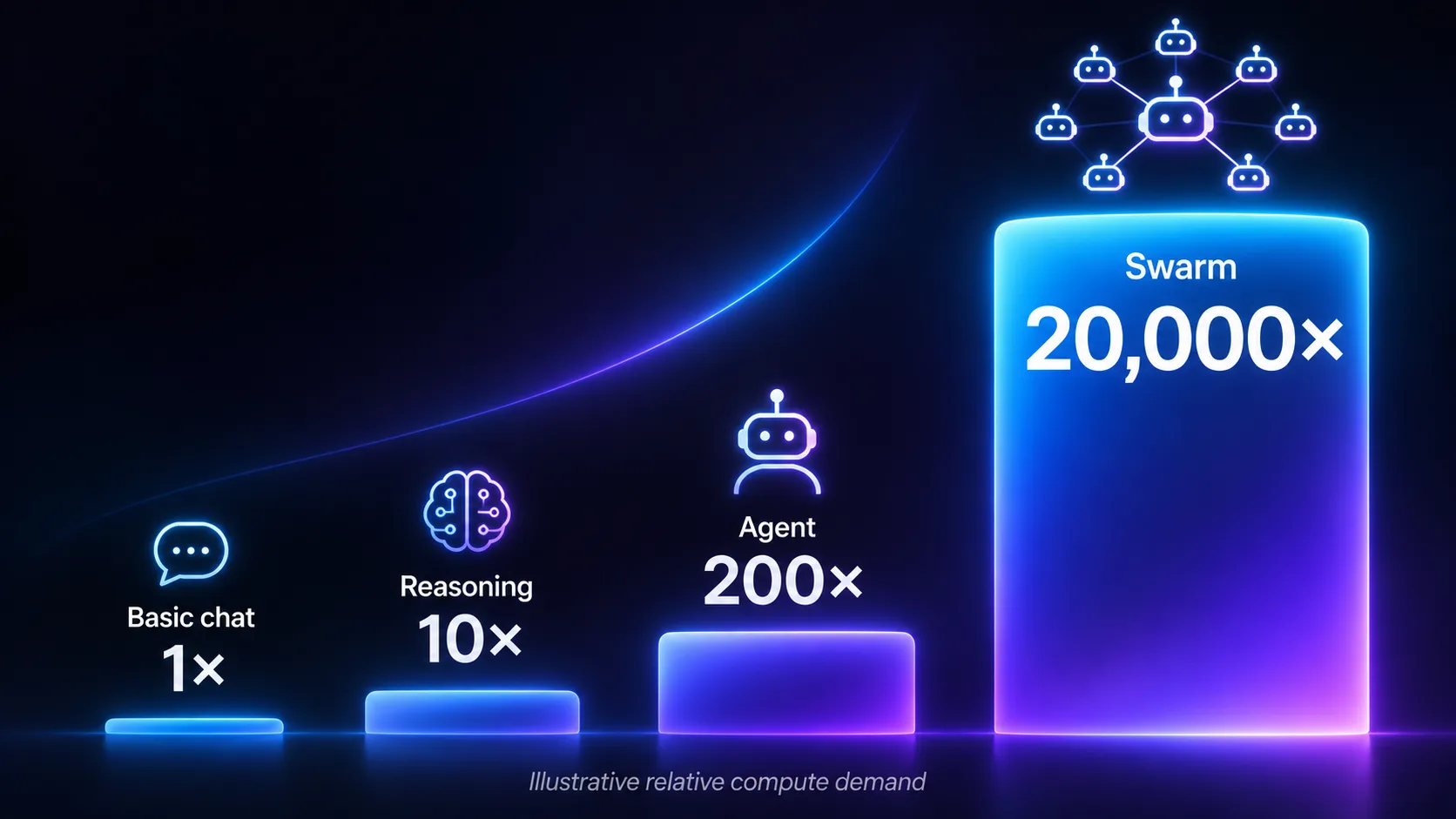
Artificial Analysis reported that reasoning models use up to ten times the output tokens of non-reasoning models. The agent and swarm steps are rough assumptions baed on what I’m hearing from clients. A hundred agents merely dividing a fixed task wouldn’t automatically multiply consumption a hundredfold. But a hundred agents each exploring a different design, investigating a fresh research avenue, or modernizing a software component certainly could. And input processing and tool execution add further computing beyond this table, mostly on the CPU side of the equation.
The agent swarm could become the everyday unit of intelligence
What we learn from the past of computing is that yesterday’s extravagance often becomes tomorrow’s ordinary application. We routinely devote computing resources to entertainment and convenience that a generation ago was only available to major institutions.
I fully expect a similar progression with AI. For substantial work, the familiar unit of intelligence may become a coordinated swarm, assembled autonomously behind a simple request. We’ll commission outcomes, and software will organize the team required to deliver them. Small tasks will still use small models and a few agents. Bigger ambitions will summon bigger teams.
If just one assignment in a thousand used 20,000 times the tokens, while all the others remained basic chats, average token consumption would rise about 21-fold. More users and more assignments per user multiply that further. I’m throwing out these numbers to illustrate my point that as the cost of intelligence falls and agents become the norm, we might think nothing of spawning a thousand agents to research a future vacation, to find that perfect dress, or to optimize our insurance payments.
But we haven’t even started getting to the new uses of intelligence.
The work waiting for abundant intelligence
I believe demand for intelligence will grow dramatically through the 2030s, supporting a sustained buildout of data centers, networks, semiconductors, and power infrastructure. Of course, financing mistakes and local overcapacity remains possible (though intelligence is fungible, so a token generated in Texas might be consumed in Tokyo, making the notion of local capacity essentially moot). But forecasting demand from today’s chatbot habits feels rather like forecasting the digital economy from my trusty 386.
Think about all the work that becomes worthwhile as intelligence proliferates. Some of these workloads listed below will consume language-model tokens; some will combine agents with specialized prediction, simulation, audio, and video models. All of these uses of intelligence will certainly expand the total market for computation.
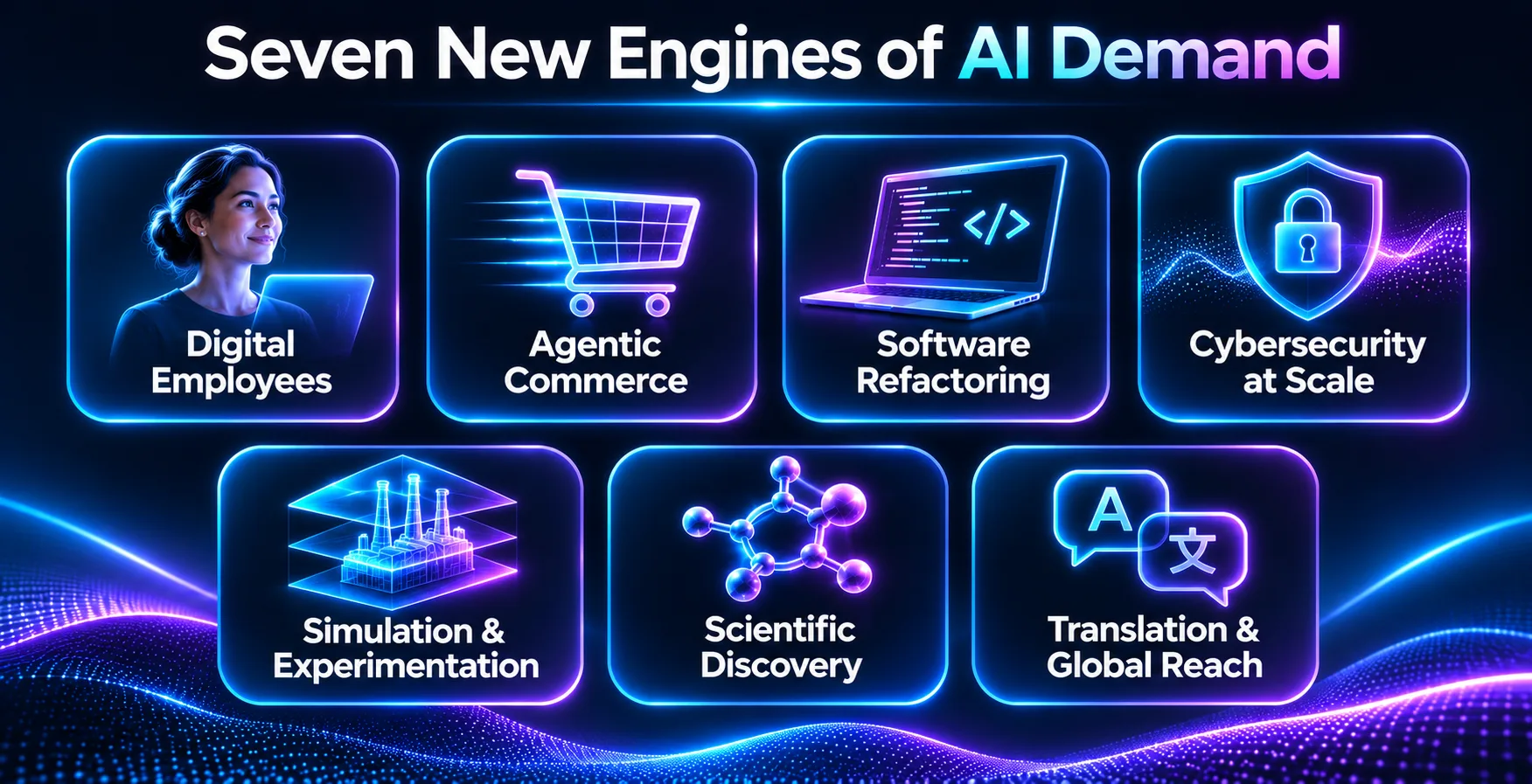
1. Digital employees at scale
As businesses progress through the Three Phases of AI Transformation, digital employees will handle increasingly substantial work across finance, procurement, service, and operations. Some will run in the cloud; others will operate closer to the business, at the edge. Every customer can receive near-constant attention, every supplier can be monitored, and every small discrepancy can be investigated. Work we currently ignore becomes economical to perform. Booking Holdings, the owners of Booking.com, OpenTable, Kayak, Priceline, and other similar companies recently launched Vayo, a 24-7 conversational AI travel agent that monitors your travel plans for changes (cancellations, broken connections, restaurant availability opening up, ticket price drops etc) and takes action for you. You couldn’t offer that service economically using human labor, but with digital employees, you can.
2. Agentic commerce throughout the supply network
Digital commerce is about to become a Moroccan bazaar of haggling merchants (thanks to Jon Stine for that great metaphor!) Buying agents will compare thousands of products, assess terms, and negotiate, fueling an arms race that sellers and brands have no choice but to respond to. Sellers will deploy AI agents to actively promote key selling points to buying agents, compete for purchases, and protect margins.

Behind every consumer purchase is a huge network of buys and sells throughout the supply chain, all the way back to raw materials extraction. So behind a single consumer–retailer relationship you might have five upstream supplier relationships, and another 25 one tier further back, with hundreds beyond that, creating myriad buyer–seller pairs. I expect procurement, replenishment, pricing, and logistics across every supply network to become ongoing agentic workloads. That transition is already underway and will continue through the end of the decade, transforming shopping forever and triggering an eCommerce agentic arms race that creates huge addition compute demand.
3. Refactoring the world’s software
Cisco has set a goal of refactoring 98% of its legacy code within 24 months using AI. I expect other companies to pursue similarly ambitious modernization. ERP systems, CRMs, operating systems, and networking software contain decades of accumulated compromises. Some companies still use pieces of legacy software for which source code has long been lost. They keep it going because it works and they don’t want to mess with it. Agents are now smart enough to tackle rewriting, testing, security checks, and compatibility. And the backlog is enormous. Almost weekly stories of massive cyberattacks like those at Binance pile on the pressure and tell us this is an urgent issue facing every software company. This effort will use up many swarms of many thousands of agents.
4. Cybersecurity at machine speed
The other obvious arms race where AI becomes both weapon and defender is cybersecurity. Anthropic already reported an AI-orchestrated espionage campaign and the frontier labs are already creating cyber flavors of their models aimed at cyber defence. Attackers are busy building their AI arsenals too, to automate reconnaissance and exploitation. Defenders will automate investigation, testing, patching, and response. As each side improves, the other must adapt, which creates persistent demand for intelligence simply to keep businesses functioning.
5. Simulation at a scale we couldn’t previously afford
Tastry describes using digital twins of products and consumers to evaluate millions of candidate formulations in minutes. Their approach offers a glimpse of how digital experimentation frees business from the cost of making many expensive physical samples. If we extend the principle to factory layouts, synthetic customers, simulated markets, robot training, product development, and scientific exploration, the opportunity to transform the economics of experimentation becomes clear.
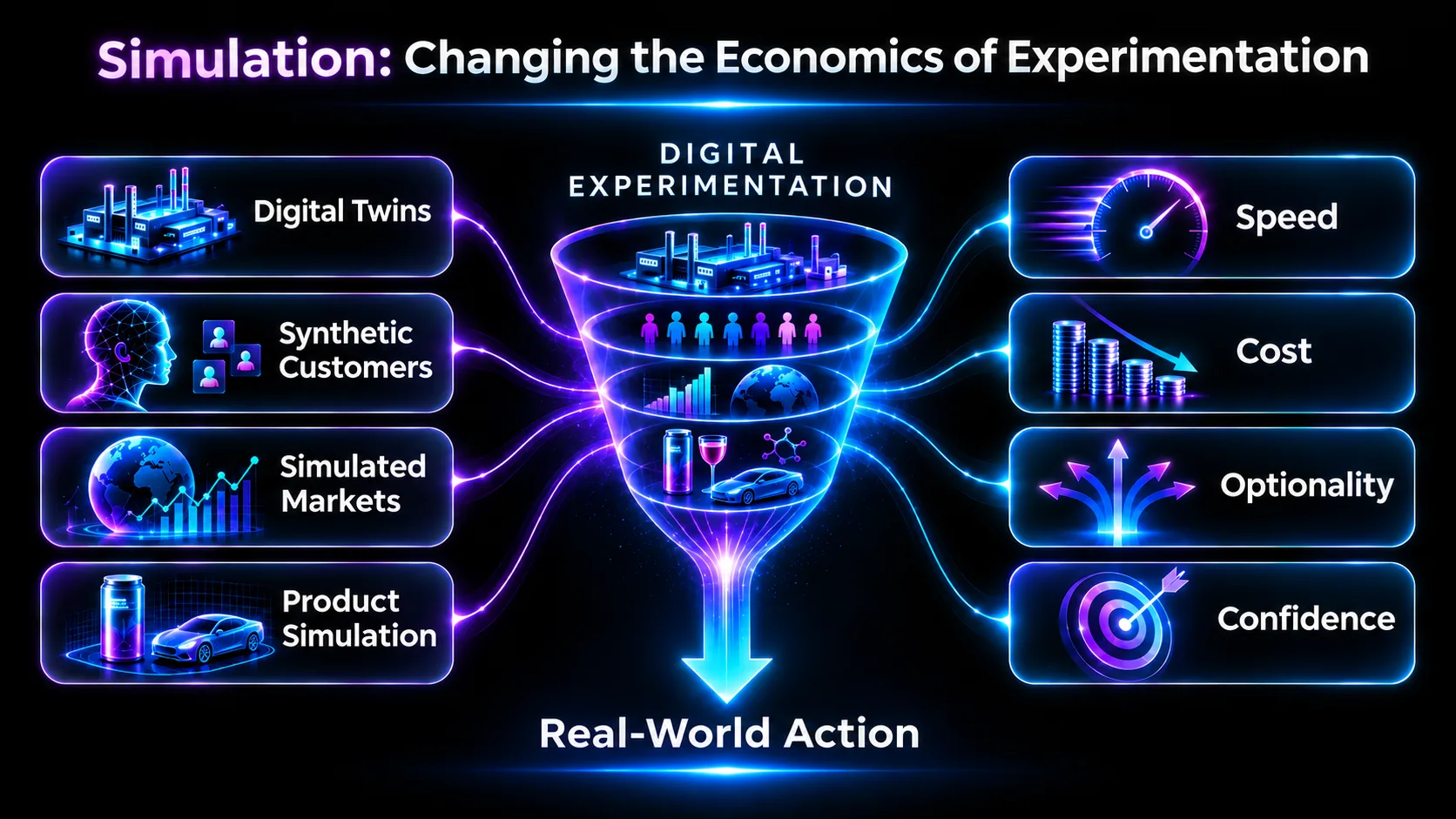
For businesses, the value of AI simulation goes beyond lowering the cost of experimentation. It also increases time to market, expands optionality, and provides greater confidence before committing resources. For example, Tastry’s technology means beverage companies know with high confidence that a new formulation will be a winner before they convene their first taste test. Physical validation still matters, of course, but with AI simulation far more great ideas will reach the starting line.
6. A fast-forward button for scientific discovery
We have no shortage of unanswered questions; we’ve had a shortage of capacity to investigate them. AI changes that. OpenAI’s recent adventure in mathematics demonstrated how swarms of agents can push the boundaries of human understanding, solving 722 open math challenges for about $100 million of compute time. Google’s AI co-scientist uses multiple agents to generate, debate, and refine hypotheses. And LILA claims they are building scientific superintelligence, powerful AI combined with autonomous labs (think agents and robots) to generate and test new hypotheses. AI is ushering in a new golden age of scientific discovery.
I expect huge teams of AI agents to attack problems across mathematics, physics, chemistry, material science, engineering, biology, and medicine, exploring new approaches, checking results, and discovery new science. The breakthroughs we gain, particularly if we can discover new physics, will justify enormous computing resources. Beyond that, the emerging longevity industry might ultimately become the second biggest industrial sector (second to humanoid robotics) within a decade or two. Think what people might be willing to pay to add an extra ten or twenty healthy, active years to their lives?
7. An internet that speaks your language
Most of the internet is still in English, yet only about 5% of the global population speaks it natively as their first language. Imagine every article, manual, course, and conversation available in everyone’s native language. Movies and shows arrive with natural voices and fully synchronized lip movements. Humor, context, and meaning survive the journey. Perfect translation still remains an ambition, but increasingly capable AI will bring it closer. Live conversations, new content, and personalized experiences will create continuing wor and much of the world’s knowledge and entertainment will become accessible to audiences it never reached before.
My 386 felt powerful because my imagination was still sized to the work I already knew. Leaders must be careful not to make the same mistake with intelligence. As its cost falls, we’ll keep discovering more things worth asking it to do. In this example, as the cost of translation falls towards zero, everyone will want, no expect content in their native language.
The net-net
The net net of just these seven sources of demand for AI compute (and there will be many more not listed here) is that even with the obscene amounts of money being committed to AI capital projects, we still won’t have enough AI infrastructure to meet demand for at least a decade to come, likely longer.
Build an AI compute capacity plan
What does this all mean for leaders?
As labor becomes digital, workforce planning increasingly becomes capital planning.
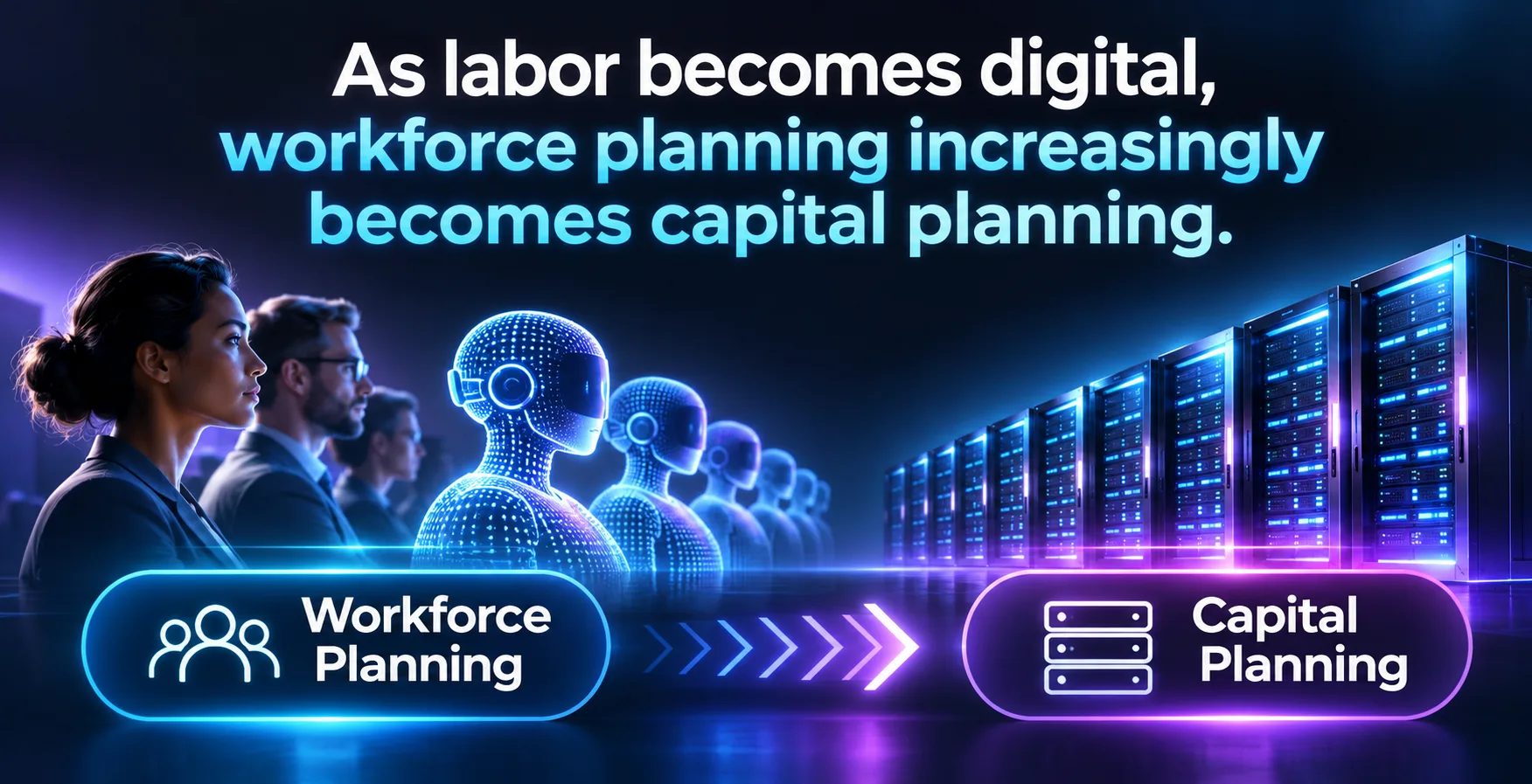
If the demand for intelligence continues to outpace supply, access to computing capacity becomes a strategic concern. Leaders should develop a rolling, multiyear AI compute capacity plan based on the business they intend to build: digital employees operating across functions, agentic teams handling complex assignments, and simulation becoming part of everyday decision-making. Translate those ambitions into capacity scenarios, then negotiate access with suppliers across cloud services, on-premises systems, and edge devices. Secure commitments where availability matters, while retaining flexibility as technology improves. Balance cloud and edge computing to meet privacy and latency needs. For example, local AI systems such as NVIDIA’s DGX Spark are built to support agents closer to your people and data.
The greatest corporate tragedies I foresee in the coming few years are that great brands with great business plans, great leadership, and great employees get crushed by inferior competitors with greater foresight in capital planning.
As a leader, your mega goal here is to ensure that your ability to deploy intelligence keeps pace with your projected ambition to use it.
Let me know how I can help.
Steve