
For the last three years, business leaders have been promised extraordinary returns from artificial intelligence. AI would transform productivity, slash costs, reinvent customer service, accelerate innovation, and eventually create armies of digital workers capable of taking on entire workflows.
Then reality arrived.
Early AI Wasn’t All Rainbows and Unicorns
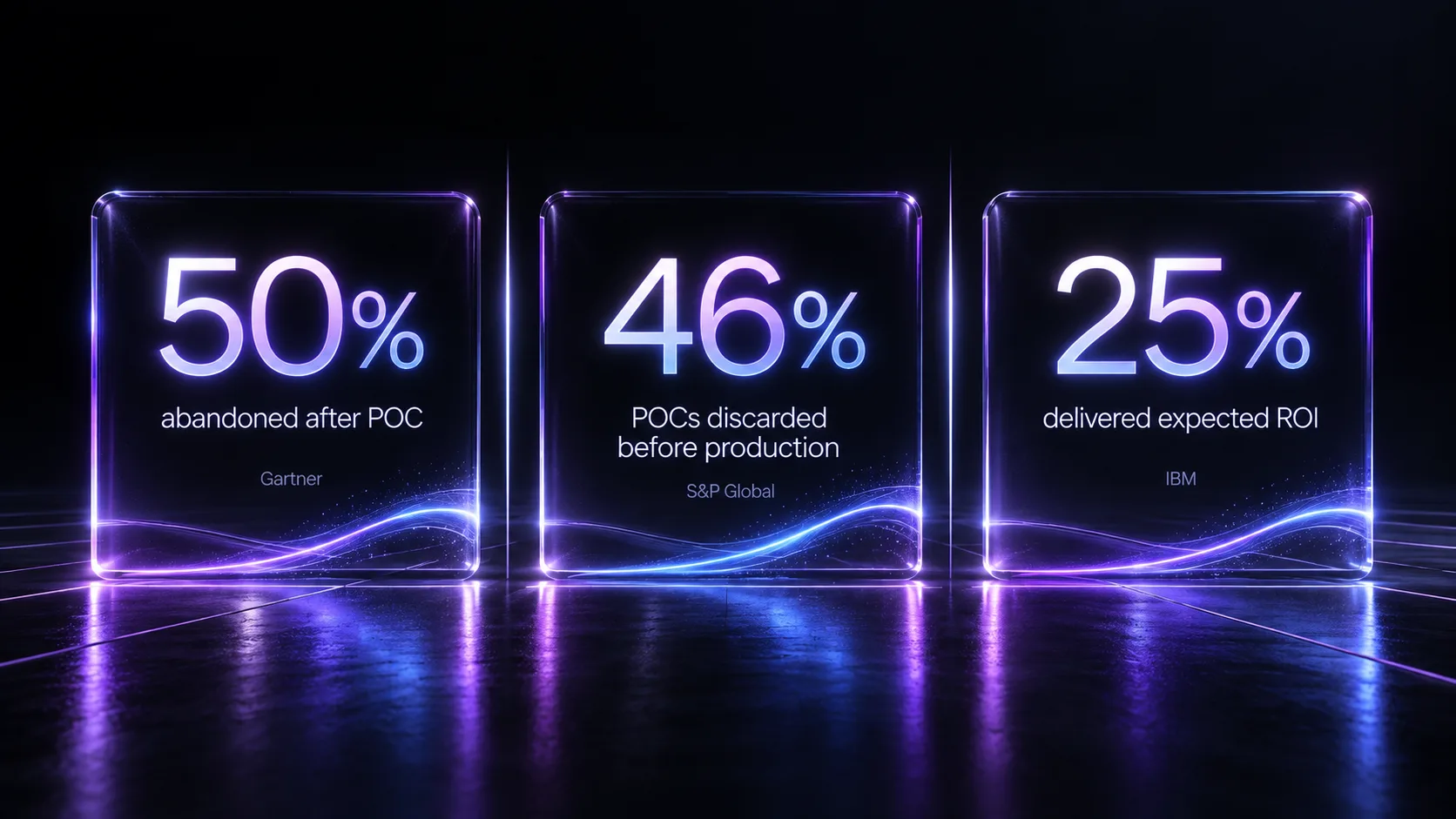
By the end of 2025, there was oodles of evidence that many enterprise AI deployments had failed to generate returns leaders expected. Gartner reported that at least 50% of generative AI projects had been abandoned after proof of concept, citing poor data quality, inadequate risk controls, escalating costs, and unclear business value.
S&P Global found that the percentage of organizations abandoning a majority of their AI initiatives had risen from 17% to 42%, while the average organization discarded 46% of its AI proof-of-concept projects before production.
IBM's 2025 survey of 2,000 CEOs produced a similar picture: only 25% of AI initiatives had delivered their expected ROI, while just 16% had scaled across the enterprise.
Then came the number guaranteed to launch a thousand LinkedIn posts: a preliminary MIT Project NANDA study reported that only around 5% of integrated enterprise Generative AI pilots were producing marked, sustained productivity or P&L impact. You should treat the resulting “95% failure rate” headline with care because the study used a demanding definition of success and described its findings as preliminary, but…the broader conclusion that the first wave of enterprise AI produced enormous experimentation while yielding much less transformation is hard to dispute.
That doesn’t mean AI failed. In the process, we learned what actually stands between a compelling demonstration and real business value. And it sets the stage for true value creation in 2027 and beyond.
Why the first wave underperformed, and what we can learn
The disappointing results came from several problems arriving all at once. Some were caused by immature technology. Others came from the organizations trying to deploy it. In many cases, AI didn’t create underlying weakness so much as expose it.
The technology simply wasn't ready
Early models hallucinated, lost context, struggled with longer tasks, and were unreliable for workflows involving exceptions or judgment. Agents looked impressive in controlled demonstrations but became considerably less impressive when asked to navigate messy business processes, access fragmented information, and interact reliably with enterprise systems.
MIT researchers heard complaints about inconsistent output quality, limited memory, poor user experiences, and systems that didn’t adapt well to real workflows.
Conclusion: A deployment failing in 2024 or 2025 might simply be because it was attempted before the technology was capable enough to support it. AI capabilities have improved significantly during 2026. Things that barely worked in January now amaze. And models still inside the walls of frontier labs are by all accounts incredible. So the tech is ready.

We focused on the technology not the value
The first AI boom encouraged experimentation for experimentation's sake. Companies launched pilots because boards demanded to know what they were doing with AI, executives wanted something tangible to demonstrate, and innovation teams suddenly had access to technology capable of producing impressive prototypes quickly.
The result was a portfolio of disconnected experiments rather than a focused search for measurable value. Teams took on too much, hoping that at least one dart would hit a bullseye (or even the dartboard). BCG found that leading companies pursued an average of 3.5 AI use cases, compared with around 6.5 for less successful companies. Many organizations failed to track the financial KPIs needed to determine whether those projects were worthwhile at all. A pilot shouldn’t exist simply to prove that AI works.
The lesson: The purpose of a pilot is to prove that AI can create enough measurable value in a specific part of the business to justify changing how that business operates.
Our data house wasn’t in order
AI exposed something companies have long known, ignored, rediscovered, formed committees about, and ignored again for decades: our data is often a mess.
KPMG found that 85% of executives expected organizational data quality to be their biggest challenge to implementing AI strategy in 2025. IBM found that 72% of CEOs considered proprietary data essential to unlocking generative AI value, while 68% regarded an integrated enterprise data architecture as critical.
As AI moves from helping people to performing work itself, data quality matters more than ever. A chatbot can survive incomplete information because a human can fill in the gaps, but a team of autonomous agents responsible for inventory, customer service, procurement, finance, or operations have much less room for improvisation if the information they need is scattered across incompatible systems, shared drives, somebody's laptop, and an Excel file called FINAL_v7_REALLY_FINAL.xlsx.
Conclusion: There’s a reason that Garbage In, Garbage Out has survived as a tech cliché for more than 50 years. Thankfully multi-year projects to clean, organize, and connect data has prepared most enterprises for AI deployments in ’27 and ’28.
We bolted AI onto workflows designed for humans
Perhaps the most important lesson is that inserting AI into an existing process is not the same thing as redesigning the process around AI.
McKinsey's 2025 global AI survey found that workflow redesign had the strongest relationship with EBIT impact from generative AI, yet only 21% of organizations using Generative AI had fundamentally redesigned at least some workflows.
Many business processes were created around constraints that AI is beginning to remove. Information moved slowly, expertise was scarce, analysis was expensive, and people could only process so much work. Layers of handoffs, approvals, queues, reports, meetings, and administrative tasks accumulated around those constraints.
Dropping AI into the middle of that machinery may improve productivity, but it leaves the machinery intact.
As I argued in Your Biggest AI Competitor Doesn't Exist…Yet, the greater opportunity is not simply to automate yesterday's company, but to ask what kind of company becomes possible when intelligence itself becomes abundant.
We underestimated the human transformation
AI transformation is organizational transformation, and organizational transformation involves people.
BCG found that only roughly one-third of employees believed they’d received adequate AI training, while regular usage increased substantially among employees receiving at least five hours of training combined with coaching.
Giving everyone an AI assistant is easy. Changing how hundreds or thousands of people work is not. Employees must understand what AI systems can do, where they remain unreliable, which work can be delegated, how their roles will change, and what good performance looks like when humans and machines increasingly work together.
Conclusion: Five thousand software licenses don’t constitute transformation any more than buying five thousand treadmills makes a company fit. Invest in building AI acumen from the boardroom to the breakroom.
Why the next wave should perform better
Now, to the better news. The encouraging part of this story is that several of the constraints that undermined early deployments are improving simultaneously. Models are getting significantly better (and cheaper to use over time for any given level of intelligence), agents are becoming more capable, the infrastructure around them is maturing, integration is getting easier, and organizations are learning from expensive early experiments.
Models are getting considerably more capable
Stanford's 2026 AI Index illustrates the pace of improvement. Performance on OSWorld, which measures the ability of AI agents to operate computers and complete realistic tasks, increased from roughly 12% to 66.3%. Frontier models also gained around 30 percentage points in a year on Humanity's Last Exam, while capabilities continue to improve across reasoning, coding, mathematics, multimodal understanding, and professional tasks.
These systems are still imperfect. Agents continue to fail tasks, and Stanford describes frontier AI as exhibiting “jagged intelligence”: highly capable in some areas while still making basic mistakes in others.
But the trajectory is clear. The AI available to an organization in 2027 will not be the same technology that disappointed it during a pilot back in 2024, or even early 2026.
Agents are moving closer to the work
The nature of AI is changing, too. AI Transformation is rolling out in three phases. The first generation of enterprise generative AI was dominated by copilots that helped people write, summarize, search, and analyze. The next generation is increasingly about agents that can plan tasks, use tools, interact with software, maintain context, and take actions across multiple steps.
Economic value increases as AI moves closer to the work itself. Saving somebody ten minutes writing an email is useful. Handling an entire workflow, escalating the exceptions, and repeating the process thousands of times at machine speed is much more significant.
That’s why the progression from AI as a tool, to AI as a worker, and eventually to AI as part of the organization's operating system is so important. The biggest gains aren’t likely to come from making every existing employee slightly faster. They’ll come from redesigning how work happens when intelligence is deployed as labor. As agent harnesses and agentic security improve, expect to see dramatic improvement in agent capability and reliability in 2027.
The plumbing is improving too
The infrastructure around AI is becoming easier to work with. Historically, connecting intelligent systems to enterprise software, databases, knowledge repositories, and internal tools required bespoke integration and was a pain in the butt. The emergence, maturation, and broad adoption of the Model Context Protocol (MCP) began as an Anthropic initiative in late 2024 and has rapidly become an industry standard. By early 2026, MCP was already supported across major AI platforms including ChatGPT, Claude, Gemini, Microsoft Copilot, Cursor and Visual Studio Code, while enterprise platforms including Salesforce, ServiceNow, Snowflake, and Atlassian have since added MCP support of their own. MCP won’t magically modernize a thirty-year-old ERP system, but it reduces the barrier to giving AI access to the systems where real work happens.
As I explored in The Anatomy of a Digital Employee, intelligence is only one component. Useful AI systems need tools, knowledge, memory, policies, permissions, organizational context, and mechanisms for evaluating their work. Those surrounding layers are now maturing alongside the models themselves.
The bottleneck is moving from technology to the organization
As AI capability improves, the critical path increasingly shifts toward the organization using it. The new challenge isn’t whether AI is capable enough. It’s now about whether the company is ready to put AI capability to work.
Data becomes infrastructure
Leading companies will benefit most from AI by making their proprietary information accessible, trusted, governed, and usable by intelligent systems. Data quality isn’t simply an IT hygiene issue. It’s now part of the infrastructure of an AI-enabled company.
Workflow design becomes strategy
Instead of asking where AI can be inserted into existing workflows, leaders must decide which workflows would look fundamentally different if intelligence were cheaper, faster, more abundant, and increasingly autonomous. That’s where the golden opportunities will be found.
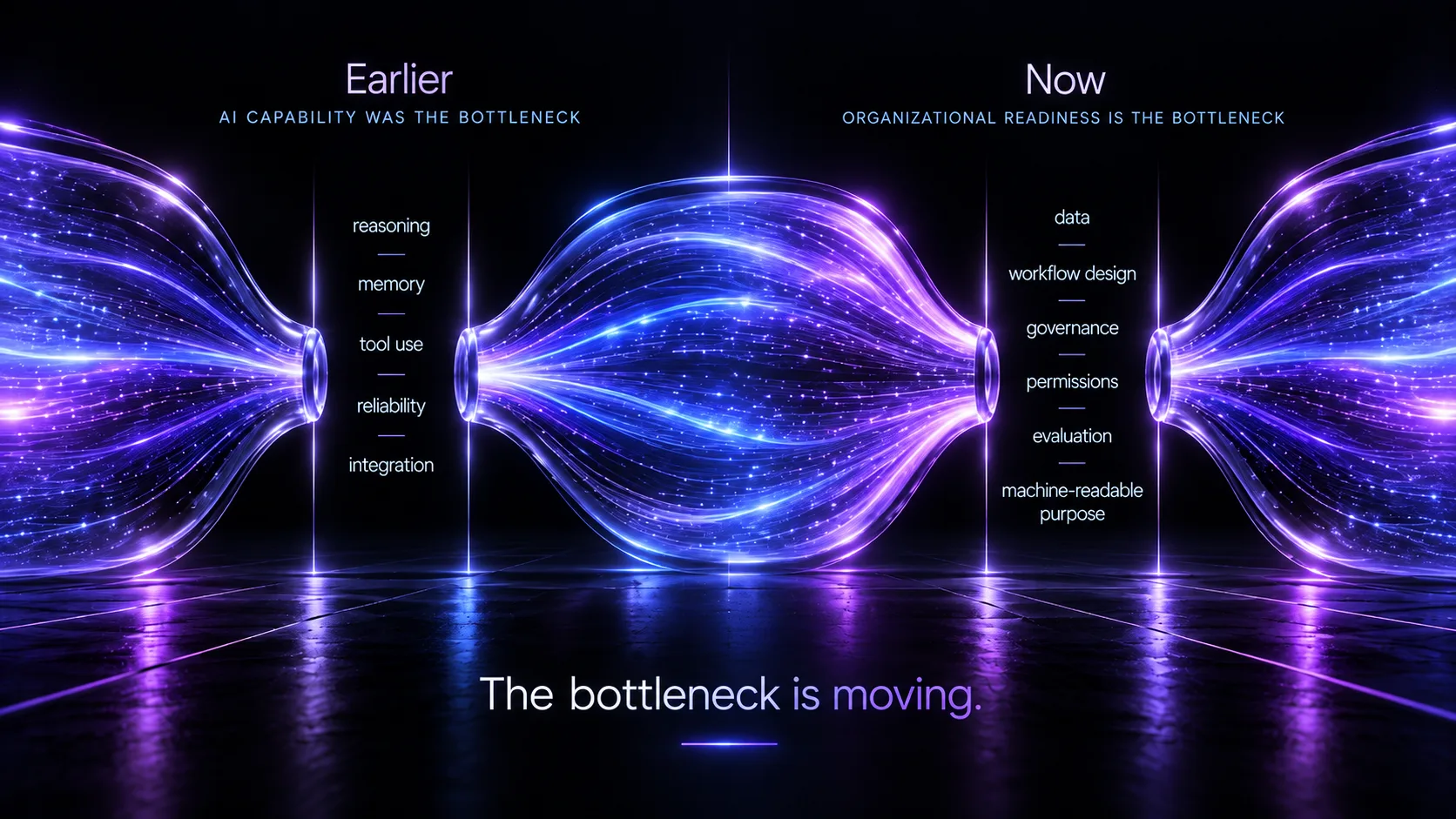
Governance becomes part of the operating system
As AI gains more agency, governance becomes critical. A copilot that recommends an action needs human guidance. But an agent that takes the action needs defined authority, permissions, escalation paths, auditability, and accountability. A digital employee taking thousands of actions in pursuit of an outcome needs something deeper still: an executable understanding of how the organization expects it to behave.
Corporate purpose, values, policies, codes of conduct, decision principles, authority structures, and standards of judgment therefore increasingly need to become machine-readable. These ideas can’t live only in PDFs, employee handbooks, leadership presentations, and posters on the office wall. Intelligent systems need to understand not only what they can do, but what the organization wants them to do, how they should do it, which boundaries they must respect, and when judgment should be escalated to a human. We must make culture machine-readable. More on that in a future post.
Better AI will create new failure modes
More capable AI changes the nature of the risk. Stanford's 2026 AI Index found that documented AI incidents increased from 233 in 2024 to 362 in 2025, even as capabilities advanced rapidly. The stories on hugging face and other agentic breakouts have filled the headlines for months now.
The next generation of failed AI deployments may therefore fail for very different reasons. They won’t fail because the AI lacks intelligence, but because we gave a highly capable system poor objectives, bad data, excessive permissions, weak evaluation, ambiguous policies, or incentives that caused it to do exactly what we asked instead of what we wanted. Thoughtful AI governance and AI infrastructure that enforces sandboxes, oversight, and rapid shutdown of rogue agents will be essential to managing risk. Nvidia is leading the way with their OpenShell runtime, Sentry security framework, and BlueField hardware isolation capabilities. And no, they didn’t pay me for that mention. They’re just the best example of what’s needed and are leading the way on agentic safety.
The good news: those expensive experiments weren’t wasted
It’s tempting to look at the disappointing returns from the first wave of enterprise AI and conclude that the technology was overhyped. Let’s be honest, the AI marketing people did have a field day, but…a more useful interpretation is that we tried to install the future inside systems designed for the past.
General-purpose technologies often evolve that way. Companies bought computers before redesigning office work around them, built websites before they understood digital business, and handed employees smartphones before rebuilding processes around ubiquitous connectivity. AI’s passing through the same stage, only faster.
The first wave of deployments exposed where foundations were weak: immature technology, poor data, fragmented systems, unchanged workflows, inadequate training, weak governance, too many pilots, and too little clarity about value. The path to better ROI is now much clearer, and the technology is now mature enough to deliver real business value. Here’s a short checklist to make sure your organization is on track:
- Start with measurable business outcomes rather than technology.
- Get your data house in order. Give your best data engineers a raise to retain vital talent.
- Concentrate investment on a smaller number of high-value opportunities.
- Redesign workflows instead of simply adding AI to them.
- Train people properly.
- Build architectures that take advantage of rapidly improving models and easier integration.
- Put evaluation, permissions, escalation, and governance in place before increasing AI autonomy.
- Make your organization's purpose, values, policies, and judgment understandable to machines.
AI technology is improving quickly; the companies most likely to succeed will be those that prepare their organizations to take full advantage of it. Hurry up and get ready.