
AI is changing how companies operate, how work gets done, and increasingly, what a company is. It stands to reason that AI will also change what we need from leaders.
Cast your mind back to 2015. Think about the skills we valued then in a great business leader: strategic planning, operational excellence, people management, delegation, analytical thinking, decision-making, communication, financial acumen, and change management. It's a solid list, and most of those skills are still vital today.
But those skills evolved in organizations built around a single, massive constraint: the scarcity of human intelligence.
When a company needed more analytical capacity, it hired analysts. More creative horsepower meant adding designers and marketers. More engineering capacity required more engineers. Leaders the skills needed to assemble teams, allocate scarce resources, divide up work, selectively outsource, monitor execution, and solve problems.
As intelligence itself becomes scalable and abundant, everything changes. Agents extend intelligence into action. Digital employees will take responsibility for increasingly complex areas of work. Robots bring near-unlimited intelligence to the physical world. As I explored in The Self-Improving Enterprise, companies are beginning to build systems in which data, models, agents, actions, and learning reinforce one another continuously.
When the fundamental architecture of a company changes, leadership needs to change with it.
From Managing Scarcity to Directing Abundance
Microsoft's research on the emerging "Frontier Firm" describes organizations built around human-agent teams and intelligence on demand, mirroring my model of the Three Phases of AI Transformation. The direction of travel is pretty clear. Leaders won't just manage people; they’ll increasingly orchestrate combinations of people, models, agents, digital employees, software, and robots.
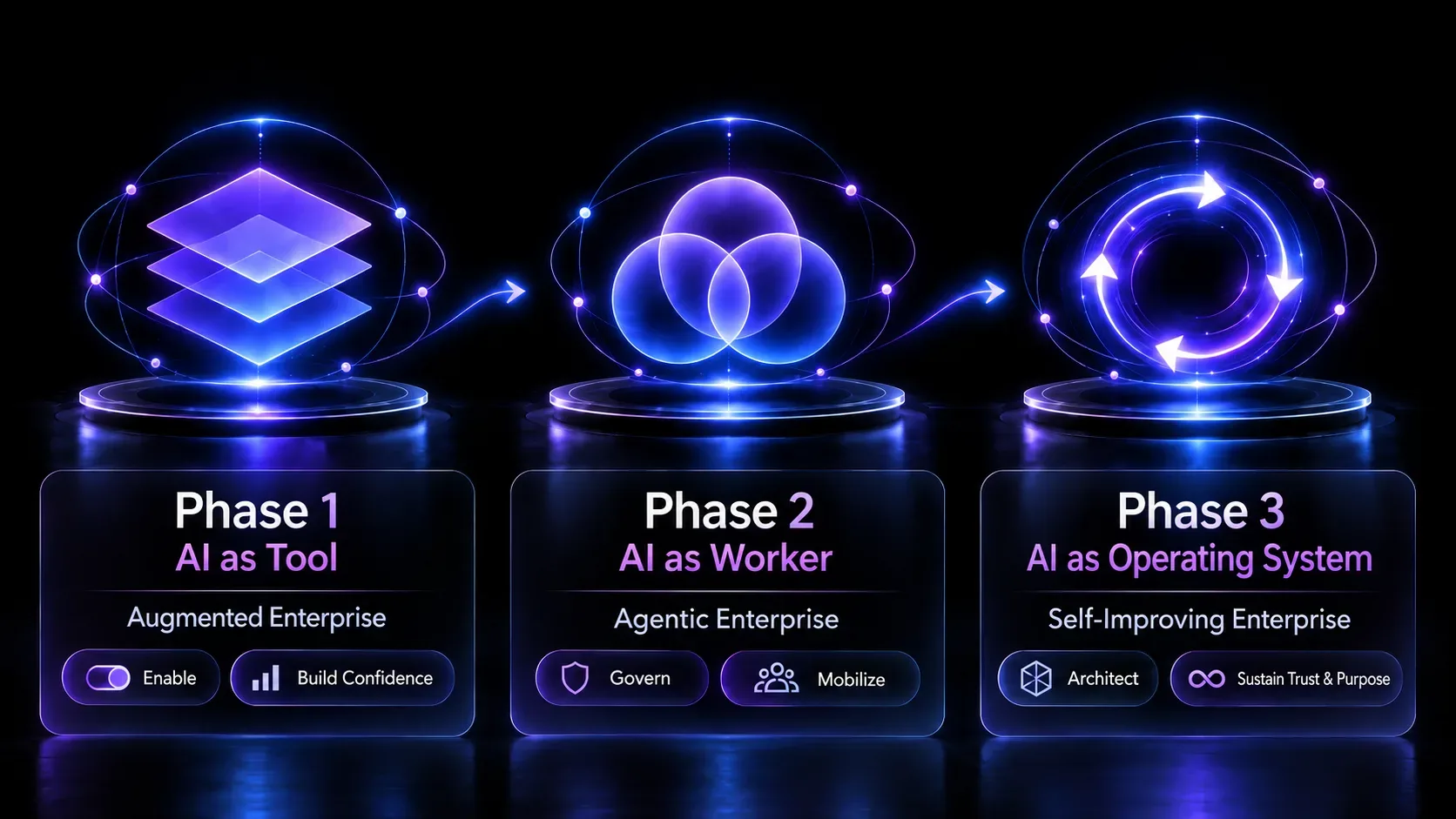
This shift changes the leadership skillset in three ways: Some familiar skills become less important, some skills become considerably more important, and some entirely new skills become essential to success. Here’s how you need to prepare yourself for what’s coming in 2027 and beyond.
What Becomes Less Important? ⬇️
Very few traditional leadership skills simply disappear. But several become less differentiating as machines take on more of the work leaders and managers used to perform themselves.
Operational coordination gets squeezed
Companies currently expend enormous amounts of human effort coordinating other humans: assigning tasks, collecting updates, tracking progress, routing information, producing reports, and escalating issues. How many status reports have you written in your life? I know I’ve spent hundreds of hours writing weekly and monthly status reports over my long career. Agents are particularly well-suited to absorbing this coordination overhead.
Delegation changes too. Leaders will increasingly decide what combination of human, agent, digital employee, automated workflow, or robot should own an outcome.
Analytical horsepower matters less
For decades, executives differentiated themselves partly through their ability to absorb information, analyze complicated situations, identify patterns, and recommend solutions.
AI’s getting good at exactly this kind of cognitive work. By 2030, having a senior executive spend hours manually grinding through information to produce a high-level analysis may make about as much sense as having the CFO do long division by hand.
The skill doesn't vanish, but its value moves upstream, as leaders shift to evaluating analysis, questioning assumptions, interpreting implications, and making the final call.
Traditional planning becomes more fluid
Strategy remains essential, but slow planning cycles make no sense when an organization continuously senses changes, simulates alternatives, acts, measures results, and adapts using a vast network of intelligence machines.
An AI-first company needs direction, but it also needs the ability to learn and adjust rapidly. So, the leadership skill shifts from creating a perfect plan to setting a clear destination and continuously steering toward it.
What Becomes More Important? ⬆️
As AI takes over more analysis and execution, several distinctly human leadership capabilities become even more valuable.
Judgment becomes vital and is the new scarce resource
If AI can generate 100 strategies, 1,000 product concepts, and dozens of possible responses to a competitor in minutes, generating options stops being the bottleneck. Instead, choosing wisely is.
Judgment combines experience, context, ethics, intuition, timing, and an understanding of consequences that may never be fully captured in the data. It allows a leader to recognize that something can be analytically correct but strategically foolish, financially attractive but harmful to the brand, or operationally efficient but terrible for customers. Judgment is about making the hard trade-offs and the right calls.
This is one of the central paradoxes of abundant intelligence: the more answers machines can generate, the more valuable sound human judgment becomes.
Culture and direction matter more - shifting from how to what and why
When execution is difficult, leaders spend much of their time worrying about how things get done. As machines take on more execution, leadership moves upstream toward deciding what should be done and why.
In this context, culture isn't about motivational slogans and posters on the wall espousing company values. I define culture simply as “how we do things around here.” Culture includes vision, mission, strategic goals, priorities, values, standards, constraints, and acceptable trade-offs.
A clear definition of culture becomes especially important as AI systems gain autonomy. A chatbot needs relatively little organizational guidance. A digital employee that can make decisions, interact with customers, spend money, or change a production schedule needs far more.
The more autonomy machines get, the clearer leaders must be about the outcomes they want and the boundaries within which machines can pursue them. Culture needs to become machine-readable.
Taste and discernment rise in value
When creation was expensive, companies were constrained by what they could produce. But when creation becomes cheap, they’re constrained by what they can recognize as good. A shift from creation to curation, if you like.
Thus taste becomes a much more important business skill than it sounds. Leaders need a clear view of what a great product, customer experience, strategy, design, decision, or piece of communication looks like. Increasingly, they’ll also need to make those standards explicit enough for machines to work against them.
AI can generate. Humans still need to know what great looks like.
Human leadership still matters
This is probably an obvious one. Communication, trust, empathy, courage, and the ability to inspire people aren't going anywhere. In fact, they matter even more during a period in which jobs, organizational structures, and career paths are changing and uncertainty runs high. The World Economic Forum's Future of Jobs Report continues to rank leadership, social influence, creative thinking, resilience, and other human capabilities alongside rapidly rising demand for AI skills.
Technology will change work, but leaders still have to bring people along with them.
What New Skills Do Leaders Need? 🌟
Here’s where extra effort will be required, developing leadership capabilities that simply weren't part of the leadership toolkit in 2015, or even 2022. By 2030, they’ll all be impossible to avoid.
AI literacy
Executives don't have to become machine-learning engineers, but they do need to understand what modern AI can and cannot do, how rapidly it’s improving, and how models, agents, digital employees, robotics, data, and orchestration fit together.
They also need to understand the economics of AI: where expensive frontier intelligence is justified, where cheaper "good enough" models will work just fine, what should run in the cloud or at the edge, and where AI creates genuine strategic advantage rather than novelty.
McKinsey's research on "superagency" in the workplace found a striking gap between investment in AI and organizational maturity. One of the biggest barriers wasn't employee enthusiasm for AI. It was leadership. You can't lead a transformation you don't understand. So, invest in yourself and build time into your week dedicated to building your AI acumen.
AI-first vision
AI literacy help you understand what the technology can do. But leaders also need the imagination to rethink what their company could become using that technology, and the courage to disrupt themselves and push their discomfort to the limit.
As I've written in Your Biggest AI Competitor Doesn't Exist…Yet, the biggest strategic threat probably won’t come from an incumbent improving today's business model with AI. More likely, it’ll be someone designing an entirely different business around abundant intelligence from day one.
Leaders must learn to challenge inherited assumptions about workflows, products, customer experiences, organizational structures, and even business models. Using AI to automate the past can deliver minor to moderate efficiency improvements in the short-to-medium term. True advantage comes by fundamentally reimagining the company around AI and building something that would have been impossible just several years prior. The trick is to avoid the AI strategy trap—invent the future; don’t just automate the past.
Intelligence orchestration
Workforce planning changes, too.
Traditionally, leaders determined how many people they needed, with which skills, in which functions, at what cost. In an AI-first company you add models, agents, digital employees, automation, and robots to that mix.
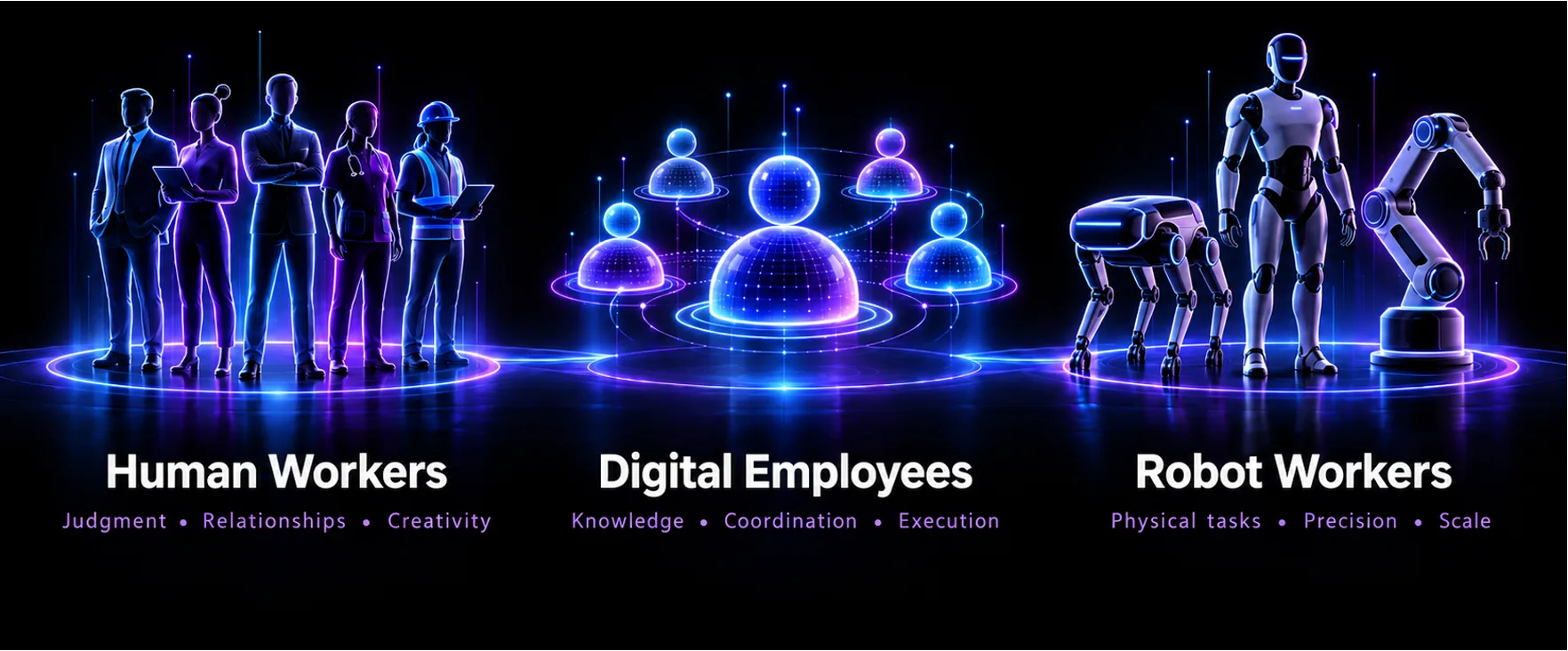
Organizational design becomes an exercise in intelligence orchestration: deciding what machines should do, what people should do, where the two should collaborate, and where human judgment must remain in control. The org chart isn't disappearing. But it will get considerably more interesting.
Governance and boundary setting
The more authority we give machines, the more important it is to define what they’re allowed to do. What decisions can an agent make independently? How much money can it spend? What data can it access? When must it escalate a decision to a person? What standards must it meet? Who remains accountable when something goes wrong?
These aren't technical questions. They’re about authority, risk, values, and accountability, which means they are leadership questions. AI-first leaders must create enough governance to keep the organization safe without surrounding every autonomous system with so much human approval that autonomy becomes pointless. A balancing act that will require sound judgment and finesse.
Designing organizations that learn
Perhaps the most important new capability is the ability to design an organization that gets smarter as it operates.
In a self-improving enterprise, organizational sensors feed data to models, models power agents and robots, those systems take actions, the outcomes create new data, and that experience improves future decisions. The result is an intelligence flywheel that continuously improves the organization's ability to sense, interpret, decide, act, and learn.
The fastest company, wins. Which makes learning velocity a key leadership concern. The company that learns fastest will identify opportunities sooner, correct mistakes faster, personalize more effectively, and adapt before competitors do. Over time, that learning compounds, and it makes it hard for others to catch you.
Your Leadership Upgrade
Put these shifts together and this is how the leadership transition looks:
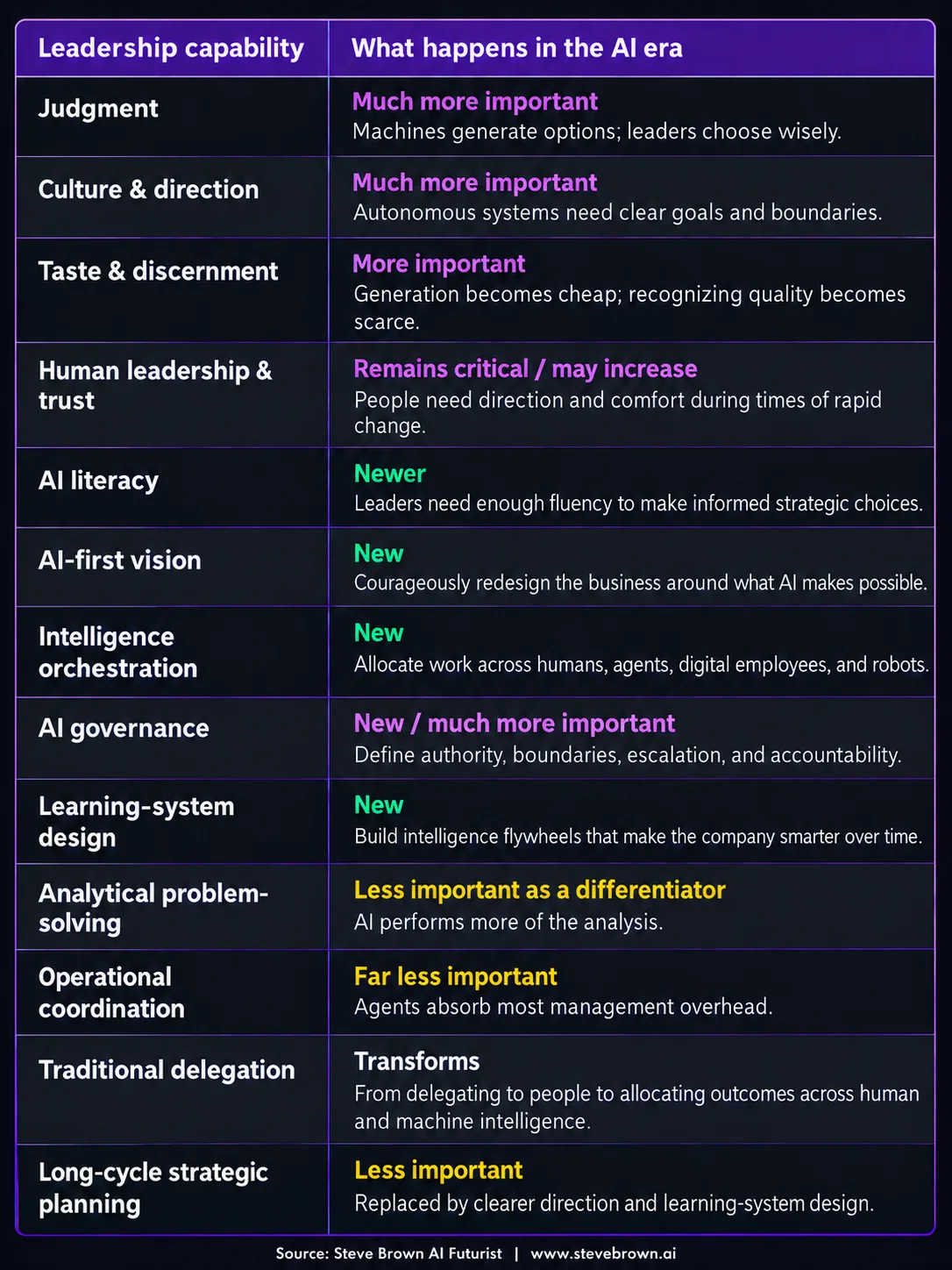
Less Management. More Leadership.
When I compare the leadership skills that mattered in 2015 with those that will matter in 2030, I don't see one list replacing another. It’s more like the center of gravity is moving. As AI absorbs more analysis, coordination, monitoring, and execution—the machinery of management—Leaders will spend more time defining direction, exercising judgment, setting standards, allocating authority, designing intelligent systems, and deciding which outcomes are worth pursuing.
This suggests an interesting paradox: AI may reduce the amount of management required inside a company while increasing the importance of leadership.
The successful leader of 2030 won't be the person who personally processes the most information or keeps the closest eye on every corner of the operation. They will be the ones building systems of human and machine intelligence capable of doing those things at a scale no individual leader ever could. Their job will be to make sure all that intelligence is pointed in the right direction. Because when intelligence becomes abundant, competitive advantage shifts from access to intelligence to the judgment to apply it wisely and pursue the right goals.