Your Biggest AI Competitor Doesn’t Exist…Yet
A Four-Step Test to Reinvent Your Business Before Someone Else Does
Most companies are focused on the wrong AI question, asking how they can use AI to improve business processes. This approach just creates a faster version of the past.
You take an existing workflow, add a copilot, automate a few tasks, shave some cost out of the system, and congratulate yourself on becoming AI-enabled. If you’re lucky and do everything right, the process is 20% faster, saves employees a few hours each week, and maybe costs 15% less. You declare victory and move on.
Build the Future; Don’t Just Automate the Past
The problem is that the process may have been designed for a world in which intelligence was expensive, scarce, and mostly human. It might contain layers of approvals from a time when information moved slowly. It could rely on specialists, because expertise was hard to scale and you batched decisions because continuous analysis was impossible. Worse, it might still force customers through awkward journeys because personalization was once too expensive to deliver at scale.
If we automate the old world with AI, we will create a highly efficient museum.
Avoid the AI Strategy Trap
This is what I call the AI Strategy Trap. Don’t mistake technological sophistication for strategic reinvention. A company can have world-class AI and still have a business designed for yesterday.
To avoid the strategy trap, don’t look only at how AI can improve what already exists. Instead, start imagining what an AI-first competitor would build if it were starting today. This is a vital thought experiment for every leadership team. And here’s how you do it. Assemble your teams, step away from email and meetings for a day, and work your way through this four-step process: DEFINE → REIMAGINE → COMPARE → ACT
Let’s bring those four steps to life with a little more detail:
- Define outcomes
- What outcome really matters?
- Reimagine from zero
- What would we build with no legacy constraints?
- Compare for breakthroughs
- Where could competitors be 10x better than us?
- Act with conviction
- What must we start, stop, or redesign now?
The AI-First Competitor Test is designed to help leadership teams temporarily escape the gravitational pull of their current organization and look at their business from the outside. It’s deliberately straightforward, and it’s designed to help you understand exactly what your next competitor will do with powerful AI as they work diligently to try and put you out of business.
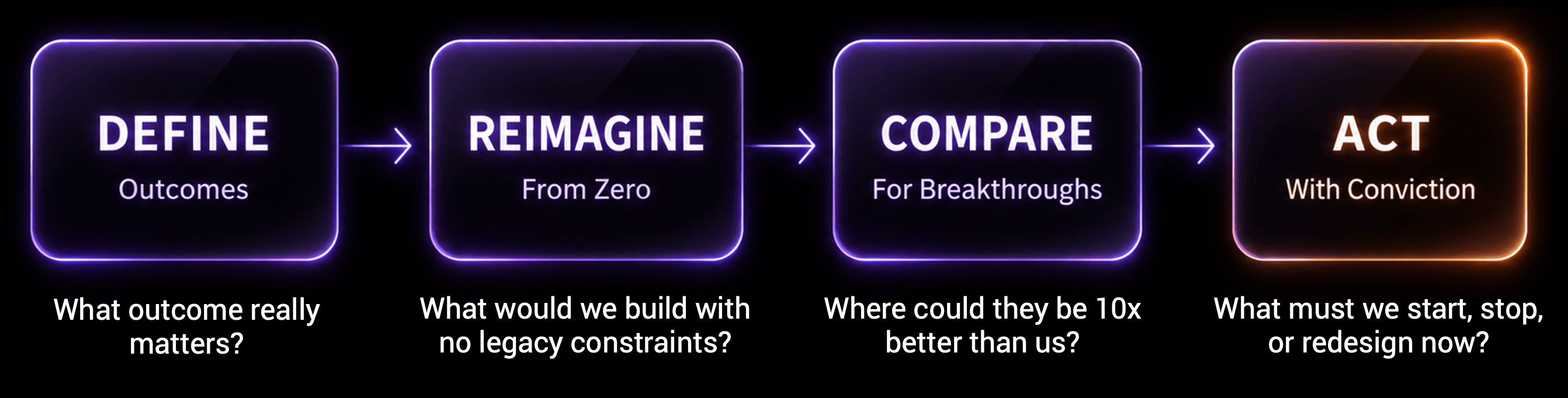
The Four-step AI-first Competitor Test
Let’s unpack the steps and review how to perform each one.
1. DEFINE OUTCOMES
The first step is to stop talking about business processes and start talking about outcomes. What are you trying to achieve? What value are you trying to create? What outcomes are you ultimately delivering to customers?
Leave your baggage behind
Organizations have a lot of baggage. We naturally think in terms of the structures we already have: claims processing, mortgage underwriting, sales operations, procurement, customer service, and manufacturing planning. While those names are useful internally, they trap thinking inside the boundaries of existing workflows, and they keep us focused on how things used to be rather than considering how things should be done in the future.
Focus on outcomes not processes or departments
Ultimately, a mortgage lender isn’t in the business of underwriting applications. It’s helping customers secure the right financing with confidence, speed, and manageable risk. An insurer isn’t really in the business of processing claims. It’s there to help restore customers after something has gone wrong while accurately managing risk and fraud. Retail isn’t about managing assortments and promotions. It’s there to help each customer discover the right product, at the right moment, in the right context, with as little friction as possible, all while creating a delightful experience.
If you define the goal using the language of today’s process, you inherit the process. But when you define desired outcomes, you make space to redesign everything between intention and result.
And that opens the door to AI-first thinking and a landscape of possibility by removing decades of accumulated assumptions that may be misplaced and no longer relevant to future success.
2. REIMAGINE FROM ZERO
Now it’s time to get creative and put yourself in the shoes of an aggressive new startup that’s gunning for you. Imagine a hot, new competitor launching against you tomorrow. They’re well-funded, they’ve got a talented leadership team, and they have access to every modern AI capability available.
Now remove everything else. They don’t have any legacy applications to protect. No org chart inherited from 2008. No processes designed around paper forms, email handoffs, call centers, departmental silos, quarterly planning cycles, or human limits on information processing. They’ve got no emotional or political attachment to how things have always been done. They understand that AI is making intelligence abundant and their founders are focused on how to use that intelligence from day one to deliver key outcomes.
Imagine the ideal state
They build a great new company. Perhaps every customer gets a dedicated digital employee that knows their history, preferences, goals, contracts, and current situation. Agents monitor conditions continuously rather than waiting for a customer to initiate an interaction. Maybe pricing becomes dynamic and personalized. In their plan, hundreds of product concepts are simulated against synthetic customers before anyone builds a prototype, and a process that currently involves seven departments in your company becomes one autonomous workflow. For them, managers no longer spend most of their time moving information between people because agents coordinate the work directly, and the organization doesn’t need a monthly forecast because its AI models forecast continuously. Their goal is to make a service that was previously premium almost free because intelligence is no longer the expensive component. And their vision is to build a self-improving enterprise that learns constantly from rapid learning loops and data. Set your mind free. The whole point of this exercise is to imagine the ideal state in an AI-first world.
To build the future, we must let go of the past
And don’t overlook what you might need to let go. Perhaps something your organization has spent twenty years optimizing simply disappears in the brave new world. As leaders, we are often very comfortable asking how technology can improve something, but we are much less comfortable asking whether that thing should continue to exist at all.
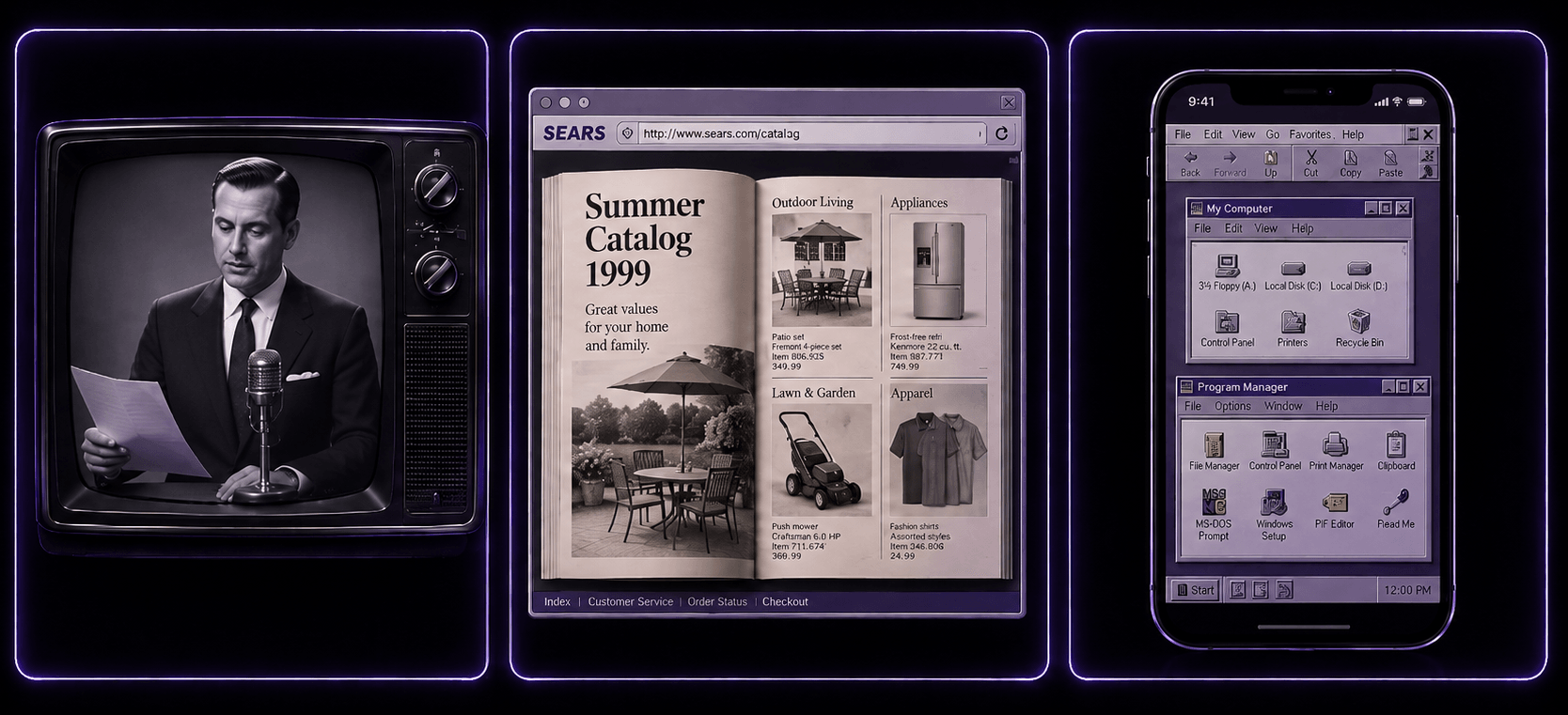
Every new medium requires a fresh mindset
History is littered with stories of how in every major tech transition, the leaders who win the future are those willing to ask what to stop doing or what to do in a radically different way. For example, new media requires a new mental model. TV isn’t radio with pictures, the web isn’t simply images of an online brochure, the smartphone isn’t a smaller desktop computer, and streaming isn’t just a more efficient VHS rental store. Each transition required new mental models and new approaches to take full advantage of the new medium. And AI will be no different.
The goal of this second step isn’t realism. Not yet. It’s to temporarily remove the constraints that make radical ideas seem impossible. We’ll add reality back into the equation later, but for now…let it rip. Have fun with it, and imagine a radically better future that you’d deliver in an ideal world.
3. COMPARE FOR BREAKTHROUGHS
Now that you’ve created your imaginary AI-first competitor, let’s see how your existing business stacks up. Place the imagined competitor beside your existing organization and document the gaps. To get your started, here are a few sample thought prompts to explore:
- Where could they deliver key outcomes dramatically faster, perhaps 10x faster than you?
- Where might their marginal cost approach zero while yours remains tied to labor?
- Could they personalize offers, products, services, and experiences for each and every customer?
- Where could they deliver 24/7/365 availability?
- Where could they offer every customer something you currently reserve for your best customers?
- How and where would they operate continuously rather than periodically?
- Where will they predict instead of react?
- Where would they use simulation instead of trial and error before they build?
- What could they make free or nearly free what’s expensive today?
- Instead of automating, what could they eliminate entirely by doing things differently?
What you stop doing is as important as what you start
That last question is important because it helps you design the future rather than automate the past. Some things only exist because intelligence, coordination, or information used to be scarce. For example, some good places to look for things to eliminate include queues and backlogs, approval chains, manual handoffs, status meetings, periodic reporting, data entry, forms, dashboards people have to interpret, batch processing, customer service tiers, manual QA sampling, forecast meetings, static price lists, physical prototyping, waiting for expertise, organizational boundaries (for example the division of sales and customer service), and intermediaries. Once intelligent agents connect buyers directly to suppliers, online travel agents like Expedia and Orbitz might become far less relevant.
Anything whose main purpose is waiting, routing, translating, checking, summarizing, reconciling, coordinating, or compensating for a lack of information is a candidate for elimination in a world of abundant intelligence, continuous operations, conversational interfaces, autonomy, hyper personalization, and rapid issue resolution.
Understand your vulnerability and opportunity
The list you generate from this exercise documents both your current vulnerabilities and your immediate opportunities. It could be the most important strategic planning exercise you do in years, because you are cataloging potential breakthroughs for your business. And leaders will recognize that AI-first companies will wield AI to bring orders of magnitude of change, not incremental change.
So, a useful question you should constantly ask is: “What could they make ten times better rather than ten percent better?”
The answer will vary by industry. In customer service, the breakthrough could be a persistent AI representative for every customer rather than a shared call-center queue. In product development, it might be predicting demand and consumer response before committing physical resources. In financial services, it might be continuous financial optimization rather than periodic advice. In manufacturing, it might be systems that sense disruptions, redesign schedules, coordinate suppliers, and execute responses without having to wait for the next planning meeting.
Reexamine your business model
Breakthroughs may also involve changes to your business model. If intelligence becomes dramatically cheaper, services previously sold by the hour may be sold by outcome, because your costs are no longer tied to hourly labor rates. Products may become continuously improving services. Expertise may become embedded into the product.
And remember, AI capability isn’t uniquely available to you. Expect customers to show up with an AI agent of their own that negotiates, compares, switches, and purchases on their behalf. The AI-empowered shopper will be in full force by this Christmas.
The point of this comparison isn’t to predict an exact future. It’s to expose where your current business architecture is vulnerable to a company designed under different assumptions.
4. ACT WITH CONVICTION
Now it’s time to do something. Without action, you just spent time at a retreat in a hotel meeting room somewhere, eating hotel food, working with flip charts, and avoiding your inbox for a while. And nothing changes. As Thomas Edison put it, “Strategy without execution is just hallucination.”
Companies are quite good at imagining possible disruption. Executives have attended enough offsites to produce entire forests of sticky notes describing the future.
The problem begins on Monday morning when you’re back in the office. You’re still faced with a legacy roadmap and a budget cycle. The urgent squeezes out any time you need for what’s really important. The breakthrough ideas you generated are just photos of whiteboards buried on someone’s camera roll. That’s why this final step is intentionally called Act With Conviction.
Turn gaps into concrete actions
Before you leave the offsite, spend at least a quarter of the time deciding what you will do when you get back to the frantic reality of running the business. Review the gaps you identified and decide which ones represent the greatest combination of strategic value and competitive vulnerability.
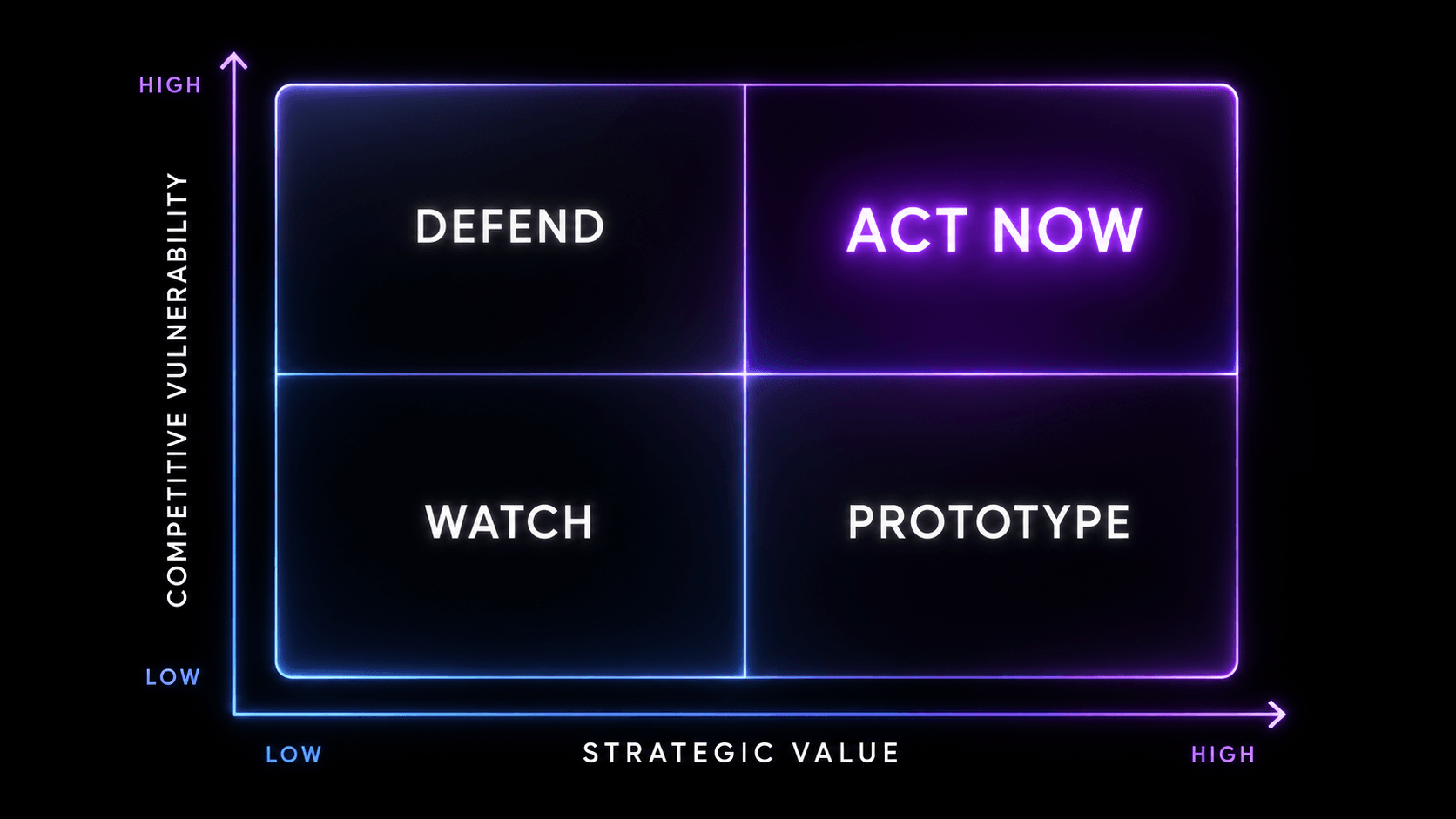
Simple strategic filter to determine where to act first
Then start closing them. That could mean redesigning an end-to-end workflow rather than deploying another isolated AI tool. Perhaps it means creating a digital employee to own an outcome. Maybe it means capturing proprietary decision data in home-grown proprietary models so your systems can learn from organizational judgment. You might decide you need to create an intelligence portfolio rather than relying on one model provider and implement a model router. Perhaps it means creating a small skunkworks AI-first unit that can rebuild part of the business without being constrained by the existing organization. Sometimes it might making the decision to stop doing something, which can be the hardest leadership decision of all.
Transformation is addition and subtraction
Transformation requires investment, but it also requires subtraction. You won’t build a radically different operating model while preserving every workflow, role, metric, system, and assumption that belongs to the old one. It will be time for tough decisions. Leadership is partly the willingness to decide what no longer deserves to survive.
Run the Test Repeatedly
Don’t make the AI-First Competitor Test a one-time strategic exercise. Because AI’s capabilities are changing too quickly for that. Something impossible today could be mundane in eighteen months.
What to anticipate in your planning
Specifically, over the next 6-12 months you should bet on AI agents becoming more capable, models becoming cheaper, robots getting smarter, more dextrous, and more adaptable, AI-powered digital simulations improving, and customer agents changing how people shop and negotiate.
The cost of intelligence and coordination will continue to fall, which means the hypothetical competitor you design next year should be more dangerous than the one you design today.
Run the test across your organization
Be sure to run this test against major functions, customer journeys, products, and business models. Make the test part of ongoing leadership responsibilities across the company. Ask your team to periodically imagine the competitor they would least like to face. Then take concrete steps to become more like that competitor before someone else does.
The Real Strategic Shift
Successful AI strategy is about having the right mindset. You need to shift from a technology mindset to a design mindset. Rather than looking for places to insert AI, an AI-first design mindset constantly asks what you would build if you started again.
Winners will focus on value creation not cost reduction
Most companies will deploy AI, many will automate tasks and workflows, and some will substantially reduce costs. But the biggest opportunities will go to organizations willing to reconsider how value is created in the first place.
So the next time your team talks about AI strategy, resist the temptation to start with your list of processes. Instead, focus on the outcome, imagine a competitor with no baggage, and compare what they would build to what you have today. Then act before the gap becomes someone else’s business model.
This four step process of define, reimagine, compare, and act may be the simplest way to avoid building a beautifully automated version of the past.